Amsterdam in Full: The Pro Tour Marvel Super Heroes Report
Yuuki Ichikawa won the first draft-decided Pro Tour Top 8 in fifteen years — while Modern's two most-played decks posted the event's worst numbers. The full Amsterdam report: Wizards' Day One win-rate graphic (transcribed), every key Top 8 list as a live embed, the Neoform and Fight Rigging engines explained card by card, and what our tracker caught the format doing the very next morning.
As of July 20, 2026. Yuuki Ichikawa is the Pro Tour Marvel Super Heroes champion, and he won it the old-fashioned way — by drafting. The Top 8 at RAI Amsterdam was decided in Marvel Super Heroes booster draft, the first draft playoff at a Pro Tour in roughly fifteen years, and Ichikawa, who squeaked into Sunday as the No. 8 seed on tiebreakers, swept Lorenzo Gruppi 3-0 in the final with a Jund deck. That's the headline. The story underneath it is Modern, and it's the one we wrote up six days ago: the hunted top tier got eaten. Wizards' own Day One numbers put the two most-played decks — Boros Energy and Izzet Affinity, 46 players each — at 45.7% and 47.8% win rates, while a 14-player afterthought called Simic Neoform posted 60.6% and put its best pilot on the trophy. This is the full report: what happened, what the official win-rate graphic actually says, how the winning decks work card by card, and what our tracker shows the format doing the morning after.
The weekend, compressed
The scale first, because it matters for everything below: 362 players, per Frank Karsten's official metagame breakdown — coverage called it "one of the largest Pro Tours since the return to tabletop play" — competing for $500,000, with $50,000 to the champion. Two days of three Marvel Super Heroes draft rounds into five Modern rounds each, 220 players surviving into Saturday, and then the twist: instead of Modern, the Top 8 fired up a fresh draft pod on Sunday. Whatever you think of deciding a Constructed tournament in Limited, it made for a genuinely different kind of playoff — Swiss seeding only set bracket position, and the best drafter in the room got to prove it.
| Finish | Player | Modern deck (Swiss) | |---|---|---| | 1 | Yuuki Ichikawa | Simic Neoform | | 2 | Lorenzo Gruppi | Broodscale Combo | | 3–4 | Bernardo Torres | Esper Goryo's | | 3–4 | Timo Bertram | Boros Energy | | 5–8 | Eduardo Sajgalik | Broodscale Combo | | 5–8 | Alex Rohan | Broodscale Combo | | 5–8 | Ken Yukuhiro | Eldrazi Ramp | | 5–8 | Mattia Oneto | Boros Energy |
Count the archetypes: three Broodscale Combo, two Boros Energy, one each for Esper Goryo's, Eldrazi Ramp, and Simic Neoform. Izzet Affinity — tied for most-played deck in the building — put nobody in the Top 8.
The stories inside the bracket are good ones. Eduardo Sajgalik was the first player to lock a seat. Gruppi had never made a Pro Tour Day Two before this weekend; he made the final on his first try and booked a Magic World Championship 32 invite doing it, alongside Torres. Ken Yukuhiro — the reigning Player of the Year and Pro Tour Final Fantasy champion — added yet another Top Finish. Mattia Oneto's last premier event was in 2020. And Ichikawa, a four-time Grand Prix champion, was the last player into the bracket and the last one standing. The Swiss had its own near-heroes: Martin Juza was the only 8-0 after Day One before what he called "a tough draft seat" went 1-2 and ended his run, and Timo Bertram stretched a 7-0-1 start all the way to 10-0-1 before losing three straight Modern rounds — and still made the semifinals. Three players went a perfect 6-0 across both drafts: Francisco Sanchez, Chris Kral, and Ramon Santos. None of them made the Top 8. Sixteen rounds is a long tournament.
The graphic Wizards published, and what it says
The Modern field split almost exactly the way the pre-tournament chatter predicted: Boros Energy and Izzet Affinity tied at 12.7% (46 players each), Broodscale Combo right behind at 11.6% (42), then Eldrazi Tron (9.7%), Esper Goryo's (9.1%), Amulet Titan and Izzet Prowess (6.9% each), Ruby Storm (4.4%), Simic Neoform (3.9%), Eldrazi Ramp (3.3%), and a long, genuinely diverse tail — all numbers Karsten's, from the official breakdown of 362 decklists. His standout stat is one we've been hammering for weeks: the Kozilek's Command + Eldrazi Temple package, shared by Broodscale, Eldrazi Tron, and Eldrazi Ramp, was in 89 of those decklists — 24.6% of the field — and he rates the Command "arguably the strongest card in the entire format."
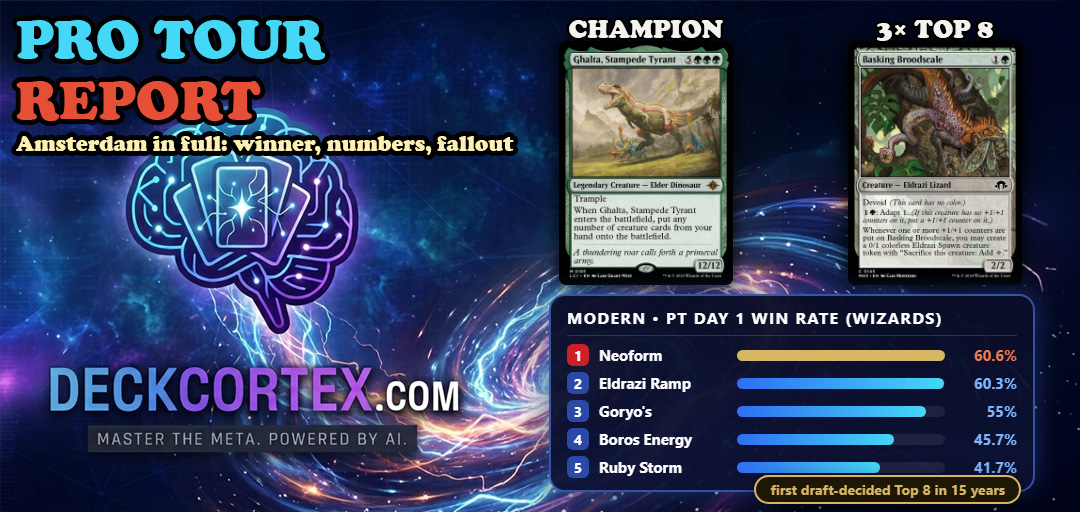
Then Day One happened, and Wizards put the results on a slide. They published per-archetype win rates for the Friday Modern rounds as an infographic — image only, no table in the text — so we transcribed it. First the picture, then the numbers:
| Archetype | Decks | Day 1 Modern win rate | |---|---|---| | Simic Neoform | 14 | 60.6% | | Eldrazi Ramp | 12 | 60.3% | | Esper Goryo's | 33 | 55.0% | | Amulet Titan | 25 | 52.8% | | Broodscale Combo | 42 | 51.8% | | Esper Blink | 11 | 49.0% | | Izzet Prowess | 25 | 48.6% | | Izzet Affinity | 46 | 47.8% | | Eldrazi Tron | 35 | 46.3% | | Boros Energy | 46 | 45.7% | | Ruby Storm | 16 | 41.7% | | Other | 57 | 49.6% |
(Wizards' official Day One numbers, transcribed from the graphic above; Friday's Modern matches only. Wizards has published no full-event table — the full-event figures below come from a community matchup matrix; see the data notes.)
Read it top to bottom and the tournament explains itself. The two 60% decks are the two smallest samples on the sheet — 14 and 12 pilots — and both of them put someone in the Top 8, one of them the champion. Esper Goryo's at 55% converted its seat too. Broodscale's 51.8% looks modest until you remember it held that rate at 42 pilots, the third-biggest deck in the room, while sending three of them into Sunday. And the bottom of the table is the top of the metagame: Boros Energy under 46%, Affinity under 48%, Ruby Storm — the format's dedicated Hex Magic deck — dead last at 41.7%. The coverage team said it plainly: "the most-represented decks in the tournament field were also among its weakest," and called it a genuine trend at this year's Pro Tours. It's the same pattern as the last Modern Pro Tour, where Tameshi Belcher won the event 11-1 in the format while Boros Energy limped to a 43% event win rate. Pro Tour fields over-prepare for the known quantity and under-prepare for the proactive deck nobody respected. Amsterdam ran the experiment again and got the same answer.
One honest caveat before we go deck by deck: these are Day One win rates, a single day of Swiss, and 14-deck samples carry wide error bars. The full-event ledger exists, though — not from Wizards, but from the community. Joan (@cross__entropy on X) compiled a matchup matrix from the event's published Modern results (archetypes self-reported; Andrea Mengucci passed it around), and all ten rounds back the Friday signal: Eldrazi Ramp finished the event at 62.4% (109 matches), Simic Neoform at 59.7% (124), while Boros Energy sank further to 44.6% (323) and Affinity to 46.2% (366). Mengucci's read of the grid is the fun one: nearly every named deck finished below 50% while the "Other" pile finished above it — in most formats it's the opposite, and it's as clean a diversity statement as this weekend produced.
The matrix also hands out corrections the Friday sheet couldn't see. Esper Goryo's faded from 55.0% to 48.9% across the event (274 matches) — Saturday was rough on the reanimator deck even as Torres carried it to the semifinals. Broodscale slid just under water at 49.5% overall (315). Ruby Storm climbed off the floor to 47.7%, passing the full-event wooden spoon to Jeskai Control at 40.0% (50). And the second predator from our July 14 briefing quietly cashed its thesis: Domain Zoo closed positive at 53.2% (62 matches). Where the numbers below go beyond Day One, they cite that community matrix — and anything under 20 matches is directional at best.
The champion's deck: Neoform, and the 12/12 that comes with it
Fourteen players brought Simic Neoform. It won the tournament and the Day One win-rate table at the same time, and if you've never had this deck kill you, the mechanism deserves two paragraphs — it's one of the cleanest combos in Modern.
Allosaurus Rider is the enabler: you may exile two green cards from your hand rather than pay its mana cost, so it hits the battlefield on turn one or two for free, a creature with mana value seven. Neoform is the payoff: sacrifice a creature as an additional cost, then search your library for a creature with mana value exactly one more and put it onto the battlefield. Seven plus one is eight, and the eight of choice is Ghalta, Stampede Tyrant — a 12/12 trampler whose enter trigger puts any number of creature cards from your hand onto the battlefield. The hand you just pitched two cards from still holds monsters: Atraxa, Grand Unifier to restock (her trigger digs ten cards deep and takes one of each card type), Griselbrand to pay seven life and draw seven, Ureni, the Song Unending — a 10/10 flier with protection from white and from black that enters clearing X damage off your opponents' creatures and planeswalkers, where X is your land count. Ureni costs and the deck can't produce red mana; it never casts her. She's put onto the battlefield or she stays home, which is exactly the kind of rules detail this deck is made of. Xenagos, God of Revels is the finishing school: at the beginning of combat he gives a creature haste and +X/+X equal to its power, which turns the 12/12 into a hasty 24/24 the turn it lands. Eldritch Evolution is Neoform copies five through eight with a wider net (mana value up to two more, so up to nine off a sacrificed Rider), and Summoner's Pact finds the Rider for free now, bill due next upkeep.
Here's the champion's exact 75:
Two things in Ichikawa's list are worth dwelling on. First, the full four maindeck Consign to Memory — the one-mana instant that counters a triggered ability or a colorless spell, the card Karsten reported as the most-played card in Modern before the event. The champion of a combo deck spent four maindeck slots on the format's Swiss-army answer, which tells you how much Eldrazi he expected to face (a quarter of the field, as it turned out — he read the room). Second, the amount of free interaction wrapped around the combo: three Pact of Negation and two Veil of Summer in the 75 mean "tap out to combo" and "hold up protection" are the same turn. The supporting cast is all quietly clever — Disciple of Freyalise // Garden of Freyalise and Bridgeworks Battle // Tanglespan Bridgeworks are green cards for the Rider's exile clause that moonlight as lands, Generous Ent and Hooting Mandrills cost nearly nothing thanks to forestcycling and delve, and Planar Genesis digs four deep for whichever half you're missing.
Our tracker adds the context the coverage can't: this deck's core is welded. Across the 26 Allosaurus Combo lists in our current sample, every single one runs Rider, Neoform, Eldritch Evolution, Summoner's Pact, Atraxa, Griselbrand, Ureni, Xenagos, and the full maindeck Consign package — and the two biggest gainers by trend slope are Ghalta and Ureni themselves, i.e. the newest parts of the kill. What the deck is not, per our data, is a metagame pillar: in our one-month top-cut sample (2,470 MTGTop8-placed lists, June 20 – July 20) it sits below the top-19 cutoff, under 2.1% — decklist-appearance share of placed lists, not field share, and a different population than the PT. The community matrix rounds out the picture: across the full event, Neoform went positive against every major deck it met — 64.7% vs Affinity (17 matches), 57.1% vs Boros (14), 70% vs Broodscale (10), 66.7% vs Goryo's (15), 80% vs Amulet (10) — with exactly one red cell on its row, 20% against Izzet Prowess on five matches. Small sample, but the mechanism is believable: Prowess is the one popular deck that's simply faster underneath. A 60.6% Day One, a 59.7% event, and a trophy from that baseline is the definition of a deck arriving. One flag for anyone picking it up: Karsten counted 47 copies of Wistfulness across the event's decklists and tied them to Neoform and Living End shells — note that the champion's build runs zero. Don't let an aggregate talk you into a card the winning list didn't want.
Three seats for the lizard
We ended our July 14 briefing with a question: would the field bring enough hate for Broodscale, or would it run the tables? Now we know. Basking Broodscale plus Blade of the Bloodchief put three pilots into the Top 8 — Gruppi to the final, Sajgalik and Rohan to the quarters — from 11.6% of the field, held a positive 51.8% Day One win rate at 42 pilots despite being the single most-telegraphed combo in the room, and, per Karsten, was one of the engines behind that 24.6% Kozilek's Command share. If you want the loop explained trigger by trigger, the briefing covers it; the one-sentence version is that Blade turns every death into a +1/+1 counter, Broodscale turns every counter into an Eldrazi Spawn token, and sacrificing the Spawn for mana is itself a death — infinite colorless mana, infinite death triggers, a lethal Glaring Fleshraker ping for each lap.
What's new is the shape of the deck. Here's Gruppi's finals list:
That's not the mono-green build that won three MTGO Challenges in one day two weeks ago. Gruppi splashes red off Grove of the Burnwillows for maindeck Unholy Heat and sideboard Firespout, trims to three maindeck Broodscale, and runs the full four maindeck Emrakul, the Promised End next to four Malevolent Rumble — this list is as much an Eldrazi ramp-midrange deck with a combo finish as it is a glass cannon. And our tracker says the field agrees with him: across the 106 Broodscale lists in our current sample, Grove of the Burnwillows is in 96.5% — the red splash is the deck now — while Haywire Mite is the fastest-climbing card in the archetype and Vexing Bauble remains a fixture in effectively every list. In our one-month top-cut sample the deck holds 6.5% once you merge our classifier's two Broodscale labels (161 of 2,470 placed lists — appearance share, not field share), and under our main label it converts 24.3% of its 37 tracked event entries into a top cut. Third-biggest deck in the room, three Top 8 seats, still the best conversion story among the big decks — with one honest asterisk from the full-event matrix: the deck closed at 49.5% overall (315 matches), Saturday grinding off Friday's edge, and its worst big-sample cell is Amulet Titan at 30.4% (23 matches). Even the famous Affinity mugging came back to earth — 55.6% on 45 matches at the PT, against the 72% our pre-PT mtgdecks.net data showed. The predator briefing holds up on results; the field, to its credit, adjusted on rate.
Yukuhiro's ramp deck is smarter than it looks
Eldrazi Ramp: twelve players, a 60.3% Day One win rate, and a Top 8 seat for Ken Yukuhiro. His list is the most interesting 75 in the bracket and nobody's talking about it, so let's fix that.
Slumbering Trudge is a 6/6 that enters with three-minus-X stun counters. Pay one green mana on turn one and you have a 6/6 that spends three untap steps asleep — which sounds like a drawback until you read Fight Rigging. Rigging hides away the top five's best card when it enters, then at the beginning of combat on your turn puts a +1/+1 counter on a creature you control — and if you control a creature with power seven or greater, you play the hidden card free. A Trudge plus one Rigging counter is a 7/7. The hidden card is Emrakul, the Promised End or Ulamog, the Ceaseless Hunger more often than either has any right to be. The Trudge doesn't even need to untap for any of this; stunned creatures still have power. Around that skeleton: four Green Sun's Zenith with a Dryad Arbor for the turn-one mana version, Fanatic of Rhonas tapping for four green as soon as any of the big bodies is around (its ferocious mode only asks that you control a four-power creature — a tapped, stunned Trudge qualifies), the Kozilek's Command + Eldrazi Temple engine this cluster shares, and Ugin, Eye of the Storms up top. Emrakul is the recurring theme of this whole Pro Tour, incidentally — Gruppi mains four, Yukuhiro mains four, and even the champion's sideboard leans on fatties — because "take your opponent's next turn and aim their removal at their own board" is unbeatable in a pseudo-mirror.
In our top-cut sample Eldrazi Ramp is a 2.1% deck. At the Pro Tour it was a 3.3% deck that finished with the best win rate of the entire event — 62.4% across ten rounds per the community matrix, on top of its 60.3% Friday. The matchup line explains both halves of its weekend: it crushed the hunted decks (81.3% vs Affinity on 16 matches, 68.4% vs Boros on 19) and folded to the two decks that go over the top of it — 16.7% vs Goryo's (12) and 14.3% vs Neoform (7), both of which were waiting in the Top 8. Twelve pilots is a tiny sample and we'd normally wave it off — but the same proactive decks now sit at the top of every ledger this weekend produced: Friday's sheet, the full-event matrix, and the bracket. At some point a coincidence becomes a reading.
The hunted: what 46 players buy you
Now the other half of the graphic. Boros Energy: most-played deck, 45.7% on Day One, and yet two Top 8 seats — Bertram and Oneto dragged the archetype into Sunday through sheer pilot quality (Bertram was 10-0-1 at his peak; Juza's 8-0 Friday was also Boros). Affinity: co-most-played, 47.8%, zero seats. The full-event matrix localizes both failures. Boros didn't lose to "the field" — it lost to specific predators: 28.6% against Goryo's (28 matches; the 71.4% inverse is the most lopsided big-sample cell on the whole grid), 26.1% against Prowess (23), 31.6% against Eldrazi Ramp (19), while still beating Affinity 56.1% (41). Affinity's row reads the same way — respectable into the fair decks, 18.8% into Eldrazi Ramp (16), under water against the combo cluster. The format's two "safest" decks were its two biggest underachievers, exactly the outcome our pre-PT numbers (57.7% Broodscale weighted win rate against the top tier on mtgdecks.net data, remember) said was live.
The detail our tracker adds on Boros is about builds, and it cuts against the popular story. The field-wide adaptation to losing Phlage, Titan of Fire's Fury was supposed to be The Legend of Roku // Avatar Roku — and at 72 copies across 47 decklists it was, per Karsten, the most-played new-to-Modern card at the event, with Haliya, Guided by Light as the other white value option in circulation. But look at what actually cashed: Bertram's semifinal list runs a single maindeck Roku and no Haliya; Oneto's runs neither card at all. Both Top 8 Boros lists are the lean, low-curve Guide of Souls + Ocelot Pride + Ajani, Nacatl Pariah // Ajani, Nacatl Avenger builds with Goblin Bombardment as the sacrifice engine and the full Galvanic Discharge suite. The saga is the field's idea of the fix; the Top 8 said the fix is staying fast.
Affinity's failure needs fewer words because Wizards already wrote them. The June 29 B&R left Modern untouched but Play Design's Carmen Klomparens singled out decks that start with "over half a dozen zero-mana artifacts" as under active scrutiny, Affinity named explicitly. The deck then showed up 46 strong on the back of Mox Opal, Kappa Cannoneer, Weapons Manufacturing and Pinnacle Emissary — and posted a losing record while being the single most countered-out deck in the metagame (maindeck Vexing Bauble in every Broodscale list is no accident; the champion's four maindeck Consign to Memory hit its triggers too). A sub-50% Pro Tour probably saves Affinity on August 10 — you don't ban the deck that just underperformed — but the scrutiny quote is still sitting there, and the next data point is RCQ season.
The B&R scoreboard
Amsterdam was the first premier-level stress test of the May 18 changes, so let's grade them with the event's own numbers:
- Phlage, Titan of Fire's Fury banned — worked as intended. Boros survived (two Top 8 seats) but stopped warping the field: 12.7% share and a sub-46% win rate is a fair deck, not a menace. The value-engine replacements exist, but as covered above, the winning builds mostly declined them.
- Lotus Field banned — Amulet Titan shrugged harder than expected: 25 players and a quietly positive 52.8% Day One. Down a peg, still very much a deck.
- Violent Outburst unbanned — eight total copies across 362 decklists, cascade fuel for the Living End decks (four players, 1.1% of the field). Jody Keith went 4-1 in Friday's Modern with a build teching Superior Spider-Man — the Spider enters as a copy of the best creature in any graveyard, which in a Living End shell is a free best-of-everyone's reanimation on legs.
- Umezawa's Jitte unbanned — "not a single copy," per Karsten. Fifteen years on the banlist, one month back, zero takers. The scariest equipment of 2005 met the format of 2026 and the format didn't blink.
Karsten's summary that the unbans made no significant impact is the fairest one-line B&R report card Wizards has gotten in years: the bans changed the format, the unbans decorated it.
New cards, and the spice that actually worked
Marvel Super Heroes' Modern footprint is real but narrow, and it mostly reinforced existing decks — the counts are Karsten's, the readings ours:
- Hex Magic (63 copies, all maindeck) is the set's biggest Constructed hit: an Arcane sorcery that exiles your hand and redraws that many, with everything exiled playable through your next turn. Ruby Storm adopted it as a three-to-four-of refuel — and still went 41.7% on Day One, the worst number on the sheet, before recovering to 47.7% across the full event. Great card, wrong weekend.
- Skateboard (49 copies) is Affinity's one-mana haste-and-tap Equipment — cute, cheap, and attached to a 47.8% deck.
- Erode (46 copies) deserves a correction to the story going around: it is not part of the land-destruction package. It's a one-mana white instant that destroys a creature or planeswalker and lets its controller fetch a basic — a new cousin of Path to Exile, showing up across white decks generally.
- The actual land-destruction package is Price of Freedom (40 copies — destroy an artifact or land, they may fetch a basic, you draw) and Avengers Disassembled, the modal sweeper-or-Stone-Rain that lets Boros Land Destruction (9 players, 2.5% — the event's one genuinely new archetype) play removal and mana denial on the same card. Its feature-match moment was as good as advertised: a sideboard Chandra, Awakened Inferno wiping away a Geist of Saint Traft board and closing the game on emblems — the uncounterable six-drop doing exactly what she was printed to do, seven years and several formats later.
- Slumbering Trudge (36 copies) — all of them, functionally, in the Eldrazi Ramp cluster that finished the event with its best win rate. Pound for pound the best-performing new card in the building.
The spice rack, from Karsten's own Friday tour of the wild lists: Jund Cosmogoyf (three pilots) threatens turn-three kills by exiling its own deck with Serum Powder mulligans until Cosmogoyf — power equal to your cards in exile — is large enough to Thud at someone's face. Jake Bailey's Samwise Gamgee Combo went 4-1 in Friday's Modern on the Samwise Gamgee + Cauldron Familiar + Goblin Bombardment infinite-drain loop, with the Ajani cat package along for value. Gaëtan Bossy milled people with Azorius Loki. Rasmus Enegren started 0-3 with Song of Creation — the deck that draws itself with Mox Amber and a Bruce Banner // The Incredible Hulk cameo — and won five straight to finish 5-3, which is the most Song of Creation result imaginable. And Gabriel Nassif, because he's Gabriel Nassif, brought a mono-blue Quantum Riddler Metalcraft deck splashing nothing so he could pitch-cast Subtlety and Force of Negation. None of it broke the format. All of it is why people watch Pro Tour decklist reveals.
The morning after, in our own data
The Pro Tour ended Sunday evening. Our tracker was already recording the aftermath Sunday morning, because MagicCon ran a 194-player 2nd Chance PTQ next door — and the winner was David Schnayer, on Broodscale:
Same event, an Allosaurus Combo list in the 3rd–4th bracket (Brady Munroe) plus three more Neoform pilots in the top 32; on MTGO the same weekend, gyyby297 took a League 5-0 and a Last Chance top 4 with Broodscale while littlebinboy — the man whose three-trophy Sunday we covered on July 14 — was back in a Super Qualifier top 16. One weekend of post-PT data is a weathervane, not a forecast. But the wind is blowing exactly the way the Day One graphic points: toward the Kozilek's Command cluster and the Neoform deck, away from the decks everyone already owns.
What to do with this
- Playing Modern this month? The Pro Tour just published your deck-selection memo. The three decks that beat their field share — Simic Neoform, Eldrazi Ramp, Broodscale — share a plan (proactive, over the top, resilient to creature removal) and two of them share a mana base. Broodscale remains our pick for the RCQ grinder: biggest sample behind its results, welded core, and the post-PT weekend already paying it off — eyes open on the two numbers the matrix flags, the 49.5% full-event close and the Amulet Titan cell. Neoform is the pick if your local field is fair decks and you'll practice the sequencing — it just beat the best field in the world from a cold start. And Eldrazi Ramp earned its seat at this table with the event's best win rate, but it's the most polarized of the three: take it into a Boros-and-Affinity room, not a Goryo's-and-Neoform one.
- If you're on Boros or Affinity, the message is tune, don't abandon. Two Boros pilots still made Top 8 — on the lean Guide of Souls build, not the Roku value build. Copy Bertram, not the aggregate. Affinity's 47.8% against a room maindecking Vexing Bauble and Consign to Memory is partly a preparation tax that your Tuesday night probably won't levy — but know that the hate template is now public.
- Circle August 10. The next B&R lands three weeks post-PT. Affinity's underperformance is its best ban insurance; the Kozilek's Command cluster's 24.6% share plus this Top 8 is the new data point Wizards has to weigh. If the Command package keeps converting at RCQs the way it did in Amsterdam and the day after, the "strongest card in the format" line stops being a compliment and starts being a case file.
Data notes: field shares, archetype counts, new-card copy counts, and the Kozilek's Command package figure are Wizards of the Coast's official Pro Tour metagame breakdown (Frank Karsten, magic.gg; 362 decklists). Day One win rates are Wizards' official infographic from the Day Two coverage, reproduced above and transcribed by us; they cover Friday's Modern rounds only. Top 8 results, records, and storylines are per magic.gg coverage and the official event page; the champion's draft-deck colors are per Cards Realm. All decklists embedded above are DeckCortex snapshots of the MTGTop8-published lists. DeckCortex sample figures — 59,521 tracked Modern lists; the 2,470-list top-cut sample (June 20 – July 20, 2026); 26 Allosaurus Combo and 106 Broodscale distribution lists; conversion rates of tracked event entries — are decklist-appearance shares of MTGTop8-placed lists, not field shares, and DeckCortex tracks no match win rates. Day One win rates are Wizards' official infographic figures; full-event win rates and matchup cells are from the community matchup matrix compiled from the event's published results by Joan (@cross__entropy on X, shared by Andrea Mengucci) — archetypes self-reported by players, both Swiss days included, cells under 20 matches directional at best. Neither is DeckCortex data. Pre-PT matchup win rates referenced from our July 14 briefing are mtgdecks.net's match database, as attributed there. Card prices shown in embeds are Scryfall paper aggregates as of July 20, 2026. Card wording per current Oracle text.