Boros Energy Is Still Modern's Deck to Beat — the Bans Couldn't Kill It, and June 29 Didn't Try
Wizards banned Phlage in May to knock Boros Energy off its perch — and for a week it worked, dropping the deck to #2. Three weeks later it was back on top, and the June 29 B&R left Modern untouched. In our data the red-white energy deck is once again the clear #1 at ~9.9% of the field, nearly 3× the next archetype. Here's why losing its best card barely mattered, how The Legend of Roku quietly replaced Phlage, and where the format's deck to beat is still beatable.
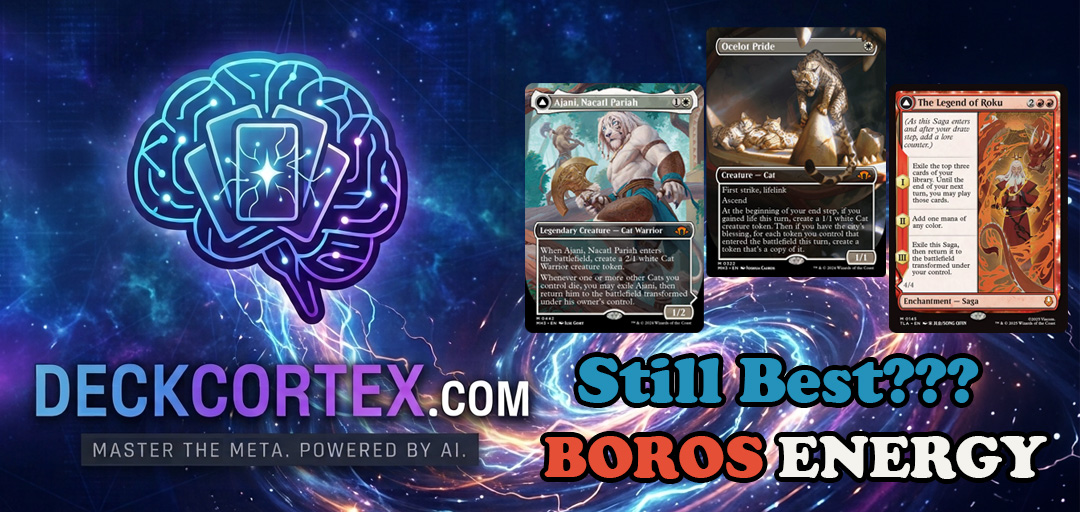
As of June 29, 2026. Wizards banned Phlage, Titan of Fire's Fury in May to take Boros Energy down a peg. It worked — for about a week. The deck slipped to second, then clawed its way back to the top, and when the next Banned-&-Restricted window arrived on June 29 it left Modern completely untouched. In our tournament data the energy deck is once again the clear #1 of the format — the only archetype anywhere near double digits — and it walks into RCQ season and Pro Tour Marvel Super Heroes as the prime deck to beat.
The honest version of the story isn't "the ban backfired and the deck went up." It's better than that for a deck's reputation: Boros Energy took the hit, lost its best top-end, and rebuilt itself back into the best deck anyway. That's resilience, not luck.
What our data shows
We pulled our own Modern corpus — 1,870 scraped tournament lists from May 30 to June 29, 2026 (all post-ban). Our classifier splits the energy deck across two same-core labels, "Boros Energy" and "Boros Aggro" — they run the identical Guide of Souls / Ocelot Pride / Galvanic Discharge shell, so we count them as one. Folded together they're about 9.9% of the field (185 lists) — and nothing else is close:
- Boros Energy — ~9.9% (the only deck near 10%)
- Broodscale combo family — ~6.6%
- Affinity (both builds) — ~5.7%
- UR Cutter Prowess — ~5.2%
- Amulet Titan — 3.6% (the biggest single non-Boros label)
- Grixis Reanimator, Esper Blink, Living End — all 3.0–3.5%
So Boros Energy isn't just first; it's roughly 2.7× the size of the next single archetype. Below it the format is broad and flat, which is exactly the picture of a healthy format with one deck sitting a clear notch above the pack.
A note on metrics, because this deck attracts a lot of differently-shaped numbers. Ours is a decklist-appearance share — how often the deck turns up across the lists we scrape. That reads a touch lower than magic.gg's performance-weighted Winner's Metagame Share, which had Boros Energy back at 11.0% and #1 in early June, and it's a different thing again from match win rate, which we don't track. Here's the part that makes the "took the hit, then recovered" framing fair rather than spin: in that same magic.gg data the deck fell to 7.8% and #2 the week immediately after the Phlage ban, behind Izzet Affinity — and only climbed back to 11.0% and first place three weeks later. It dipped. Then it came back.
Why losing Phlage barely mattered
The reason the ban didn't break the deck is structural, and our card data spells it out. The cards doing the heavy lifting in Boros Energy are powerful aggressive threats that don't care about Phlage at all. In our 107-list "Boros Energy" sample, the entire one-drop core shows up in 100% of decks:
- Guide of Souls — every other creature you control that enters gains you 1 life and an energy counter; then, attacking, you can pay to put two +1/+1 counters and a flying counter on an attacker and make it an Angel. A one-mana engine that fuels life, energy, and an evasive finish.
- Ocelot Pride — first strike, lifelink, and an end-step Cat token whenever you gained life; with the city's blessing it copies every token that entered that turn. It snowballs a board out of nothing.
- Ragavan, Nimble Pilferer — still the best one-drop in the format: a Treasure and a stolen card on every connection.
Add Ajani, Nacatl Pariah — a two-mana Cat that makes a 2/1 token and flips into a planeswalker when your Cats start dying — plus Galvanic Discharge, a one-mana removal spell that turns three energy counters into up to three damage. None of that was touched in May. As MTG Rocks put it, Boros Energy "is really just a pile of powerful, aggressive red/white cards"; the energy synergies are a bonus on top of cards that would be playable without them. Take away the best card on top of a great pile, and you still have a great pile.
Roku is the new Phlage — and the data already knows it
What Phlage actually provided was a mid-game value and reach engine sitting above the aggressive curve. Boros didn't need a one-for-one replacement; it needed to refill that slot, and three cards now share the job. The headliner is the one the deck's pilots have converged on fastest: The Legend of Roku.
This is the card the original brief mislabeled "Roku, Hardened Dragonbeast." The real card is a Saga from Avatar: The Last Airbender, and it fills the Phlage hole almost perfectly:
- Chapter I exiles the top three cards of your library and lets you play them until the end of your next turn — immediate card advantage.
- Chapter II adds one mana of any color — a splash-fixer and a tempo bump.
- Chapter III exiles the Saga and returns it transformed into Avatar Roku, a 4/4 with firebending 4 that adds when it attacks and can spend to make a flying 4/4 Dragon.
That's why it works as a Phlage stand-in: it's card advantage in the mid-game, it dodges early creature removal by entering as an enchantment first, and it converts into a recurring threat with a mana sink late. Our numbers back the eye test hard — The Legend of Roku is already in 86.9% of Boros Energy lists and is the deck's single biggest gainer (trend slope +14.6), and our flex-slot engine tags it as "rising tech," its presence jumping from ~37% to ~61% across our windows.
It doesn't carry the slot alone. Seasoned Pyromancer — discard two, draw two, make an Elemental for each nonland pitched, with a graveyard rebuy — is a near-universal 97.9% of lists, and Fable of the Mirror-Breaker rounds out the value suite at 55.7%. The top-end changed names; it didn't lose function.
A winning list, read by the engine
Here's the deck the way it's actually winning right now — Relieve's first-place list from a recent MTGO Modern Challenge 64:
We ran it through DeckCortex's deck engine, and two things stand out. First, there is no combo here: the engine finds zero complete two-card combos. Goblin Bombardment — sacrifice a creature to deal 1 damage anywhere — is a sacrifice outlet and a reach/insurance card (sac a creature in response to removal, push the last points through), not a combo piece. This is a fair aggro-midrange deck, full stop.
Second, the core/flex split is the whole thesis in miniature. The engine locks the aggressive shell as core — the one-drops, Galvanic Discharge, Arena of Glory, the fetch base, Voice of Victory (a two-drop that shuts off your opponents' spells on your turn) — with core-lock scores at or near 1.0. The flex band is exactly where the post-ban tuning is happening: The Legend of Roku ("rising tech"), Solitude ("volatile"), a Lightning Bolt or two, and the sideboard. In other words, the parts that win games are settled; the parts still being argued over are the value top-end and the answers. That's a deck adapting, not a deck in trouble.
The white half: disruption, not just beaters
The red half of the deck supplies the threats and the reach; the white half is why Boros Energy beats the decks trying to do something unfair. It's a genuine disruption suite, and most of it is maindeck.
Voice of Victory is the quiet MVP — a two-mana 1/1 with Mobilize 2 (it makes two tapped, attacking 1/1 red Warrior tokens when it attacks) whose real text reads "Your opponents can't cast spells during your turn." Against combo and control, shutting off instant-speed interaction on your own turn is brutal, and it's in 100% of our lists. Ranger-Captain of Eos doubles down: it tutors up any creature with mana value 1 or less on the way in, then sacrifices itself so your opponents can't cast noncreature spells for the rest of the turn — a built-in protection spell for your alpha strike, or a wrench in someone else's plan. Static Prison is a one-mana exile-removal that also banks energy, and Thraben Charm is a flexible instant that can burn a creature for twice your board size, blow up an enchantment, or exile graveyards. Round it out with a maindeck Blood Moon to punish greedy manabases, Solitude for free, flashed-in removal off a spare white card, and Dalkovan Encampment sneaking extra Warriors out of the lands.
That base is what makes the sideboard plans so punishing: Wrath of the Skies is a scalable, energy-fueled sweeper for the Affinity decks, Vexing Bauble taxes the free-spell decks, and Rest in Peace shuts off graveyards — all layered on top of the same disruptive white shell.
Winning, not just showing up
Metagame share without conversion is only popularity, so here's the other half. Our recent Modern results are full of Boros finishes: the list above is Relieve's MTGO Modern Challenge 64 win; rastaf took the deck to the Top 4 of a 111-player Challenge on June 24; and in the back half of June Mickroman and Jacob Dawson posted outright trophies — an MTGO League and a Regional Championship Qualifier in Bangor, Maine. The community read lines up: MayoDominaria has stacked multiple post-ban MTGO Challenge wins, and a Boros list went 6-0-2 at a recent Melee.gg event.
One detail worth seeing for yourself: the list above is filed in our database as "Boros Aggro," while rastaf's below is tagged "Boros Energy." Same deck, same Guide-of-Souls core — which is exactly why we fold the two labels into one share number. Compare them and notice how little actually moves between "different" builds:
Beatable, not unfair — which is the point
Here's the honest counterweight. Boros Energy is the best deck; it is not an oppressive deck, and the matchup numbers say so. Across mtgdecks.net's tracked matches (a ~2,138-match window that mixes pre- and post-ban lists, so read it as a trend, not a clean post-ban figure), Boros sits around 54% overall — clearly winning, clearly not warping. It punishes the fair decks it's favored against — Izzet Prowess ~61%, Living End ~63%, Grixis Reanimator ~61% — but it has real, exploitable holes: roughly 32% versus Simic Neoform, 36% versus Tameshi Belcher, 44% versus Esper Reanimator and Golgari Yawgmoth. Fast linear combo is its kryptonite, and the mirror is a coin flip.
And the deck isn't standing still on those holes. The fastest-rising new card in our data — Boromir, Warden of the Tower, already up to 47.4% of lists and climbing — is a pointed answer to exactly the decks that prey on Boros: "Whenever an opponent casts a spell, if no mana was spent to cast it, counter that spell." That's a hard no to a cascade off Violent Outburst, to free-spell combo starts, and to the mana-cheating that makes the linear decks so fast — and the body keeps vigilance and a sacrifice-for-indestructible button on top. It's the clearest sign in the numbers that this is a deck actively patching its weak matchups, not coasting on its good ones.
That's the profile Wizards said they wanted. The May ban was explicitly designed to de-power Boros Energy, not delete it: the actual problem was Phlage, Titan of Fire's Fury plus Arena of Glory, a combination that could throw 12 damage at your face in a single turn and was homogenizing the format. They banned the Elder Giant and kept Arena of Glory on purpose — and with the combo gone, lists have quietly trimmed Arena from the multiples the Phlage plan wanted down to a single copy, even as it still shows up in ~95% of decks in our data. (The same announcement banned Lotus Field to defang Amulet Titan and unbanned Violent Outburst and Umezawa's Jitte.) A 54%, plenty-beatable best deck is the outcome they were aiming for.
June 29: Wizards looked, and shrugged
Plenty of speculation pieces had Boros cards on the chopping block for the June 29 update — Ocelot Pride and Guide of Souls were the usual names. It didn't happen. The June 29, 2026 B&R made no changes to Modern, and Wizards spoke directly to this deck:
"Boros Energy is a strategy people are still finding success with at Regional Championship Qualifiers and Magic Online Challenges. The exact configurations shift from list to list, but that exploration and tuning is what we like to see in the mainstays of nonrotating formats."
They flagged Affinity as the thing they're watching ahead of the Pro Tour, while pointing to "a ton of diversity through the rest of the Top 8." Translation: the best deck in Modern just got an official clean bill of health, with its constant list-to-list tinkering cited as a feature. For anyone grinding toward Pro Tour Marvel Super Heroes (July 17–19, Amsterdam, in Modern), that removes the last asterisk. And no — the new Marvel set isn't a factor here; Boros Energy doesn't need it.
Bottom line
If you're picking a Modern deck for the RCQ-to-Pro-Tour stretch, Boros Energy is the safest call on the board: the format's #1 at ~9.9% of our data, freshly un-banned, endorsed by Wizards, and powerful enough to beat the fair field while still being fair itself. It isn't cheap — Ragavan, Nimble Pilferer, Ocelot Pride and Ranger-Captain of Eos each run $40 or more (Scryfall paper), so a stock 75 lands well into three figures — and the core is portable enough that a Mardu black-splash build, trading a little consistency for extra removal and reach, has put up its own 5-0 leagues. Want the exact 75 that took down the Challenge? It's embedded above — copy it in DeckCortex and start tuning your own flex slots. And if you're aiming at it instead, the recipe is on the table too: go fast and linear, bring graveyard hate and an Affinity-grade sweeper, and remember that the value top-end — Roku, Pyromancer, Fable — is the part still in flux. That's where the deck is soft, and where the next edge is.
Data: DeckCortex Modern corpus, 1,870 scraped tournament lists, May 30 – June 29, 2026; shares are decklist-appearance shares (our classifier splits Boros Energy / Boros Aggro — merged here), not performance-weighted and not match win rate. Card prices are Scryfall paper-market aggregates, not a live TCGPlayer feed. Win rates are external (mtgdecks.net) over a window that mixes pre- and post-ban lists. Tournament finishes come from our scraped results; a few community results (MayoDominaria's Challenge wins, a 6-0-2 Melee.gg finish, Mardu 5-0 leagues) are flagged as such. The deck engine's combo count is a signal, not a verdict — it found none here. Banlist facts confirmed against the May 18 and June 29, 2026 B&R announcements.