cEDH State of the Format — Blue Farm Rules, Kinnan Reigns, and the Numbers That Correct the Story
DeckCortex's 106,614-list cEDH corpus confirms the shape everyone expects — Blue Farm is the most-played deck, Kinnan the best commander without a partner — but the conversion data quietly corrects the story: Magda, not Blue Farm, is the top tier's best converter, and Kinnan wins about as often as Blue Farm rather than lagging it. A data-true State of the Format for July 2026, straight from our own tournament numbers.
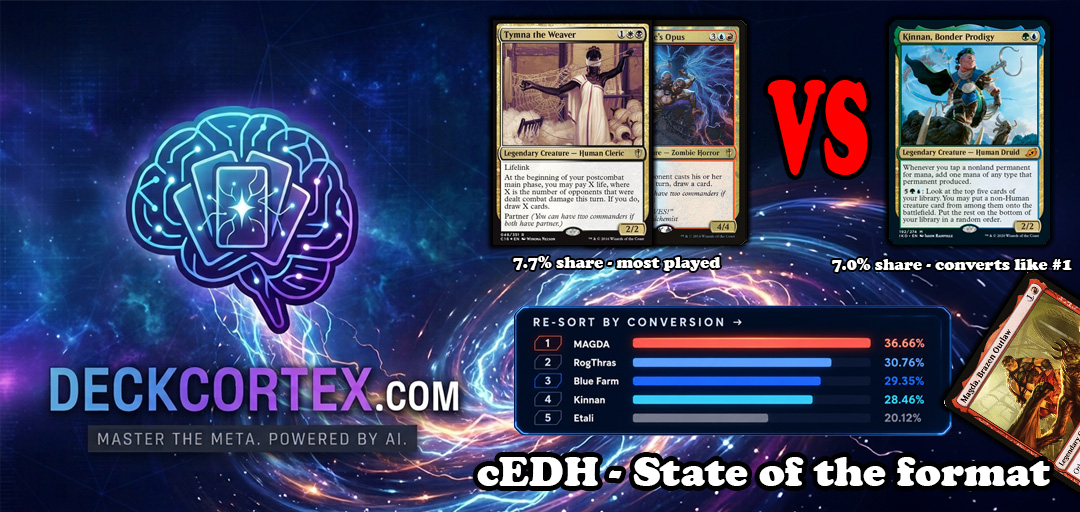
As of July 1, 2026. Everyone already knows the top of cEDH: Kraum, Ludevic's Opus and Tymna the Weaver — "Blue Farm" — is the deck to beat, and Kinnan, Bonder Prodigy is the best commander that doesn't have a partner. Our own corpus agrees, and that agreement is worth something: DeckCortex tracks 106,614 cEDH decklists, and across the 26,503 tournament entries from the last three months, Blue Farm is the single most-played deck and Kinnan is the most-played deck without a partner. So far, so expected.
But the conversion numbers — the part of the data that says which decks actually win, not just which decks show up — quietly rewrite two pieces of the conventional wisdom. The best-converting deck in the top tier isn't Blue Farm. And the popular line that "Kinnan converts worse because beginners play it" is, in our data, simply false — the deck that fits that description is Etali, Primal Conqueror, not Kinnan. This is the state of the format as our numbers actually see it.
What the data shows
Everything below is DeckCortex's own cEDH data, sourced from Topdeck.gg tournament brackets: 26,503 entries, April 2 – July 1, 2026 (the trailing 3-month window inside our 106,614-list corpus). Two numbers per deck. Share is a metagame/appearance share — how often an archetype shows up across the entries we track. Conversion is our Top-Cut conversion rate — the share of that archetype's counted entries that reached their event's Top Cut (the parenthesized n is the entries that figure is computed over). Share tells you what you'll sit across from; conversion tells you what beat the pod to get there.
| # | Deck | Share | Entries | Conversion (n) | Type | |---|------|-------|---------|----------------|------| | 1 | Blue Farm (Kraum + Tymna) | 7.7% | 2,029 | 29.35% (1,591) | Partner | | 2 | Kinnan, Bonder Prodigy | 7.0% | 1,843 | 28.46% (1,483) | Solo | | 3 | RogThras (Rograkh + Thrasios) | 5.2% | 1,389 | 30.76% (1,086) | Partner | | 4 | RogSi (Rograkh + Silas Renn) | 5.0% | 1,318 | 28.14% (1,002) | Partner | | 5 | Sisay, Weatherlight Captain | 3.4% | 908 | 29.15% (710) | Solo (5c) | | 6 | Ishai + Rograkh | 2.6% | 680 | 29.22% (527) | Partner | | 7 | TnT (Thrasios + Tymna) | 2.5% | 675 | 29.11% (529) | Partner | | 8 | Dargo + Tymna | 2.5% | 655 | 25.10% (510) | Partner | | 9 | Etali, Primal Conqueror | 2.0% | 530 | 20.12% (492) | Solo | | 10 | Magda, Brazen Outlaw | 2.0% | 527 | 36.66% (401) | Solo (mono-R) |
Three things jump out of that table.
First, partners own the format's structure. Six of the top ten are partner shells, and together they are 25.5% of the entire field. Look closer and it's really two creatures doing the work: Rograkh, Son of Rohgahh is a piece of three top-ten decks (RogThras, RogSi, Ishai/Rograkh) that add up to 12.8% of every tracked list — one in eight — and Tymna the Weaver is in another three (Blue Farm, TnT, Dargo/Tymna) worth 12.7%. The top five archetypes alone are 28.3% of the field. This is a concentrated top and a long, fragmented tail.
Second, "Blue Farm is #1 at everything" is half true. It is the most-played deck, comfortably. But it is not the best converter in its own tier: Magda, Brazen Outlaw converts at 36.66% and RogThras at 30.76%, both clear of Blue Farm's 29.35%. Blue Farm's claim to the throne is popularity plus an elite-but-not-best win rate, which is a different — and more honest — sentence than "best at both."
Third, the "beginner deck" label is on the wrong commander. The idea that Kinnan's conversion lags because it's an entry-level pick doesn't survive contact with the numbers: Kinnan converts at 28.46%, Blue Farm at 29.35% — a rounding error apart. The genuine top-of-field underperformer is Etali at 20.12%, a full nine points under the ~29% pack. Etali is cEDH's actual "baby's-first-deck," and it drags exactly the way the story claims Kinnan does.
One more note before the deck techs, because momentum matters more than a static tier list: both pillars are slightly softer than they were six months ago. Blue Farm is down from 8.5% to 7.7% (−0.8 pts) and Kinnan from 7.5% to 7.0% (−0.5 pts). Nothing is collapsing — the format is stable — but the very top is drifting a hair flatter, not consolidating.
Blue Farm: the WUBR combo-control machine
That's Eli Montoya's first-place list from Turbo Tuesday 2 (June 30) — an aggressive build, but the engine underneath is the Blue Farm everyone respects. The commanders draw the whole thing: Tymna the Weaver turns combat damage into cards at your postcombat main phase, and Kraum, Ludevic's Opus draws a card every time an opponent casts their second spell in a turn — in a three-opponent pod, that trigger fires constantly. In ("Sans-Green"), that card advantage is paired with the best free interaction in the game.
The consistency is almost comical in our inclusion data. Across all 2,029 Blue Farm lists, the win pieces are near-unanimous: Underworld Breach at 99.94%, Brain Freeze at 99.89%, Lion's Eye Diamond at 99.8%, plus the taxing engines Rhystic Study (99.81%), Mystic Remora (99.86%) and Esper Sentinel (99.88%). When a card sits at 99.8% presence across two thousand lists, it isn't a "staple" — it's part of the definition of the deck.
DeckCortex's combo engine flags four complete win lines in this list, and they're the two families Blue Farm has always leaned on:
- Demonic Consultation + Thassa's Oracle. Consultation lets you "choose a card name" and exile from the top until you hit it; name a card that isn't in your deck and you exile your entire library. Then Thassa's Oracle enters, and because "if X is greater than or equal to the number of cards in your library, you win the game," an empty library is a win. Tainted Pact does the same job the singleton way.
- Underworld Breach + Lion's Eye Diamond + Brain Freeze. Breach gives your graveyard escape; Lion's Eye Diamond makes three mana; Brain Freeze is a storm mill you keep escaping back to mill the table out. Our engine also lists the Lotus Petal variant of the same loop.
Note what these lines cost: two or three cards, all cheap. The rest of the deck is protection — white locks like Silence ("your opponents can't cast spells this turn"), free counters like Fierce Guardianship (no mana if you control a commander), and cheap counters like Flusterstorm — guarding a combo that can assemble under almost any circumstances. That, not raw speed, is why Blue Farm is the most-played deck in cEDH.
Kinnan: the two-mana engine that is the solo king
If Blue Farm is control-combo, Kinnan, Bonder Prodigy is the ramp-combo answer, and it is the strongest non-partner deck in the format by a distance — #2 overall, and converting within a point of Blue Farm. The reason it works out of a two-mana commander is that Kinnan does three jobs in one card. Its static — "whenever you tap a nonland permanent for mana, add one mana of any type that permanent produced" — supercharges every rock and dork (Arcane Signet taps for two and pays back its own cost in a single tap). Its activated ability, ": look at the top five cards … put a non-Human creature card … onto the battlefield," is both a value engine and a combo tutor. And at two mana, it's cheap to rebuild after a removal spell.
Where the Blue Farm turbo list had four complete combos, DeckCortex's engine flags seventeen in this Kinnan list (Donavon's #6 finish at the 62-player Battle by the Bay). A count like that is a signal, not the final 1–5 bracket — DeckCortex assigns the bracket itself — but seventeen complete two-card loops in one 100-card deck tells you exactly how this archetype wins: it trips over a combo.
The two the deck is built around are the ones the user's own notes called out, and our engine confirms both as complete:
- Kinnan, Bonder Prodigy + Basalt Monolith. Basalt Monolith taps for ; Kinnan makes it four; the untap ability nets you one colorless mana every cycle — infinite. Swap in Nyxbloom Ancient ("if you tap a permanent for mana, it produces three times as much") for the same result without the commander.
- Kinnan + Birds of Paradise + Freed from the Real. Freed from the Real untaps a mana dork for ; the dork taps for a color Kinnan doubles; you come out ahead each loop — infinite colored mana, which Finale of Devastation turns into the game.
The most-popular line our engine found isn't even a Kinnan line — it's Hullbreaker Horror plus any of Sol Ring / Mana Vault / Mox Amber for infinite mana and storm. That's the point: Kinnan is a toolbox of redundant kills wrapped around 's best interaction and value tops (Nezahal, Primal Tide, Seedborn Muse, Gaea's Cradle). Explosive and reactive in the same 99 cards. That's the solo king.
The read from the table
The data explains what is winning; a few games behind the deck explain why, and the two agree.
Partners dominate because they cheat the fundamental math of the format. Two commanders is two engines in the command zone that can never be milled or countered away, four or five colors of access to the best tutors, and — with a Rograkh, Son of Rohgahh — a turn-one body that gets a commander onto the battlefield early enough to make "free" spells like Fierce Guardianship free from turn one, and that can be sacrificed for value besides. With six of the top ten archetypes being partner shells — 25.5% of the tracked field — it's not fashion; it's that the archetype starts every game up resources.
Kinnan is the solo king because it's the one non-partner deck that doesn't pay the tax it looks like it should. A two-mana commander that ramps, draws (via its dig), and combos is doing partner-deck things out of one card — and our conversion number (28.46%, level with Blue Farm) says the format's best pilots get the same mileage out of it that they get out of the consensus best deck. Its weakness is real, specific, and visible in our own inclusion data: Kinnan's top staples skew creature- and rock-heavy (Birds of Paradise, Thrasios, Triton Hero, Basalt Monolith), while Blue Farm's card-advantage core is enchantments — Rhystic Study, Mystic Remora — that a creature sweeper doesn't touch. A well-timed board wipe costs Kinnan more of its engine than it costs Blue Farm. Graveyard hate, by contrast, is Blue Farm's problem, not Kinnan's: Underworld Breach sits at 99.94% presence in Blue Farm, and nothing in Kinnan's combo suite touches the graveyard at all. "Beginner tax," though, is not one of Kinnan's weaknesses either way.
Magda: the overperformer nobody's drafting
The single clearest edge in our data isn't a top-of-table deck at all — it's Magda, Brazen Outlaw, on a modest 2.0% share but the best conversion in the top ten at 36.66%, seven points clear of Blue Farm. That's rob mallari's list above, a #2 finish out of 42 players at June's "Battle for Mox Opal." A mono-red Dwarf deck out-converting the WUBR consensus best deck is exactly the kind of thing a play-rate chart is built to hide.
Here's how it wins. Magda, Brazen Outlaw reads "whenever a Dwarf you control becomes tapped, create a Treasure token," and "sacrifice five Treasures: search your library for an artifact or Dragon card, put it onto the battlefield." The deck's whole trick is making everything count as a Dwarf: Universal Automaton is a changeling (every creature type), and Maskwood Nexus makes all your creatures every creature type at once. Our inclusion data shows the shell is nearly fixed — Universal Automaton and Clock of Omens at 100%, Xorn (which doubles every Treasure you'd make) at 99.5%, Maskwood Nexus at 98%.
DeckCortex's engine flags 12 complete combos in the list, and they all rhyme: Magda, Brazen Outlaw + Clock of Omens + a changeling artifact creature. Clock of Omens ("tap two untapped artifacts you control: untap target artifact") taps the Dwarf as part of its own cost — firing Magda's Treasure trigger — then stands that same Dwarf back up to fire again. The Treasures pile up without end, and Magda's own sacrifice-five ability cashes them in for every artifact and payoff in the deck; Xorn doubling each trigger (and Roaming Throne doubling Magda's trigger directly) turns the loop into literal infinite mana. Best of all, it's cheap — Magda herself is a ~$2 card and the combo core is a pile of inexpensive artifacts. Elite conversion at a fraction of Blue Farm's cost is precisely why "underrated" fits.
The rest of the field
Below the two pillars and Magda, the top ten is mostly Rograkh and Tymna wearing different colors. A quick, data-anchored tour:
- RogThras — Temur, and the field's second-best converter. Rograkh, Son of Rohgahh + Thrasios, Triton Hero (5.2% share) posts a 30.76% conversion — behind only Magda in the top ten, and ahead of Blue Farm. It earns its "Cradle Farm" nickname in our data: Crop Rotation (99.3%) sacrifices a land to fetch Gaea's Cradle (99.2%), and Thrasios's draw-or-ramp outlet turns the resulting flood of mana into the whole deck.
- RogSi — Grixis turbo. The same Rograkh, but Silas Renn, Seeker Adept pushes it into black (5.0%, 28.14%). The inclusion data is a turbo list top to bottom: Dark Ritual at 99.9%, a wall of fast mana rocks, and the same Underworld Breach + Brain Freeze kill Blue Farm runs. It wants the game over on turn two or three.
- Sisay — the five-color toolbox. Sisay, Weatherlight Captain (3.4%, 29.15%) grows with each color among your other legendary permanents and tutors any smaller legendary permanent straight onto the battlefield — a singleton toolbox with access to every color's best legends.
- The rest of the Rograkh/Tymna spread. Ishai + Rograkh (2.6%, 29.22% — Jeskai), Thrasios + Tymna (2.5%, 29.11% — four-color "no red"), and Dargo + Tymna (2.5%, but a lagging 25.10% — Mardu) round out the partner tier, all leaning on the same command-zone card advantage.
- Etali — the field's true beginner deck. Etali, Primal Conqueror (2.0%) is the Gruul payoff whose enters-the-battlefield trigger free-casts spells off the top of every library. Splashy and fun, but its 20.12% conversion is the worst in the top ten by nine full points — this, not Kinnan, is where the inexperienced pilots cluster.
One last note on the long tail: the Final Fantasy storm commander Vivi Ornitier — which pings each opponent and grows every time you cast a noncreature spell — has quietly become a real presence at 1.86% (492 decks), roughly four times Ral, Monsoon Mage's 0.43% (113). If you're watching storm climb the tables, watch Vivi.
Bottom line
The headline holds: Blue Farm is the most-played deck in cEDH and Kinnan is the best commander without a partner, and our 106,614-list corpus backs both. But if you're sleeving up for a July event, sleeve up with the corrected version of the story. Blue Farm is the safe, flexible pick — most-played, elite conversion, best free interaction — but it is not the single best converter in the room. Kinnan is a real co-#1, not a beginner's compromise; treat its 28% conversion as the ceiling it is. If you'd rather attack the field than join it, Magda is the overperformer the play-rate charts are hiding. And whatever you register, this is a grind-rewarding format — lean into card advantage and free interaction, not raw speed alone.
Want the exact 75s? All three spotlight lists above are embedded — copy Eli Montoya's Blue Farm, Donavon's Kinnan, or rob mallari's Magda into DeckCortex and start tuning your own flex slots against the table you actually expect to face.
Data: DeckCortex cEDH corpus — 106,614 tracked decklists total; the meta table draws on the 26,503 tournament entries from April 2 – July 1, 2026, sourced from Topdeck.gg brackets. "Share" is a decklist-appearance (metagame) share; "conversion" is DeckCortex's own Top-Cut conversion rate, computed over the parenthesized entry count (a different metric from share, and from match win rate, which we do not track). External aggregators (EDHTop16, EDHREC, cedhstats) use different corpora and windows and are not the source here; where our ordering matches theirs, that's corroboration, not a citation. Card prices referenced elsewhere are Scryfall paper-market aggregates, not a live TCGPlayer feed. Combo counts (4 for the Blue Farm list, 17 for the Kinnan list, 12 for the Magda list) are DeckCortex engine signals of complete combos present — not the final 1–5 bracket, which DeckCortex assigns separately. Embedded decklists are verified DeckCortex snapshots (ids 358777, 357948, 357532); numeric snapshot ids can change on re-scrape and were confirmed to resolve on July 1, 2026. Every card named was validated against live Oracle text before publication.