Commander Staples 2026: The Cards Nobody Credits
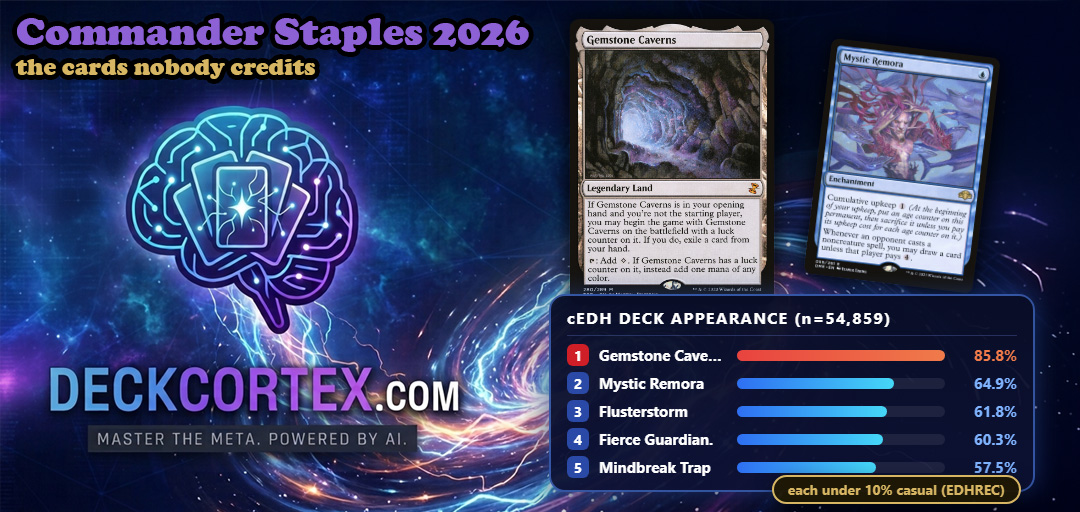
Everyone names the same three Commander staples — Sol Ring, Command Tower, Arcane Signet — and that's exactly why they tell you nothing: they're the only cards the competitive and casual rooms actually share. Set our cEDH tournament data (54,859 decklists) against EDHREC's casual census, then against 1v1 Duel Commander where Sol Ring is banned outright, and the three rooms agree on almost nothing below the famous top. Gemstone Caverns is in 85.8% of cEDH decks and 5.1% of casual ones — the invisible staple no "best staples" list ever credits.
You already know the answer to "what are the best Commander staples." Sol Ring. Command Tower. Arcane Signet. Every list names them, and every list is right. That's exactly the problem: a card that shows up in nearly every deck can't tell you anything about how a deck is built. It's background radiation.
So we went looking one row down — the cards a huge share of decks quietly run without ever making a "cards every deck should own" article. We have three rooms to compare. Our competitive numbers come from the DeckCortex tournament corpus: 54,859 cEDH decklists scraped between January 7 and July 6, 2026, and every percentage is decklist-appearance — the share of lists a card actually shows up in, not a top-cut or win-rate stat. For the casual room, where no tournament data exists, we lean on EDHREC's public census of user-submitted decks (millions of lists; we label every one of those figures as EDHREC's, not ours). And for the third room — sanctioned 1v1 Duel Commander — we're back on our own data, 5,582 tournament lists. Same metric across all three.
The gap between them is the whole story, and by the end the third room turns even the "obvious" answers upside down.
The three cards both big rooms agree on
Start with the overlap between cEDH and casual, because it's tiny. Only three cards clear 60% appearance in both:
Sol Ring is in 98.0% of our cEDH lists and 83.4% of casual decks (EDHREC) — a colorless rock that taps for , a full turn of mana ahead for one card. Command Tower runs 87.5% to 74.1%. And Arcane Signet is the punchline: 71.2% in cEDH, 72.0% casual (EDHREC). A statistical tie across two rooms that share almost nothing else.
That's the tell. The staples everyone can name are famous precisely because they're the exception — the handful of cards both a cutthroat competitive table and a Tuesday-night pod put in the same slots. The moment you look past them, the two rooms stop agreeing at all.
The invisible staples
Here's the card that should be on every "hidden gem" list and isn't:
Gemstone Caverns appears in 85.8% of our cEDH decks — higher than Arcane Signet. In EDHREC's casual data it's in 5.1%. Read those two numbers again. A card more common than Arcane Signet in the competitive room barely registers in the casual one, and it never shows up on a staples list because it looks like a durdly do-nothing land. It isn't. If it's in your opening hand and you're on the draw, you exile a card and it starts the game already in play with a luck counter — a free extra mana on turn zero, and with the counter it taps for any color. In a format where the first player to combo off usually wins, "an extra mana before anyone's taken a turn" is worth a $53 land (Scryfall paper).
Gemstone Caverns isn't a fluke. The competitive room is built on three packages the casual room mostly ignores, and the first is free counterspells:
The word doing the work is free. In a game that's often decided by who can force through a combo on turn four, the counter that costs you no mana on the turn it matters is worth far more than a card that costs . Fierce Guardianship counters a noncreature spell for nothing as long as you have a commander out — 60.3% of cEDH decks run it, 8.5% of casual ones (EDHREC). Deflecting Swat redirects any spell or ability, also free with a commander, and turns an opponent's removal or game-winning trigger back on them: 52.2% to 8.6%. Force of Will — pay 1 life and pitch a blue card instead of — sits at 60.6% versus 4.7%. Pact of Negation counters now and bills you next upkeep (miss the payment and you lose the game, which on a winning combo turn you won't be around to worry about): 59.9% to 3.2%. Mindbreak Trap exiles any number of spells for once an opponent's cast three in a turn — the storm-kill button — at 57.5% versus 2.5%.
The second package is cheap card advantage and interaction that casual never adopted:
Mystic Remora is a one-mana enchantment with cumulative upkeep that draws you a card every time an opponent casts a noncreature spell unless they pay — a couple of turns of that is a fistful of cards for a single blue pip. It's in 64.9% of cEDH lists and 7.7% of casual decks (15.7% of the blue decks that can run it, on EDHREC). Flusterstorm taxes the stack and copies itself for each spell cast before it, which makes it the counter that beats a counter war — 61.8% to 3.6%. Swan Song answers an instant, sorcery, or enchantment for and hands back a 2/2 Bird nobody cares about: 52.0% to 8.9%.
And underneath all of it is the third package, the one that actually powers the format: fast mana.
Lotus Petal sits in 86.7% of cEDH lists (7.0% casual), Ancient Tomb in 85.0% (9.2%), Chrome Mox in 85.1% (5.7%), Mana Vault in 83.0% (5.7%), Mox Diamond in 81.0% (4.2%). Five different cards, every one in more than eight of ten competitive decks and fewer than one in ten casual ones. This is the real reason cEDH doesn't run the classic ramp package — why bother with a three-mana land-fetch when your acceleration costs zero and comes down turn one? Even Mox Amber, a build-around that only makes mana if you've got a legend on the board, clears 60.2%.
To be fair to EDHREC, its raw top-cards data does surface a few of these near the bottom — Swan Song, Fierce Guardianship, Deflecting Swat and Mystic Remora all scrape in once you're deep enough into the list. What leaves them out is the human-written guide, the "30 cards every Commander deck should own" listicle. That's the omission worth naming: not that the data hides these cards, but that the curated advice does.
The other direction: what cEDH won't touch
Flip it around and the casual staples look just as strange from the competitive seat.
| Casual favorite (EDHREC) | Casual % | cEDH % (DeckCortex) | |---|---|---| | Swiftfoot Boots | 26.3% | 2.7% | | Lightning Greaves | 24.6% | 5.4% | | Path to Exile | 21.2% | 6.6% | | Counterspell | 19.9% | 3.3% | | Cultivate | 17.2% | 2.3% | | Farseek | 15.8% | 2.0% | | Rampant Growth | 12.8% | 0.0% |
The ramp package is the clearest split. Casual Commander ramps with two- and three-mana sorceries — Cultivate finds two basics and puts one onto the battlefield tapped, Farseek grabs a dual, Rampant Growth does the cheap version. Fine cards, and none of them costs more than a dollar, so this isn't a money story — cEDH skips them because they're a full turn too slow for a format trying to win on turn three, and Rampant Growth literally rounds to 0.0% of competitive lists. Same logic on protection: casual straps Swiftfoot Boots (hexproof and haste) or Lightning Greaves (shroud and haste, equip ) onto its commander and calls it safe; cEDH would rather hold up a free counter and never spend a card slot on the equipment. Even Counterspell — the platonic blue card, the one every new player learns — is a casual staple at 19.9% and a competitive afterthought at 3.3%, because on a fixed turn is simply worse than a Fierce Guardianship that costs nothing on the turn that decides the game.
Neither room is wrong. They're playing different games, and the card choices are just being honest about it. Hold onto Counterspell, though — it's about to do something interesting.
The price wall — and where it cracks
There's an uglier reason a lot of these cEDH cards skip the casual lists: they cost a mortgage payment. The fast-mana and card-advantage tier is genuinely expensive (all prices Scryfall paper, early July 2026):
Mox Diamond is a ~$1,119 Reserved List card. Lion's Eye Diamond runs ~$817, Mox Opal ~$248, Chrome Mox ~$170, Ancient Tomb ~$135, Mana Vault ~$111. Nobody's putting those in a "build any deck" starter article, and fair enough. (A note for readers buying in euros: the gap isn't symmetric — Chrome Mox is around €95 against its $170 US price, and Mox Diamond about €794 against $1,119. The Reserved List staples are meaningfully cheaper on Cardmarket than on TCGplayer.)
But price isn't the whole story, and the cards that prove it are the interesting ones. Borne Upon a Wind — , gives all your spells flash for the turn and replaces itself — is in 43.8% of cEDH decks and 2.0% of casual ones. It costs $3.65. Swan Song is $8.27, Flusterstorm $8.48, Mystic Remora $12.68 — none of them a barrier, all of them near-absent from casual decks. Compare that to the shared three, which are pocket change: Command Tower $0.36, Arcane Signet $0.70, and Sol Ring itself around $2. So the wall between the rooms is partly money — but the cheap cards clear it just as rarely, which means the real barrier is knowledge. Casual players skip Borne Upon a Wind because the effect doesn't matter at their table, not because it's out of reach.
One card on the move
Movement over these windows is small — this is a settled format — but one card is climbing in more than one room at once:
Hexing Squelcher, a Goblin Sorcerer from Lorwyn Eclipsed, makes your spells uncounterable and hands your other creatures "Ward—Pay 2 life," all on a two-drop that itself can't be countered. In our cEDH data it's in 36.0% of lists over the six-month window and 38.3% over the last three, so it's still climbing. It's rising in Duel Commander at the same time, which is the unusual part — the rare card both the multiplayer and the 1v1 crowd are picking up at once. If anything on this list graduates to a "known" staple by 2027, it's this one.
The third room: Duel Commander turns it all over
Everything above is a two-room story. Add the third and it fractures further. Duel Commander is sanctioned 1v1 Commander with its own ban list (maintained at duelcommander.org), and it opens by banning the exact fast-mana package cEDH is built on — Sol Ring included. That's a rules difference, not a deckbuilding choice, so there's no honest way to line a banned card's "play rate" up against a legal one. The fair comparison is the cards legal in all three rooms — and those still tell three completely different stories:
| Card | cEDH | Casual (EDHREC) | Duel Commander | |---|---|---|---| | Prismatic Vista | 8.7% | 4.7% | 71.5% | | Gemstone Caverns | 85.8% | 5.1% | 23.4% | | Swords to Plowshares | 20.5% | 26.9% | 39.9% | | Counterspell | 3.3% | 19.9% | 37.9% | | Lightning Bolt | 12.2% | 5.6% | 48.3% | | Fury | 2.9% | 0.7% | 45.7% |
With the explosive mana gone by rule, Duel Commander's manabase gets honest. Prismatic Vista — , pay 1 life, sacrifice to fetch a basic — sits at 71.5% in DC against 8.7% in cEDH, because cEDH runs almost no basics for it to find while a fair 1v1 deck runs plenty.
With the broken starts gone, Duel Commander rewards efficient, fair Magic, and three packages define it. First, cheap removal that trades one-for-one — exactly what's too slow or too narrow for a three-opponent pod:
Lightning Bolt is in 48.3% of DC decks and 12.2% of cEDH ones; Fatal Push 37.7% against a rounding-error 0.4%; Swords to Plowshares, the most efficient removal in the game, climbs to 39.9%. In a duel, killing the one threat across the table wins games. In cEDH, spot removal is a losing trade — you spend a card, and two other opponents are still assembling their combos.
Second, the interaction cEDH can't afford to run: soft counters and cantrips.
Force Spike ("counter unless they pay ") is a real card at 40.2% in DC and 0.0% in cEDH. Mana Leak is 39.9% to 0.5%, Spell Snare 39.8% to 0.6%, Daze 34.8% to 10.1%. A tax counter is dead the moment a table has three players floating extra mana, but in a duel where every point of tempo counts it's premium. Same with the cantrips — Ponder at 33.3% and Preordain at 33.0% in DC, both near 2% in cEDH — because a fair deck wants to smooth its draws while a combo deck wants its whole hand to be action.
Third, the evoke elementals, the free-if-you-pitch-a-card creatures that let a 1v1 deck answer a threat and develop at instant speed: Fury at 45.7% (2.9% cEDH), Subtlety at 39.3%, Solitude at 35.1%. Add Snapcaster Mage at 34.2% and Thoughtseize at 31.1% and you've described a format that looks far more like Legacy than like a four-player pod.
Now go back to Counterspell. It's the same card in every room, and its number tells you which game you're in: 3.3% in cEDH, 19.9% casual, 37.9% in Duel Commander — it gets better the fewer opponents you face. The free counters run the opposite way. Force of Will is 60.6% of cEDH decks and 0.1% of Duel Commander ones; Fierce Guardianship, Deflecting Swat and Mindbreak Trap are all essentially 0% in DC. In a duel you'd simply rather run a clean two-mana answer than pay a whole card to cast one for free — the tempo math that makes free counters mandatory against three opponents doesn't hold against one.
What survives in all three rooms? The manabase — the fetchlands and duals — plus two cards: Mental Misstep, the counter for any one-drop (61.8% cEDH, 45.5% DC), and Force of Negation (44.3% to 34.4%). Both formats are built on cheap spells, so the answer to cheap spells travels. Everything else is a different deck. One card pool, three rooms, and outside of a shared pile of lands they might as well be different games.
Method & sources. cEDH and Duel Commander figures are DeckCortex tournament-corpus decklist-appearance — the share of lists a card appears in — over 54,859 cEDH decks and 5,582 Duel Commander decks, 2026-01-07 to 2026-07-06 (cEDH three-month sub-window: 26,258). Not top-cut share, not field share, not win rate, and not a claim about which decks win — appearance only. Casual figures are EDHREC's public census of user-submitted decks (≈9.3M lists trailing two years / 816K past month), reported as EDHREC's percentage of all decks, with the color-eligible figure noted where it matters; EDHREC is an outside source and labeled as such throughout — DeckCortex's own data covers the two competitive rooms. The Duel Commander ban list is per duelcommander.org. Prices are Scryfall paper market aggregates, snapshot 2026-07-06, and they move.