The $545 Million Quarter and the $93 Deck: What Playing Magic Actually Costs
Magic just posted its first half-billion-dollar quarter while its players argue the game has priced them out — so we priced 3,437 July tournament decks card by card across eight formats. The answer runs from a $93 Red Deck Wins list to a €48,000 Vintage Workshop pile, in every format half to nine-tenths of the money sits in four cards, and for the game's single most famous card there is no dollar price at all.
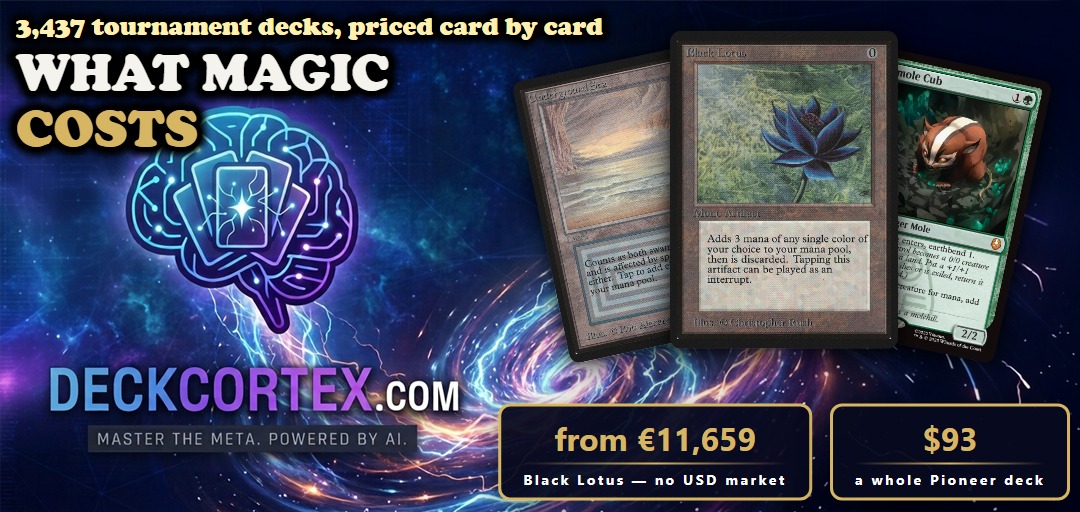
The $545 Million Quarter and the $93 Deck: What Playing Magic Actually Costs
Magic just booked the biggest quarter in its history — $545 million between April and June, up 32% year over year, the first time the game has ever cleared half a billion dollars in three months. The same week that number dropped, one of the biggest Magic podcasts around ran an episode titled "Magic Players Keep Complaining. Magic Keeps Breaking Records." That's the whole debate in one headline: the game has never made more money, and its players have never been more convinced they're being priced out.
Both sides argue with anecdotes. We'd rather argue with decklists. So we took every tournament list our scraper ingested in July — 20,820 deck snapshots across eight formats — grouped each format's twelve most-played archetypes, and priced the forty most recent lists of each, card by card, quantity by quantity, at today's paper prices. Nearly 3,450 fully priced decks later, here's what the game people actually play costs. The short version: the cheapest deck putting up results in a major format costs $93. The most expensive costs about as much as a used car, and you can't even get a dollar price for its best card.
The board
| Format | Median deck (top archetypes) | Cheapest way in | The four-card problem | |---|---|---|---| | Pauper | $140 | Urzatron, $106 | 65% of the price sits in 4 cards | | Standard | $278 | Izzet Spellementals, $219 | 68% | | Pioneer | $323 | Red Deck Wins, $93 | 69% | | Modern | $796 | Boros Ponza, $295 | 60% | | Duel Commander | $1,438 | Light-Paws, $595 | 53% | | Legacy | $4,984 | Boros Aggro, $1,717 | 84% | | cEDH | $7,817 | Magda, Brazen Outlaw, $3,249 | 51% | | Vintage | see below | Dredge, ~$8,400 | 78–98% |
Medians over the sampled top-twelve archetypes per format, July 1–31 lists at July 31 Scryfall paper prices, full 75 (or 100) including sideboard and basics. That last column is the number this article keeps coming back to: in every format we measured, half to nine-tenths of a deck's price sits in its four most expensive cards. You don't really buy a deck. You buy four cards, and the rest comes along for change.
Standard: the $50 badger
Standard's two-pillar meta has a two-tier price structure. The Izzet family — Prowess at $260, Spellementals at $219, the Lessons builds around $270 — is the cheap half. The Selesnya deck is the expensive half at $565, and the gap has a single name on it: Badgermole Cub, the Avatar: The Last Airbender mythic that untaps into an extra every time you tap a creature for mana. It's a four-of, it's $50 a copy, and it alone is around $200 of that deck — about as much as an entire Spellementals list.
The quieter tax is the mana. Riverpyre Verge shows up in 52% of all sampled Standard decks at $20.76 — a rare land from Aetherdrift is the most ubiquitous cost line in the format. And the single most expensive card in some lists isn't from 2026 at all: Cavern of Souls at $48, a 2011 design still Standard-legal because its Lost Caverns reprint never rotated out (no rotation this year — the calendar shift pushed it to early 2027). If you want the floor instead: the cheapest Spellementals list we priced won a slot at an Osaka tournament and totals $190.
Pioneer: a whole deck for less than one Sheoldred
Pioneer's price story is one card wearing a praetor suit. Sheoldred, the Apocalypse costs $97 a copy, and every black midrange shell pays it four times: The Rock at $673, Dimir Aggro at $550, Golgari Midrange at $776. Nearly $390 of each of those decks is the same playset.
Meanwhile Red Deck Wins — 120 lists in July, the format's second-most-played deck — has a median cost of $93.17. The entire deck costs four dollars less than one Sheoldred. The cheapest RDW list we priced, straight off an MTGO League, came in at $69.11:
The rest of Pioneer's cost lives where it always has: Thoughtseize is in half the format at a very reasonable $8.79, while Boseiju, Who Endures at $50 and Urborg, Tomb of Yawgmoth at $63 do the real damage. Lands, again. Write that down; it becomes a theme.
Modern: a thousand dollars is the price of the best deck, once
The Boros deck — our classifier splits it into Boros Aggro and Boros Energy, but it's one core — is Modern's most-played archetype and its median list costs $963–986. Ragavan, Nimble Pilferer tops the curve at $43, but no single card dominates the way Sheoldred does in Pioneer. Modern's cost is death by a dozen $30–55 cuts: Urza's Saga ($43), Force of Negation ($57), Boseiju in 37% of the format, Solitude, Ocelot Pride, and a fetchland manabase where Marsh Flats, Arid Mesa and Flooded Strand each sit in roughly a third of all decks.
The "competitive Magic costs over a thousand dollars" line that gets repeated in every affordability thread? In our top-twelve tables across Standard, Pioneer, Modern and Pauper, it's true exactly once: Amulet of Vigor pilots pay $1,107 median for Amulet Titan, $53 of it for the one-mana Worldwake artifact the deck is named after. Everyone else in Modern's top twelve is under a grand — and Boros Ponza puts up real numbers at $295.
Legacy: the format where the land costs more than the deck
Legacy's median top archetype costs $4,984, and 84% of that is four cards. The four cards are almost always the same kind: Underground Sea is in 39.5% of all sampled Legacy decks at $1,006 per copy. Across our 473 priced Legacy lists, that one land accounts for over $620,000 of cumulative deck value — more than double any other card in the format. The Lands deck is the extreme case: $9,024 median, topped by Mox Diamond at $1,129 and The Tabernacle at Pendrell Vale at $2,900, a card whose entire rules text is giving every creature on the table an upkeep bill.
The counterweight: the actual spells are cheap by eternal-format standards. Force of Will, the card that defines the format, is $63 and in 60% of decks — a playset costs less than a quarter of one Underground Sea. Which is why Legacy's budget door is the deck that skips blue duals entirely: the Boros lists (Aggro and Energy cores) run $1,717–1,736 on Plateaus, and July's cheapest sampled Lands list — if you already own the manabase, we have bad news about that sentence — was $8,310 at a Hareruya Cup.
Vintage: there is no dollar column
We wanted to tell you what Vintage costs in dollars. We can't, and the reason is the finding: Black Lotus has no USD price on any printing. Neither does Mox Sapphire or Mox Ruby. TCGplayer simply runs no live market for them — the paper market for the Power is so thin in the US that the aggregate we use for every other card in this article returns nothing at all. The cards trade, but through auctions and brokers, not a price feed.
Cardmarket does quote them. An Unlimited Black Lotus carries a €11,659 trend price — Beta is €22,454, Alpha €38,720 — so Vintage is the one format this article prices in euros. With the Power counted, the Workshop decks led by Mishra's Workshop ($3,001, in 31% of the format) run a median of €48,154; Initiative Hatebear is €28,588, Doomsday €25,272. The "budget" doors are Bazaar Aggro and Dredge around €11,900 ($8,400 ex-Power), which skip most of the Power for four copies of Bazaar of Baghdad — $1,925 each, and 98% of the deck's cost in four cards, the most concentrated price tag we measured anywhere. Treat every Vintage unit price as an estimate with wide error bars; when one or two listings ARE the market, "market price" is a strong word.
Pauper: $140, and the chase cards are from 1994
The commons format's median is $140 — half a Standard deck — with Madness Burn bottoming out at $52.88 and nothing in the top twelve above Grixis Affinity's $210. The punchline is which commons carry the cost: Pyroblast at $11.81 sits in 51.7% of all sampled Pauper decks, and Red Elemental Blast adds $14.92 in another 39%. The two biggest cost drivers in the format that exists to be cheap are Ice Age and Alpha-era sideboard commons whose job is countering blue. Your Pauper maindeck is nearly free; your opinion about Islands is what costs money.
The Commander desks: Mox Diamond is the entry fee
cEDH is, by our numbers, the second-most expensive way to play Magic: $7,817 median across the top twelve commanders, with Blue Farm (Kraum + Tymna, 606 lists in July — the most-played deck in this entire study) at $9,285 and Sisay at $10,225. The tax collector is Mox Diamond: 93.1% of sampled cEDH decks run it at $1,129. Chrome Mox is in 99.2% at a comparatively charitable $166. Above them sits the luxury tier — Timetwister at $6,050 in 13% of decks, Gaea's Cradle at $1,638, and Candelabra of Tawnos at $2,600, which Legacy banned on June 29 and cEDH continues to shuffle up without blinking.
The value doors are real, though: Magda, Brazen Outlaw — a $2.80 commander — fields a $3,249 median deck, and Kinnan, Bonder Prodigy lists run $4,923 with a sampled floor of $3,920. Nobody would call that cheap. In this field it counts as thrift.
Duel Commander tells the gentler version: $1,438 median, Spider-Man 2099 leading the field on a $0.61 commander in front of $1,804 of deck, and Light-Paws, Emperor's Voice as the honest budget entry at $595. It also has the flattest cost curve we measured — Tifa lists put only 26% of their price in the top four cards. The expensive tail is the usual suspects: dual lands, again.
What the record quarter actually bought
Put the two numbers next to each other honestly. Hasbro's $545 million is overwhelmingly sealed product — the Marvel Super Heroes launch it credits by name, boosters, Collector packs. The prices in this article are the singles market, where most of the money changes hands between players and stores, not with Wizards. These are two different economies that share one card pool, and the bridge between them is reprint policy: the reason a Steam Vents costs $11.45 and not several times that is that it keeps getting reprinted; the reason Underground Sea is a four-figure land is that it never will be. When players say "the game" is too expensive, they're usually pointing at the second economy. When Hasbro reports a record, it's counting the first.
What our numbers actually support is narrower than either side's version. Playing competitive Magic in 2026 costs anywhere from $93 to functionally unbounded, the entry price is set almost entirely by format choice, and within every format the real decision is four cards — a Sheoldred playset, a Badgermole set, a pair of Underground Seas. The complaint and the record aren't in tension. They're about different products.
Three dates will move these numbers: August 10's B&R announcement, The Hobbit on August 14 (whose reprint sheet is already pulling Tales of Middle-earth prices around), and the rotation that isn't happening this fall. We've put July's floor on record — $93 in Pioneer, $52.88 in Pauper, $190 in Standard. When someone tells you what Magic costs, ask them which Magic. We'll re-run the board when the Hobbit dust settles.
Methodology: 20,820 deck snapshots ingested 2026-07-01 to 2026-07-31 across Standard (n=1,729), Pioneer (1,380), Modern (3,414), Legacy (1,906), Vintage (675), Pauper (2,445), cEDH (8,656) and Duel Commander (615); per format, the 12 most-played archetype labels, up to 40 most recent lists each, 3,437 decks fully priced. Prices are Scryfall paper aggregates as of 2026-07-31 (not a live TCGplayer/Cardmarket feed); names whose newest printing has no price yet are filled with their cheapest priced printing, per currency. Full 75/100 priced, sideboards and basics included. Medians describe the sampled top archetypes, not a field-weighted average; cheapest-printing shopping will land below these numbers. We track deck appearances, not match results — nothing here is a win rate.