How a $0.41 Dack Fayden Wins cEDH Events by Giving Its Creatures Away
Dack Fayden, Helping Hand costs $0.41 and gives away every creature he flips. In cEDH that's the combo: the creatures enter under your control before they change hands, so every trigger stays yours, and every exile-until effect sends a gift back to its owner. Here's the exact line, the three builds behind seven event wins in nine days, and what the deck around a 41-cent commander really costs.
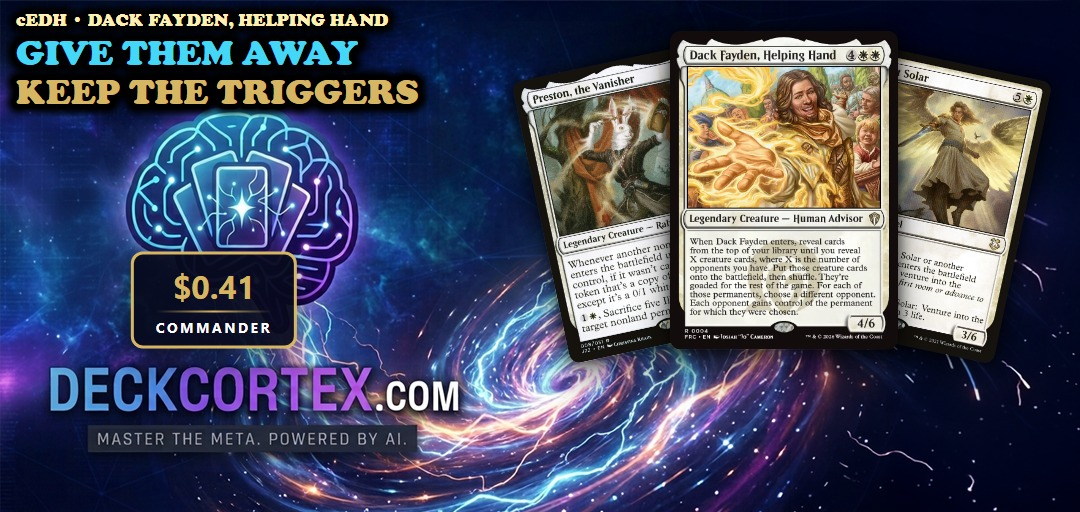
Dack Fayden, Helping Hand looks like a group-hug card that wandered into the wrong format. He costs six mana. When he enters, he flips creatures off the top of your library and hands one to each opponent, and those creatures stay goaded for the rest of the game. In a normal pod that is three free creatures for the table, from a rare that sells for $0.41 in the Reality Fracture Commander precon.
Since October 3 he has won seven tournaments in our cEDH corpus. Two of those came in big fields: 119 players in New York and 69 in Pennsylvania.
The gift is the combo. Dack's creatures enter the battlefield under your control and change hands a moment later, and every trigger they create on the way in stays yours. Build the deck so those triggers point back at Dack, at each other and at the creatures you just gave away, and one resolved cast from the command zone can end the game.
The card, exactly
When Dack Fayden enters, reveal cards from the top of your library until you reveal X creature cards, where X is the number of opponents you have. Put those creature cards onto the battlefield, then shuffle. They're goaded for the rest of the game. For each of those permanents, choose a different opponent. Each opponent gains control of the permanent for which they were chosen.
Four details matter more than the donation itself.
X is the number of opponents, so three in a four-player pod. "Put those creature cards onto the battlefield" means they are never cast, which turns out to matter a great deal for one of them. "Then shuffle" sends every noncreature card you revealed back into the library: no mill, no card advantage. The ability is a pure creature tutor, and how predictable it is depends only on how many creatures you run. With seven in the 99 it finds three of those seven. With exactly three, it finds those three every time.
And goaded for the rest of the game means each gift has to attack every combat, and has to attack a player other than you if it can (rule 701.15b). In a four-player pod, every gift swings at one of the other two opponents.
Whose triggers are they?
That is the question the whole deck is built on, and the Comprehensive Rules answer it cleanly.
An effect that puts a card onto the battlefield puts it there under the control of the player it instructs (rule 110.2a). Dack's ability instructs you. The creatures' enters abilities trigger at that moment, and permanents entering together see each other (603.6a). Only after that, still inside the same resolution, does each opponent gain control of one.
The triggers don't go on the stack until a player would next receive priority (603.3), which is after the gift. But a triggered ability's controller is fixed when it triggers: it is "the player who controlled its source at the time it triggered" (603.3a). That's still you. Every "you" in those abilities means you (109.5), and you stack all of them in any order you like (603.3b).
Two more rules finish the picture. A token is owned and controlled by the player who creates it (111.2). And a card exiled "until" something happens comes back "under its owner's control" (610.3c). You own every creature Dack gives away.
So the bodies go to your opponents, the abilities stay with you, and every exile-until effect is a ticket home.
The engine: three creatures that read the rules correctly
Felidar Guardian exiles "another target permanent you control" when it enters and returns that card under its owner's control. Pointed at Dack, that's another flip.
Preston, the Vanisher creates a 0/1 white Illusion token copy of every other nontoken creature that enters under your control without being cast. Dack's creatures are never cast. Preston's tokens are yours, because you created them.
Radiant Solar ventures into the dungeon whenever it or another nontoken creature you control enters. That's the kill, and the dungeon comes in a moment.
Here is the best case: Dack flips exactly those three in a four-player pod. Each step is the Oracle text plus the rules above.
- Preston, Felidar and Solar enter under your control.
- Preston triggers twice (Felidar and Solar entered without being cast). Solar triggers three times (itself plus two other nontoken creatures). Felidar triggers once.
- Dack's ability finishes: shuffle, goad, one creature to each opponent.
- All six triggers are yours. Solar's three ventures take you through the first three rooms of Lost Mine of Phandelver: scry 1, a Treasure, and each opponent loses 1 life while you gain 1.
- Preston's triggers create your token copies of Felidar and Radiant Solar. The token Solar ventures as it enters, which draws you a card and completes the dungeon.
- The original Felidar's trigger exiles Dack and returns him. Dack's ability triggers again.
After one resolution, each opponent holds a Preston, a Felidar or a Solar that must attack somebody other than you. You hold Dack, a Treasure, a fresh card, and token copies of Felidar and Radiant Solar. The token Solar ventures every time a nontoken creature enters on your side. And the next flip is already on the stack.
Bringing the gifts home
The second flip finds three of the remaining four creatures in a list like the 119-player winner's: Fiend Hunter, Werefox Bodyguard, All-Fates Stalker and Abdel Adrian, Gorion's Ward. Your token Solar ventures for each, and their triggers are yours too. This time you point them at your own donated creatures.
Werefox Bodyguard exiles "up to one other target non-Fox creature until this creature leaves the battlefield". Aim it at the Preston an opponent now controls. All-Fates Stalker's trigger, stacked to resolve second, exiles the Werefox. The moment Werefox leaves the battlefield, Preston returns under its owner's control. Yours. Fiend Hunter does the same job with two separate triggers: it exiles a creature, and returns it when Fiend Hunter leaves.
Spells do it too. Flicker of Fate and Eldrazi Confluence can target a creature an opponent controls and return it under its owner's control, and Eldrazi Confluence can choose that mode three times in one cast.
Everything aims at one state: Preston on your side, and the real Felidar Guardian entering under your control without being cast.
The kill: forty laps through a dungeon
Once you have that, Commander Spellbook already documents the loop, listed with Ephemerate, Cloudshift or Flicker of Fate as the starter. Felidar enters, Preston copies it, the token's trigger blinks the real Felidar, it enters again uncast, Preston copies it again, and so on. Felidar's trigger is a "may" every time, so the loop stops when you say so.
On its own the loop produces endless enters and Illusion tokens. Radiant Solar turns that into a win, because the real Felidar is a nontoken creature entering under your control. Every time it does, your Solar (the token copy is enough) ventures once.
The route is Lost Mine of Phandelver: Cave Entrance (scry 1), Mine Tunnels (create a Treasure), Dark Pool (each opponent loses 1 life and you gain 1 life), Temple of Dumathoin (draw a card). That's four ventures per lap, and you choose the dungeon again each time you start a new one. Commander players start at 40 life, so 160 ventures finish a table that hasn't lost a point. With an infinite loop, it's a matter of counting out loud.
The second build skips Preston. Restoration Angel, Wispweaver Angel and Icewind Stalwart each loop with Felidar Guardian on their own: Felidar blinks the other creature, which blinks Felidar back, forever. Spellbook lists all three as two-card combos. Radiant Solar still supplies the kill.
Three builds, one commander
DeckCortex has 28 Dack entries in its cEDH corpus between October 2 and 12. Sorted by creature package:
| Build | Lists | Wins | Best results | Creature package | |---|---|---|---|---| | Preston | 9 | 3 | 1st of 119, 1st of 24, 1st of 9 | Preston, Felidar, Radiant Solar, plus Fiend Hunter, Werefox Bodyguard, All-Fates Stalker, Abdel Adrian | | Angel | 8 | 2 | 1st of 69, 1st of 14 | Felidar, Restoration Angel, Wispweaver Angel, Icewind Stalwart, Radiant Solar, Bronzebeak Foragers | | Boonweaver | 7 | 1 | 1st of 15, 5th of 65, 7th of 66 | exactly three: Boonweaver Giant, Preston, Roaming Throne | | Other | 4 | 1 | 1st of 21 | three different one-offs |
The Preston build won the biggest event. Tim Taranto (Goldsabertooth) took BAKED ZITI 4 in New York on October 3, a 119-player field. His 100 cards are our reference list for this piece, imported card for card as a DeckCortex deck you can open, copy and edit:
The DeckCortex engine finds ten complete combo lines in this list, every one of them three or four cards: Preston plus Felidar plus Ephemerate or Cloudshift, and a set of Abdel Adrian lines (Abdel exiles any number of your other nonland permanents until it leaves and gives you a Soldier token for each, which turns into a loop with Felidar and a blink). The bracket-fit model reads the list as cEDH: 11 Game Changers, seven fast-mana pieces, ten combo lines. That combo count is one input of six, a signal rather than the bracket. None of the ten lines includes the Radiant Solar kill either, because Spellbook doesn't catalogue that payoff. The engine counts the loops, not the win.
The Angel build won the second-biggest. Ian Flannery took the 69-player Mulligan Championship Series event in Warminster, Pennsylvania, on October 4, with ten creatures and no Preston:
Here the engine finds 29 complete lines, five of them genuine two-card pairs between Felidar Guardian, Restoration Angel, Wispweaver Angel and Icewind Stalwart. More creatures means more redundancy, and a less predictable flip. The homecoming card in this build is Bronzebeak Foragers, which exiles up to one nonland permanent from each opponent until it leaves the battlefield: one trigger, and one gift back from every opponent once Foragers goes.
The Boonweaver build plays exactly three creatures: Boonweaver Giant, Preston and Roaming Throne. With X at 3 and three creatures in the library, Dack's reveal isn't random at all, as long as none of them has been drawn. A bug report filed against the Forge rules engine on release day describes exactly this flip, with Roaming Throne naming Rabbit so Preston's triggers fire twice. The Giant's trigger puts an Aura from your library, hand or graveyard onto itself, and all seven lists carry Super State among 9 to 14 Auras. Super State only enchants a creature you control, makes it a 9/9 with flying, first strike, trample and haste, and whenever it deals combat damage to an opponent, it deals that much damage to each other opponent. Preston's token Giants are creatures you control. We found no write-up of the exact kill, so read this paragraph as what the lists are set up to do, not as a verified line. The build's one win came at 15 players.
That leaves four outliers, including the strangest result in the sample: a 32-creature list that won a 21-player event in Barcelona billed as "Commander Budget".
Where the deck came from
None of the combo pieces is new. The delivery is.
Between August 1 and October 1 (16,298 tracked entries), Preston and Felidar were already working cEDH technology in Aang, at the Crossroads // Aang, Destined Savior lists: Felidar sat in all 78 and Preston in 70. Aang's own trigger digs one creature with mana value 4 or less out of the top five cards. Radiant Solar, at mana value 6, is out of that reach; in the same two months it showed up in exactly 11 cEDH lists, all of them Sefris of the Hidden Ways.
The rest of the 99 belongs to a different deck: Oswald Fiddlebender's mono-white artifact stax. Of the 45 cards that sit in at least 75% of Dack lists, 26 were in at least half of the 31 Oswald lists from August and September: Tezzeret, Cruel Captain, Trinisphere, Defense Grid, Mishra's Workshop, Basalt Monolith and Grim Monolith, both untap Keys, Urza's Saga, Mox Opal and Vexing Bauble. What the Dack lists dropped is Oswald's own engine: Rings of Brighthearth, in 30 of 31 Oswald lists, is in one of the 28. What they added: Silence and Orim's Chant (27 of 28 each) to protect the turn Dack resolves, Gleaming Splendor and Smothering Tithe for Treasure, and more stax in Static Prison and Cursed Totem.
Oswald's own numbers are too thin to call this a migration (31 entries in two months, 4 since October 2). The card overlap is the evidence: the chassis existed, the loop existed, and Dack is a commander that fetches the loop from the command zone, in the chassis's color.
The lists also deal with the obvious problem of a six-mana commander, which is getting him to resolve. Cavern of Souls is in 27 of 28 lists, and Dack is a Human Advisor: cast with Cavern's mana after naming Human, he can't be countered. Command Beacon, in 16, puts him back into your hand from the command zone, so the second attempt dodges the commander tax.
The results, with the caveats attached
The window is October 2 to 12: 3,351 tracked tournament entries across 246 events. Dack has 28 of them (0.84%, rank 23 of 423 commanders), from 26 different players at 23 events, the first on October 3 and the last on October 11.
He has seven wins and ten top-four finishes. Among the 40 most-registered commanders in the window, only Kraum + Tymna (23), Kinnan (14) and Sisay (8) won more events; Rograkh + Thrasios also has seven, on 186 entries. Two of Dack's wins came in big fields, 119 and 69 players. The other five came at events of 9 to 24 players.
Conversion is the eye-catching number: 14 of 23 entries with full standings made the top cut (60.9%), against 27.3% for the whole window. It sits on 23 entries over nine days of play, so read it as "not a fluke so far", not as a rate. Eight of the 28 entries came at events of 64 or more players, which means this isn't only a small-store deck either.
Two data notes. One event in Galicia appears twice under two different identities, so read the counts as plus or minus one. And our pre-release control fails this time: four entries list Dack as commander at events dated September 26 and 27, before the Commander deck that prints him went on sale on October 2. Most likely those are decklist links that were edited after the event; our data can't tell for sure. They sit outside the window, and nothing above counts them.
The winning lists are already being copied. Goldsabertooth's exact 100 cards won again in Celle, Germany, on October 10 (Yannick Siegmund, 24 players) and finished third in Victoria, Canada, the same day. Flannery's list was registered card for card at another event. Nine of the 28 lists are one of the two winners or within eight cards of one.
Credit for the idea isn't ours. Draftsim traces the package to a Reddit user posting as Traffic_Kone, and mtgrocks reported early wins on October 5. Away from tournaments, Dack is mostly a different deck: EDHREC counts 3,186 Dack decks, with blink (194), forced combat (96) and donate (83) as the biggest tags, and 100 on its cEDH page.
What it costs
The commander is $0.41. The seven creatures in Taranto's list cost $46.42 together, and $38.92 of that is Preston, which has only ever had one paper printing. The package that does the killing costs less than a single Mana Vault ($91.59).
The deck around it doesn't:
At the cheapest paper printing of every card, Taranto's list costs $11,314.41. Mishra's Workshop ($3,699.99) and The Tabernacle at Pendrell Vale ($3,239.00) are 61% of that on their own. The ten cards over $100 make up 92.7% of the total, while the 57 cards under $5 add up to $79.18. Flannery's list skips the Tabernacle and comes to $7,945.04, with Workshop alone close to half of it.
Across all 28 lists the median is $7,987.81. Twenty-two of them run Workshop and seven run the Tabernacle. The cheapest is the Barcelona budget winner at $110.32; the cheapest Angel list, which won a 14-player event, is $1,960.55 without Workshop.
So the cheap part of this deck is the combo. The expensive part is the Reserved List: Workshop and the Tabernacle, plus Mox Diamond, Lion's Eye Diamond, City of Traitors and Grim Monolith, most of it fast mana that gets a six-drop commander down early. mtgrocks' Nathan Ball wrote that with the right hand the deck can "put a win on the stack as early as turn two". The six lists without Workshop have only played events of 14 to 34 players so far.
What beats it, and what to watch
The deck lives on creatures entering the battlefield and triggering. Torpor Orb ("Creatures entering don't cause abilities to trigger.") and Hushbringer switch the entire plan off, Dack's own trigger included, and an opponent's Elesh Norn, Mother of Machines does the same to your permanents. In October's 3,351 lists, Torpor Orb appears in 80 (2.4%), Elesh Norn in 22 and Hushbringer in 7. A Stifle can counter Dack's trigger outright; Stifle itself is in 42 lists. The field isn't built for this deck yet.
Other weak points come straight from the card text. Dack costs six. Every creature in these lists is an engine piece, so each one you draw is one his reveal can't find. And the gifts are real creatures; they just can't attack you while they have someone else to attack.
Three things to watch. First, conversion as the sample grows: 60.9% on 23 entries is unlikely to hold at that level, and the question is whether it settles clearly above the window's 27.3%. Second, whether Torpor Orb and Hushbringer start showing up in the decks that keep losing to this. Third, which build wins the argument: the Preston list took the biggest event, but the Angel list carries five two-card loops and doesn't need a $38.92 rabbit.
Dack isn't the most-played Reality Fracture card in cEDH, not even close: Samut, Tyrant of Naktamun is already in 682 of 3,351 lists (20.4%). That story is in our companion piece, Reality Fracture in cEDH after ten days.
To try Dack yourself, start from the reference list in DeckCortex, Taranto's 119-player winner, or from Flannery's Angel list above, and keep the creature count where the winners kept it: seven with Preston, ten with the Angels.
Data: DeckCortex cEDH tournament corpus, canonical entries; window 2026-10-02 → 2026-10-12 (n = 3,351 entries, 246 events); pre-release comparison window 2026-08-01 → 2026-10-01 (n = 16,298 entries). Share = share of tracked tournament entries, not field share; conversion = top-cut entries ÷ entries with known full standings, n shown. DeckCortex tracks no match win rates. Builds are classified by each list's creature package. Combo lines come from the DeckCortex engine (Commander Spellbook data); the combo count is one of six inputs to the bracket-fit model, a signal and not the final 1–5 bracket. Card text, rulings and prices from Scryfall and rules from the Comprehensive Rules effective September 25, 2026, all pulled 2026-10-12. Prices are Scryfall paper market aggregates at each card's cheapest paper printing, not a live TCGplayer feed. External figures (Draftsim, mtgrocks, EDHREC, the Forge issue tracker) are labelled as theirs.