Legacy State of the Format, July 2026: The Car, the Turtle, and Tron's Quiet Disappearance
Three DeckCortex snapshots taken nine days apart chart something no single stat can: Trini Tron Karn's top-cut share collapsing from 9.9% to 4.4% since the Candelabra of Tawnos ban — with zero Tron decks making a top cut in the twelve days since. Reanimator didn't rise to fill the gap; it was already there. The real story is two Universes Beyond cards, The Fantasticar and a Ninja Turtle named Raph & Mikey, quietly becoming Legacy's newest staples.
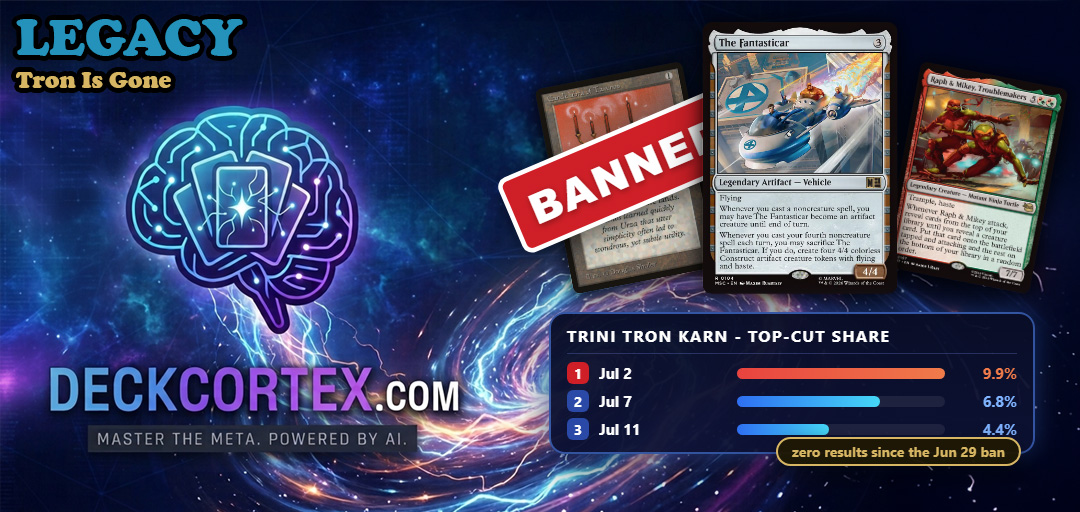
As of July 11, 2026. Three DeckCortex snapshots, taken nine days apart from three different articles, line up into a single chart: Trini Tron Karn's top-cut share — 9.9%, then 6.8%, then 4.4%. That's not noise. It's the Colorless Tron deck disappearing in real time after Wizards banned Candelabra of Tawnos on June 29. And here's the part no single-point comparison catches: in our entire trailing month of results, the most recent Trini Tron Karn decklist to make a top cut anywhere is dated June 28 — one day before the ban. Twelve straight days of Challenges, Leagues, and paper events, and the deck hasn't shown up once.
Tron leaving a hole is the least interesting part of this story, though. Reanimator didn't rush in to fill it — our numbers show it holding a flat 9% across all three windows, because it was already the format's best-converting deck before June 29. What's actually reshaping Legacy is two Universes Beyond cards nobody was talking about a month ago: The Fantasticar, a Fantastic Four vehicle that just became its own tracked archetype out of nowhere, and Raph & Mikey, Troublemakers, a Ninja Turtle that's now the fastest-rising card in Reanimator's whole 83-deck sample.
Three snapshots, one collapsing deck
We didn't set out to build a time-lapse. It fell into our lap: this is the third Legacy dossier DeckCortex has built since late June, and each one pulled the same rolling one-month top-cut sample.
| Built | Window | Sample | Trini Tron Karn | Reanimator | |---|---|---|---|---| | July 2 | Jun 2 – Jul 2 | 856 decks | 9.9% (85 decks, 20.4% conversion) | 9.0% (77 decks, 37.8% conversion) | | July 7 | Jun 7 – Jul 7 | 884 decks | 6.8% (60 decks) | 9.3% (82 decks) — #1 | | July 11 (today) | Jun 11 – Jul 11 | 946 decks | 4.4% (42 decks, 25.0% conversion) | 8.8% (83 decks, 34.15% conversion) |
Each window is a rolling month, so it drops roughly ten old days and picks up ten new ones. As the ban recedes further into every window's past, less of that window is pre-ban Tron — and the share has more than halved in the nine days between the second and third readings alone. Look at `recent_results` instead of the aggregate and the picture sharpens further: every one of the 42 Trini Tron Karn decks counted in today's window predates June 28. Not one Tron list has cracked a published top cut since the ban took effect. One event proves nothing; twelve straight days of MTGO Challenges, Leagues, and paper results producing exactly zero is a pattern.
That's also why you should ignore the naive trend math. Our own trend field reports Trini Tron Karn's `focus_share_6m_pct` at 3.8% against a current 4.4% — nominally up 0.6 points. Don't read that as stability. It's an artifact of period-mixing: today's one-month window still contains eighteen pre-ban days, which is where all 42 counted decks live. The recency of the results, not the aggregate percentage, is the honest signal here.
Wizards' own framing anticipated this. The June 29 announcement — written by Play Design's Carmen Klomparens — didn't just remove a card, it described where the format was heading next: "Reanimator is taking on more of an all-in combo shape, Sneak Attack variants are showing up with big creatures, and there are a few flavors of white creature-based decks that toe the line between grinding and aggression." And on the record for one specific card: "we are aware that the community has taken notice of The Fantasticar. It isn't lost on us that this is a card that plays very well with the fast mana and colorless artifact enablers of Eternal formats." MTGGoldfish's Joe Dyer went further after the fact, in his July 8 column "Beep Beep! Vroom Vroom!": players had been leaving Tron for Fantasticar shells before the ban, "not because of the Candelabra ban" at all. Our data doesn't contradict either read — it just makes the disappearance measurable down to the day.
For the record, Candelabra's solved 16-card core — Ancient Tomb, Planar Nexus, all five Urza's-named lands, Kozilek's Command, Candelabra itself, Disruptor Flute, Grim Monolith, Manifold Key, Karn, The One Ring, Trinisphere, Ugin — was in 100% of every one of those 42 pre-ban lists. Our per-card trend tool still flags Candelabra as a "top gainer" here, and that's not a contradiction: it's measuring the internal composition of a shrinking, entirely pre-ban population, not the archetype's fate afterward. Here's Trini Tron Karn's last recorded appearance in our data — AFX, squeaking into 28th of 32 at the June 27 Legacy Challenge, two days before the axe fell:
Reanimator was never filling a gap
The tidy story would be "Tron got banned, so Reanimator rose to take its place." Our own numbers say that's not what happened. Reanimator sat at 9.0% on July 2, 9.3% on July 7, and 8.8% today — essentially flat, and already the format's #1 by conversion (34.15% to 37.8% of its counted entries reaching a cut, roughly double Tron's rate even before the ban). It didn't rise into the vacuum. It was already there, doing the same thing it's been doing, while the deck next to it fell apart.
What has moved inside Reanimator is the payoff suite. The manabase reads Rakdos with a light blue splash — Badlands, Raucous Theater, Underground Sea, Undercity Sewers — feeding Faithless Looting and the Secrets of Strixhaven workhorse Grave Researcher / Reanimate into a graveyard, then Animate Dead and Shallow Grave to put something back. The bodies coming back are the usual suspects — Griselbrand, Atraxa, Grand Unifier, Archon of Cruelty — but the fastest-climbing card in the entire 83-deck sample, by a wide margin, is Raph & Mikey, Troublemakers: 93.19% presence and a trend slope more than double the next-closest riser.
Here's why a Ninja Turtle earns a slot next to Griselbrand: reanimate it, or hardcast it off six lands, and the moment it attacks you reveal cards off the top of your library until you hit a creature — that creature comes down tapped and attacking alongside it, no reanimation spell required. A 7/7 trample attacker that's also its own second threat is exactly the kind of card that turns a reasonable attack into a two-for-one your opponent didn't budget for. And it's a genuinely safe include, not a novelty: Teenage Mutant Ninja Turtles is Wizards' first Universes Beyond release to ship Standard-legal, which means it's legal everywhere above it too — Legacy, Modern, Vintage, Commander, all confirmed clean on the current banlist. No asterisk, no "wait, is that tournament-legal" moment at a judge's table.
Here's the archetype's current #1, Matiuzzzo's list from a 13-player weekly in Campinas, Brazil:
The Fantasticar: an archetype that didn't exist a month ago
Now the actual breakout. The Fantasticar is a three-mana Legendary Artifact Vehicle out of the Marvel Super Heroes Commander decks: flying, and it can turn into an artifact creature whenever you cast a noncreature spell. Cast your fourth noncreature spell in a turn and you may sacrifice it to make four 4/4 flying haste Constructs — sixteen power out of nowhere, the turn after you've already been casting cheap spells anyway. It costs nothing to keep around and everything to ignore.
A month ago, this card didn't have its own line in our archetype table. On July 2 it isn't in our top 11 at all. By July 7, our sibling dossier on the Marvel set's format impact was tracking it purely as a card — showing up in 111 of 959 checked Legacy decks (11.6%), scattered mostly across Doomsday and Reanimator shells, with no archetype label of its own yet. Today it's consolidated into a distinct, named archetype at 3.8% share — 5th in the format — and its six-month trend comes back `null`, because there's nothing under that name to compare against. The classifier is catching up to a card that spread faster than it could be named.
The shell built around it is a UB(x) cantrip-and-fast-mana tempo deck: Brainstorm, Ponder, and Flow State for selection; Force of Will and Daze to protect the plan; Lotus Petal and Mishra's Bauble for the free acceleration that lets you jam three or four spells in a single turn. The Fantasticar isn't the engine — it's the payoff riding on top of a deck that was already built to chain cheap spells. That's also why it dodges classic storm hate like Mindbreak Trap: you're usually casting it as your second spell of the turn, sacrificing it on your fourth, never sitting in "third spell" territory where a counter is waiting.
The results back up the hype. In a single MTGO League on July 9, The Fantasticar archetype took four of eight published finishes — 1st, 2nd, 4th, and 7th place. It also placed in a 44-player Challenge on the 8th and Leagues on the 6th and 7th. And it's not confined to its own namesake shell: a Legacy Doomsday list running four full copies took first place at Tournament #7 in Osaka on July 4, in the hands of Hiroaki Fukushima — the same cantrip-and-ritual toolbox (Brainstorm, Ponder, Force of Will, Daze, Dark Ritual, Lotus Petal), just aimed at assembling the Doomsday pile instead of a UB tempo clock:
Here's the archetype's own #1 from that July 9 league:
The legality question comes up constantly with any Commander-product card, so let's settle it: The Fantasticar is confirmed Legacy, Vintage, Commander, and Oathbreaker legal, and confirmed not legal in Standard, Pioneer, Modern, or Pauper. It's a Commander-set-exclusive Universes Beyond print, same category as plenty of other genuinely powerful cards that never touch the Standard-legal formats. Its price backs up the demand story, too: our own price check today puts it at $34.63 — up from $28.28 on July 2 and matching an independent $34.63 read from July 7. That's roughly a 22% climb across nine days, tracked three separate times from three separate dossiers, and it moves in exactly one direction: up.
What the ban actually did — and what it didn't
Zoom out to why any of this is happening now. Wizards' stated reason for banning Candelabra wasn't a bad matchup spread — it was a preemptive call on a card whose ceiling worried them more than its recent results did. Joe Dyer's rebuttal in "No More Candles" argued the card wasn't even the real engine — Planar Nexus and threat density (The One Ring, Karn) carried Tron, not the untap effect — and that the ban "won't" bring the deck back in line on its own. Nine days of our own data say he had a point: Tron isn't rebuilding around a Candelabra-less shell. It's gone.
Candelabra's price is the other half of the story, and it's the cleanest confirmation in this whole piece: a Reserved List card losing its competitive home doesn't crash, because the collector and Commander/Vintage demand never left. Our own fresh Scryfall pull today puts the paper printing (Candelabra of Tawnos, Antiquities #43, 1994) at $2,275.12 — independently matching the market figure cited elsewhere — while listing-based trackers still show asks in the $3,500–$4,200 range on thin volume. That spread is real and reflects a card that barely trades hands, not a mispricing; either way, nothing close to a crash. It's still legal in Vintage and Commander, both formats it never left.
The next checkpoint is the August 10, 2026 B&R announcement — the next one after this. Watch two things: whether The Fantasticar, which Wizards already flagged by name as something they're monitoring in Eternal formats generally, draws action in Legacy specifically; and whether Reanimator's steady ~9% share with a 34%+ conversion rate starts reading as the kind of "popular and outperforming" profile that got Tron hit last time.
The rest of the format
Below the top two, Legacy is still recognizably itself. By our own numbers this window: Lands at 4.2% (40 decks), UWx Control at 4.0% (38), Ur Cori-steel at 3.5% (33), Doomsday at 3.4% (32, and now a Fantasticar-adopting archetype as shown above), Dimir Tempo at 3.4% (32), Ub Tempo at 2.5% (24), Sneak Show at 2.4% (23), Beseech the Storm at 2.0% (19), and UR Cutter at 2.0% (19). None of these moved dramatically this month — the story is concentrated entirely at the top of the table.
For outside context (never our own headline number, since the sampling methods don't match ours): mtgdecks.net's trailing-two-month view has Izzet Cutter at 8.13% and Dimir Tempo at 7.14% ahead of Reanimator's 5.19% and Tron's 5.09%, while AetherHub's 180-day window puts Dimir Tempo as high as 14.67% and even tracks a dedicated Fantasticar shell at 2.28%. The differences come down to window length and whether MTGO-only or paper-inclusive data is being counted — not a disagreement about direction. Every external tracker agrees on the one thing that matters here: Tron is down and The Fantasticar is a real, growing presence that wasn't worth tracking a month ago.
Legacy doesn't have a premier event to anchor a piece like this the way Modern has Pro Tour Amsterdam — the next one is Eternal Weekend, October 29 in Pittsburgh. Until then, the format's clock is the B&R calendar and whatever MTGO's Challenges keep producing week to week. Right now, that clock says: one card gone, one card everywhere, and a third one from a Ninja Turtle set quietly becoming a Reanimator staple.
The honest fine print: shares above are DeckCortex's own top-cut share (MTGTop8-sourced published results), not full-field share and not match win rate, which we don't track. "Conversion" is the share of an archetype's counted entries that reached an event's cut — a signal on small samples (as few as 4–16 entries for some rows here), not a precision statistic. The three-snapshot Tron comparison uses three separately-built DeckCortex dossiers (July 2, July 7, and today) pulling the same rolling one-month window each time — real dates, not smoothed. External metagame percentages (mtgdecks.net, MTGGoldfish, AetherHub) and any quoted win rates are attributed to those sources, not DeckCortex data, and use different sampling windows than ours. Prices are Scryfall paper market aggregates, not a live vendor feed.