Modern Before Amsterdam: The Deck to Beat Wears a Very Light Crown
Pro Tour Marvel Super Heroes plays Modern in nine days, and our 2,000-list June corpus shows the metagame the pros are testing against: Boros Energy is the deck to beat at 12.1%, but no deck runs away, dozens of archetypes took trophies, and the combo decks built to punish Boros — Amulet Titan, Belcher, Broodscale — post the best finishes in the format. It shrugged off losing Phlage (The Legend of Roku walked right in), Marvel left exactly three real cards behind, and the last Modern Pro Tour was won by the very kind of combo deck now lurking at the bottom of the table.
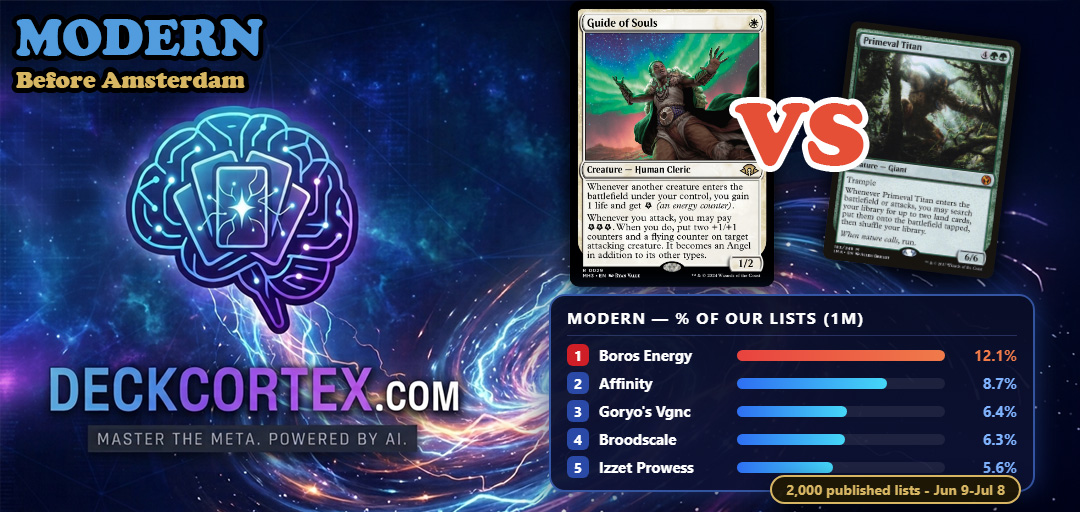
As of July 8, 2026. In nine days the best players in the world sit down at RAI Amsterdam for Pro Tour Marvel Super Heroes, and five of their sixteen Swiss rounds each day are Modern. So this is the metagame the pros are testing against right now, locked in the week before decklists are due — and our tracker's picture of it is unusually flat. Across the 2,000 most-recent published Modern lists (June 9 through July 8, out of 58,110 we track), the most-played deck is Boros Energy at 12.1%, and then the field just… keeps going. Affinity at 8.7%. A reanimation complex that adds up to 11.6%. Broodscale at 6.3%, Izzet Prowess at 5.6%, and a long tail of combo and big-mana decks that each win their share of events. We can name a first-place pilot for 123 event wins across more than a hundred separate tournaments in that window, and no single archetype owns more than a small slice of them. Boros Energy is the deck to beat. It is not the deck that's beating everyone — and the last time Modern crowned a Pro Tour champion, the trophy went to exactly the kind of combo deck built to punish it.
The two announcements that built this format
Modern's shape today was set on May 18, 2026, when Wizards banned Phlage, Titan of Fire's Fury and Lotus Field and unbanned Violent Outburst and Umezawa's Jitte. (Scryfall's current legality data confirms all four — Phlage and Lotus Field banned, Outburst and Jitte legal — which matters because our card proxy's cached legality can lag a B&R by weeks.) Phlage was the removal-plus-lifegain engine holding up Boros Energy and every Jeskai midrange pile; killing it was supposed to knock the energy deck down a peg.
It didn't take. The June 29 announcement left Modern untouched, and Play Design's note is worth quoting because our data agrees with it line for line: Affinity "was already a player in Modern prior to the latest bans," so "it makes sense that it would have a higher starting point than the rest of the format," and the Violent Outburst unban "gave a bit of juice to Living End decks." No Modern changes, in other words, because nothing is running away. The next scheduled B&R is August 10 — three weeks after the Pro Tour, which is the entire point. Wizards has deliberately left the format frozen so the Pro Tour resolves on the metagame players actually built, not one the ban list nudged the week before.
The one thing everyone expected to fall — Boros Energy without Phlage — simply refilled. More on that below, but here's the tell: in our 109-list Boros Energy sample, not one copy of Phlage remains (it's banned), and the card that replaced it, The Legend of Roku // Avatar Roku, is in 92 of them and is the single fastest-rising card in the whole archetype.
The map, once you merge the labels
One methodology note first, because every Modern metagame table you'll read this month — including ours — has the same disease. Archetype labels fragment. Our classifier files the same energy deck under "Boros Energy" and "Boros Aggro"; it splits the artifact deck across "Manufacturing Affinity," "Pinnacle Affinity," and plain "Affinity"; it calls the Basking Broodscale combo "Broodscale" on one feed and "Broodscale Bloodchief" on another — the two labels even share the same event winners. So we merged, and we merged only where the distribution cores matched card-for-card (or where a pilot showed up under both names). What did not get merged: land-destruction "Boros Ponza" is not the energy deck (no Guide of Souls, no Ocelot Pride — it's Cleansing Wildfire and Avengers Disassembled), and the two reanimator shells run genuinely different combos.
Here's Modern in the month before the Pro Tour, one line per real deck. Share is decklist-appearance share of the 2,000 published lists; top-8 rate is how often that deck's lists reached an event's top 8 (a rough performance signal — it runs hot for decks whose results come mostly from paper events that only publish a top 8, and it is not a match win rate, which we don't track).
| Deck | Share of 2,000 lists | Top-8 rate | Outright wins | |---|---|---|---| | Boros Energy | 12.1% (242) | 39.3% | 13 | | Affinity | 8.7% (174) | 48.3% | 11 | | Goryo's Vengeance (reanimator) | 6.4% (127) | 39.4% | 7 | | Broodscale | 6.3% (125) | 46.4% | 9 | | Izzet Prowess (Cutter) | 5.6% (111) | 46.8% | 12 | | Grixis Reanimator | 5.3% (105) | 43.8% | 4 | | Ruby Storm | 4.4% (87) | 28.7% | 4 | | Boros Ponza (land destruction) | 3.8% (75) | 37.3% | 4 | | Amulet Titan | 3.7% (74) | 55.4% | 9 | | UrzaTron | 3.7% (74) | 52.7% | 7 | | Eldrazi Tron | 3.3% (65) | 30.8% | 2 | | Living End | 3.2% (63) | 49.2% | 1 | | Azorius Control | 2.7% (53) | 58.5% | 3 | | Eldrazi Ramp | 1.7% (33) | 51.5% | 2 | | Golgari Yawgmoth | 1.7% (33) | 42.4% | 1 | | Domain Zoo | 1.6% (32) | 43.8% | 3 | | Belcher | 1.5% (30) | 73.3% | 5 |
Below that live Esper and Azorius blink decks, Dimir Control, Hollow One, Death's Shadow, and a dozen one-off brews that each took a trophy. Two ways to read the table depending on how you like to lump: if you fold every reanimation deck together (Grixis Persist plus the Goryo's Vengeance shells) you get 11.6% and a clear number two — but they're two different combos wearing one raincoat, so we don't headline it. Same story if you stack all the Karn/Ugin Eldrazi and Tron piles: 8.6% of big-mana, spread across three land bases.
The shape is the story. Compare our 12.1% Boros Energy against the external trackers you may have seen — mtgdecks.net has it at 9.79%, MTGGoldfish at 12.3%, AetherHub's 90-day window at a scary-looking 15.89% — and the disagreement is all methodology (raw counts vs. paper-weighted vs. a longer window straddling the May bans). Everybody agrees on the shape anyway: one deck around 10–13%, an Affinity deck behind it, and no deck within shouting distance of the ~30% that gets things banned. This is a healthy format, and Wizards clearly thinks so too.
Boros Energy: still king, still refilling
The energy deck is the best-rounded fair deck in Modern and the easiest to pick up, which is most of why it's the volume pick. The engine hasn't changed: Guide of Souls turns every creature you play into a life-and-energy trigger, Ocelot Pride snowballs Cat tokens on any turn you've gained life, and Galvanic Discharge is a one-mana removal spell that hands you three energy and spends only what it needs to kill something. Ajani, Nacatl Pariah // Ajani, Nacatl Avenger — a red-white two-drop, not the mono-white card people misremember — flips into a planeswalker when your Cats start dying, and Ranger-Captain of Eos both tutors up the one-drops and, on sacrifice, stops your opponent casting noncreature spells for a turn, which is how the aggro deck steals games from combo.
What replaced Phlage is the quiet, important part. The Legend of Roku // Avatar Roku is in 92 of 109 lists and rising faster than anything else in the deck: the Saga impulse-draws three cards, then fixes your mana, then flips into a 4/4 that makes four red mana every time it attacks and can vomit out 4/4 Dragons. It is not a Phlage replacement in the "deals 3, gain 3" sense — it's a different card that happens to plug the same hole, giving an aggressive deck a resilient top-end that grinds. The other new tuning: Wrath of the Skies, an energy-scaling board wipe the deck can size exactly to the turn, and a rising Boromir, Warden of the Tower out of the sideboard against the format's spell-based combo. Here's Tia93's July 5 Challenge winner — note the complete absence of Phlage and the full Roku package:
The crown is real but light. On mtgdecks.net's match-win-rate database — the one number DeckCortex doesn't compute, so treat it as their data, not ours — Boros Energy sits around 54% overall, good but nowhere near oppressive, and it splits hard by matchup: a heavy favorite against Izzet Prowess (~61%) and Living End (~62%), roughly even against the Affinity decks, and a genuine underdog to the combo decks that prey on it — around 44% versus Belcher and Golgari Yawgmoth, and as low as ~32% against Simic Neoform. Our own numbers say the same thing from a different angle: Boros Energy wins the most events because it's the most-played deck, but its 39.3% top-8 rate is middle of the pack. The decks above it on that column are the ones you should be scared of.
The other two pillars: Affinity and Prowess
Affinity is the number-two deck and, if anything, the best-positioned deck in the format — 8.7% of our lists, 11 trophies, and a 48.3% top-8 rate that's meaningfully better than Boros Energy's. The shell is the classic Mox Opal plus Urza's Saga artifact engine, but the payoffs are new-school: Kappa Cannoneer is a ward-4 threat that grows and turns unblockable off every artifact you play, Pinnacle Emissary spits out flying Drones, and Weapons Manufacturing turns each artifact into a two-damage bomb waiting to leave the battlefield. It grinds, it goldfishes fast, and it's favored or even against most of the field. When Wizards wrote that Affinity had "a higher starting point than the rest of the format," this is the deck they meant, and our data doesn't argue.
Izzet Prowess is the format's cautionary tale. It's a top-five deck at 5.6% and racks up wins on volume — 12 of them, including a ReCQ at SCG CON Las Vegas — but its reputation outruns its results. It leans on Cori-Steel Cutter, the very card Pioneer banned in May, which is still perfectly legal here and still makes a prowess Monk every time you cast your second spell. Backed by Dragon's Rage Channeler and Slickshot Show-Off, it's fast and it's cheap, but mtgdecks.net has it at a losing ~47% overall and a grim ~39% against Boros Energy — a popular deck that a metagaming pro can safely expect to beat. Popularity and positioning are not the same thing, and Prowess is where they come apart.
The decks built to beat Boros
Here is the part that should have a Pro Tour team's attention, because it's the reason the crown is light. Modern's combo decks are low-population and high-conversion — and the last Modern Pro Tour, Edge of Eternities, was won by a Tameshi Belcher deck going 11-1, precisely because that deck feasts on a Boros-heavy field. The decks positioned to do it again are all right here in our data, quietly posting the best top-8 rates in the format.
Amulet Titan carries a 55.4% top-8 rate — the best of any deck holding a 3%-plus share of the field — on 3.7% of the metagame and nine event wins, including the main event at 4Seasons Spring Edition in Bologna, one of the largest European paper tournaments of the month. It's the purest "your removal doesn't matter" deck in Modern: Amulet of Vigor untaps the bounce lands as they enter, Spelunking makes them all come in ready, and Summoner's Pact fetches Primeval Titan to end the game a turn before a fair deck is set up. When a deck this linear posts a top-8 rate this high, it's telling you the field isn't respecting it. Epreez's July 7 Challenge win is the current template:
Belcher posts an eye-watering 73.3% top-8 rate — inflated by paper events that only publish their top 8, but still, five wins in a month across MTGO and RCQs in Italy, Colombia, and Brazil is a real signal. This is the Edge of Eternities champion archetype: fire off Goblin Charbelcher with almost no lands in the deck (the "lands" are modal double-faced spells like Sink into Stupor and Jwari Disruption), reveal your whole library, and deal lethal in one shot, with Tameshi, Reality Architect rebuilding and Whir of Invention tutoring the Belcher. It is the deck a pro brings specifically to punish a room full of fair aggro:
Broodscale is the format's would-be number two if you count it generously — 6.3% and nine wins, built on the Basking Broodscale plus Glaring Fleshraker engine that loops Eldrazi Spawn tokens and +1/+1 counters into arbitrary damage, with Kozilek's Command as the flexible glue and Emrakul, the Promised End as the fair-deck's-nightmare top end. Golgari Yawgmoth (1.7%) is the grindy predator — Yawgmoth, Thran Physician plus Grist, the Hunger Tide and Agatha's Soul Cauldron — and it's another deck mtgdecks.net has favored against Boros. And Ruby Storm (4.4%) is the glass cannon: Ruby Medallion, a pile of rituals, Past in Flames, and a new Marvel card doing real work, which we'll get to.
Reanimation, big mana, and the fair middle
The second-biggest bloc in Modern, if you're willing to lump, is reanimation. Our two shells — Grixis Reanimator (5.3%), which reanimates Archon of Cruelty off Persist and Emperor of Bones with Psychic Frog as the disruptive beater, and Goryo's Vengeance (6.4%), which flashes Goryo's Vengeance back a hasty Griselbrand or Atraxa, Grand Unifier — add up to 11.6% of the field. They pull in opposite directions (one grinds, one goldfishes turn three), which is why we keep them apart, but together they sit just behind the energy deck as the format's second-largest force.
The Karn/Ugin big-mana decks are the other 8.6%: Eldrazi Tron and UrzaTron both lean on Ugin, Eye of the Storms, Karn, the Great Creator, and Thought-Knot Seer to break parity, while Eldrazi Ramp goes greener with Sowing Mycospawn to fetch and destroy lands. Living End (3.2%) got its "bit of juice" from the Violent Outburst unban exactly as Wizards said — cascade into the Living End, reset the board, and back it up with free Subtlety and Endurance. And the fair blue decks are alive and well: Azorius Control posts the format's best top-8 rate of any non-combo deck (58.5%) on Teferi, Time Raveler and Wrath of the Skies, and an Esper blink deck actually won the Modern RC Super Qualifier. Boros Ponza (3.8%) rounds out the top tier as the format's land-destruction deck, and it's the home of one of the three Marvel cards actually doing something in Modern.
Marvel Super Heroes in Modern: three cards, not thirty
The preview-season hype said Marvel Super Heroes would reshape Modern. It didn't — but three cards genuinely landed, and it's worth being precise about which. The biggest footprint is Hex Magic, the Storm deck's new reset button — it's in 58 of 74 Ruby Storm lists, an Arcane sorcery that exiles your hand, draws that many fresh cards, and still lets you play the exiled ones until your next turn: a massive mid-combo refuel that nearly doubles your resources. Second is Avengers Disassembled in the land-destruction deck, at 36 of 62 Boros Ponza lists: a three-mana sorcery that either sweeps the board for three or blows up a land, which is exactly the flex a Blood Moon deck wants.
The one to watch is Loki, God of Mischief — a mono-blue two-drop that draws a card whenever you target something with an ability, which in an Affinity deck full of Mishra's Baubles and Emry activations is a real card-advantage engine. It's still emerging, in only about 11 Affinity lists, but Deathmaxx already won an MTGO Challenge with it, and a Challenge trophy is how these things go from "spice" to "staple." Here's that list — the first Modern trophy for the configuration:
Everything else Marvel promised Modern — the big legends, the equipment, the planeswalkers — is nowhere in our data. Three cards found homes in decks that already existed. That's a normal, healthy set impact, not a format-warping one, and it's the opposite of what the previews sold.
What it means for Amsterdam
Unlike Pioneer — a format we recently described as competitively healthy but starved of events — Modern is where the premier-play energy actually is right now. Our June sample is packed with Regional Championship Qualifiers on four continents, a Modern RC Super Qualifier, the Champions Cup in Osaka, 4Seasons in Bologna, SCG CON Las Vegas. The RCQ season runs through Modern, and the Pro Tour plays Modern. This isn't a fringe data set; it's the format the competitive world is grinding.
Decklists lock on July 15 and go public July 17, so nobody's Pro Tour Modern deck is knowable yet — what follows is inference, not a leak. The safe read: Boros Energy will be the single most-registered deck, because it's the best-rounded, easiest-to-pilot fair deck, and because this Pro Tour's Top 8 is a Marvel draft (the first Limited Pro Tour Top 8 in about fifteen years, per Wizards' coverage), which pushes pros toward a low-variance Modern deck they can pilot to a Day 2 conversion while they save their real prep for the draft. Expect Affinity and Prowess as the other two pillars. And expect the sharpest teams to attack a known Boros field from the combo angle — Amulet Titan, Broodscale, Belcher, Ruby Storm — because that's the lane our top-8 rates say is open, and because it's how the last Modern Pro Tour was actually won.
Bottom line
If you're registering a Modern deck this month: the volume pick is Boros Energy, and it's a fine one — biggest share, thirteen trophies, and it survived losing Phlage without blinking because Roku walked right in. The sharp pick is a combo deck aimed at it. Amulet Titan has the best top-8 rate of any deck with real field share, and a paper main event to show for it; Belcher is the deck that already won a Modern Pro Tour on this exact plan; Broodscale is a coin-flip-fast engine hiding inside a 6% share. And the deck to respect quietly is Affinity — number two, best-positioned, and the one card Wizards name-checked as the format's real winner.
The number to watch isn't on the B&R page until August 10. It's whether Amsterdam's Modern Top 8 — well, its Swiss, since the Top 8 is a draft — is a wall of Boros Energy, or whether a combo deck breaks through one more time and turns the "deck to beat" into the deck that got got.
The honest fine print: shares are decklist-appearance shares of the 2,000 most-recent published Modern lists tracked by DeckCortex, June 9–July 8, 2026 (MTGO Challenge standings from mtgo.com, MTGTop8-hosted events including paper RCQs, and MTGO 5-0 leagues), out of 58,110 Modern lists tracked overall. Published lists over-represent decks that finish well, and full-standings events, top-8-only paper events, and league 5-0 dumps are pooled, so a deck's "top-8 rate" here is a rough performance signal, not a match win rate — which DeckCortex does not track. Archetype labels were merged only where distribution cores matched card-for-card or a pilot appeared under both labels (Boros Energy + Boros Aggro; the three Affinity labels; the Broodscale pair; the two Prowess labels; the reanimator families). Match win rates and the external metagame percentages (mtgdecks.net, MTGGoldfish, AetherHub, magic.gg) are attributed to those sources and not reproduced from our corpus; DeckCortex is itself a metagame source and the shares above are ours. Pro Tour Marvel Super Heroes details (July 17–19 at RAI Amsterdam, Modern Constructed plus Marvel Super Heroes Booster Draft, 16 Swiss rounds, a Booster Draft Top 8, $500,000 prize pool, decklists due July 15) are per magic.gg; the "first Limited Pro Tour Top 8 in ~15 years" framing and the Edge of Eternities result are per Wizards' event coverage. Phlage, Titan of Fire's Fury and Lotus Field are banned in Modern and Violent Outburst and Umezawa's Jitte are legal per the official B&R list, cross-checked against Scryfall; our proxy's cached legality can lag announcements. Card prices are Scryfall paper aggregates as of July 8, 2026. The Marvel scan (Hex Magic, Avengers Disassembled, Loki) is from archetype distributions plus spot-checked winning decklists.