Nothing Rotates: Premodern, Vintage, and the 2,443-Card Gap
Premodern and Vintage both refuse to rotate — and in the last twelve months one of them gained 2,443 cards while the other gained none. We put 15,417 Premodern and 17,398 Vintage lists through our own corpus, and the two formats answer that in opposite directions: Premodern's most-played card sits in 0.6% of main decks, a land printed in 2021 beats Ancestral Recall on play rate in Vintage, and there's a $4.88 Ancestral Recall that exactly zero Vintage decks want.
Nothing Rotates: Premodern, Vintage, and the 2,443-Card Gap
Every format that refuses to rotate still has to decide what to do with Magic's new cards, and no two decide it more differently than Premodern and Vintage: one hasn't admitted a single card printed after 2003, the other absorbed 2,443 new cards in the last twelve months alone. We had never published a word about either, so we pointed the corpus at them — 15,417 Premodern lists and 17,398 Vintage lists — and spent a day reading what came back. Premodern turns out to be a format whose most-played card is in almost nobody's main deck. Vintage keeps practically the whole history of the game on the table, and the newest cards win anyway. And there's a $4.88 Ancestral Recall that exactly zero Vintage players want.
The two pools
Premodern's card pool closed twenty-three years ago and stayed closed. Scryfall lists 5,375 Premodern-legal cards, and the number of those first printed after Scourge (May 26, 2003) is zero — we checked, because a pool that never moves is the whole premise. Thirty-three cards are banned on top of that.
Vintage's pool is the opposite proposition: 31,534 legal cards, 101 banned, 51 restricted to a single copy. Of those legal cards, 2,443 were printed for the first time in the last twelve months (1,506 of them in 2026 alone). Neither format rotates. One of them takes on more than 200 new cards a month; the other takes on none.
That gap is the whole article. Everything below is what two formats do with it.
Premodern's most-played card is in 0.6% of main decks
Here is the top of the Premodern card list, ranked by how many decklists a card appears in anywhere across the 75 — main deck plus sideboard (n=6,552 lists, January 27 to July 26, 2026, our corpus):
| # | Card | % of 75s | Lists | |---|---|---|---| | 1 | Tormod's Crypt | 46.4% | 3,040 | | 2 | Swords to Plowshares | 38.9% | 2,552 | | 3 | Naturalize | 32.0% | 2,097 | | 4 | Wasteland | 30.1% | 1,975 | | 5 | Wooded Foothills | 27.2% | 1,783 | | 6 | Hydroblast | 26.5% | 1,735 | | 7 | Tsabo's Web | 25.4% | 1,661 | | 8 | Counterspell | 24.9% | 1,629 | | 9 | Annul | 24.2% | 1,586 | | 10 | Mishra's Factory | 23.6% | 1,546 |
Read that list again and notice what's missing: threats. The most-played card in Premodern is a free artifact that exiles a graveyard. Seven of the top ten are answers and the other three are lands. Then run the same query against main decks only, and the format falls apart in the most informative way:
| Card | % of 75s | % of main decks | Main-deck lists | |---|---|---|---| | Tormod's Crypt | 46.4% | 0.6% | 41 | | Hydroblast | 26.5% | 0.1% | 4 | | Blue Elemental Blast | 22.6% | 0.0% | 3 | | Red Elemental Blast | 21.1% | 0.0% | 1 | | Annul | 24.2% | 1.7% | 112 | | Tsabo's Web | 25.4% | 6.2% | 409 | | Naturalize | 32.0% | 15.6% | 1,022 | | Counterspell | 24.9% | 24.8% | 1,624 | | Swords to Plowshares | 38.9% | 36.2% | 2,373 |
Tormod's Crypt is the format's number one card and it is in 41 main decks out of 6,552. Nearly half of Premodern brings graveyard hate to the tournament and almost none of them start the game with it. Same story for Hydroblast and the Blasts: about a quarter of the field packs them, and single-digit numbers of decks play them in game one.
This is what twenty-three years without a new printing converge to. Nobody is waiting for a new answer, because there won't be one. The threats are known, they're the same threats they were last year, and the community has settled on the exact hate that beats each of them — Tsabo's Web for the Wasteland-and-Rishadan-Port manabases, the Blasts for the red and blue decks, Crypt for the graveyard. Premodern isn't a format with sideboards. It's a format that mostly is a sideboard, with a main deck attached.
The one card that shrugs at all of this is Swords to Plowshares. One mana, exile the creature, hand them the life — it's been the best removal spell in the pool since 1993 and it's played maindeck in 36.2% of the format. Some things don't need iterating on.
What Premodern actually plays
No archetype breaks ten percent of the field (n=6,550 lists, same window):
| Deck | Share | Lists | |---|---|---| | Stiflenought | 9.7% | 638 | | Goblins | 7.1% | 463 | | Enchantress | 6.9% | 453 | | Sligh (RDW) | 5.5% | 361 | | Landstill | 5.0% | 329 | | Replenish | 4.7% | 311 | | Terrageddon | 3.3% | 217 | | Full English Breakfast | 2.5% | 164 | | The Rock | 2.4% | 160 | | Stasis | 2.4% | 158 | | Moneyball Black | 2.4% | 158 | | Oath of Druids | 2.4% | 154 | | Elves | 2.2% | 143 | | Mono Black Aggro | 2.2% | 143 |
Those fourteen labelled archetypes cover 3,852 lists — 58.8% of the format. The other 41.2% sits outside those fourteen labels, a long tail of smaller decks, which in a format this old means a lot of people are still building their own thing. A 9.7% best deck is a metagame with room in it.
The best deck is also the one that best explains why people play this format. Stiflenought's plan is Phyrexian Dreadnought, a 12/12 trample artifact creature for a single generic mana whose entry trigger reads "sacrifice it unless you sacrifice any number of creatures with total power 12 or greater." You have no such creatures. So you cheat: Stifle counters the trigger outright, or Vision Charm phases the artifact out in response, and a phased-out permanent is treated as though it doesn't exist — nothing to sacrifice. It phases back in before your next untap step, and phasing in isn't entering the battlefield, so the trigger never comes back. Turn two, 12/12, trample, backed by Counterspell and Foil.
The other thing worth knowing about Premodern is what it can't do, and this is where the ban list matters more than the calendar. Brainstorm is banned. Force of Will is banned. So are Vampiric Tutor, Necropotence, Balance and Mind Twist. You can see the bans in the data without being told: Force of Will and Vampiric Tutor appear in zero of 6,552 lists, and Brainstorm in exactly one. Take the free counterspell and the best cantrip in Magic away from a format, and blue has to actually pay for its interaction — which is why Premodern's blue decks run Impulse, hard Counterspell and the pitch-counter Foil instead of the Brainstorm-and-Force package everyone recognises.
Vintage: 31,534 cards on the table, and the new ones win anyway
Vintage's most-played cards are exactly who you'd expect. Across 4,951 lists in the same window, Black Lotus shows up in 90.3% of them, Mox Sapphire in 90.0%, Mox Jet in 89.2%, Mox Pearl in 79.9%, Mox Emerald in 70.2% and Mox Ruby in 66.4%. Ancestral Recall and Time Walk are both at 59.2%. Every one of those cards is restricted to a single copy, and nine decks in ten still find room for the Lotus.
Then look at what's mixed in among them:
| Card | First printed | % of 75s | |---|---|---| | Urza's Saga | 2021 (Modern Horizons 2) | 68.8% | | Vexing Bauble | 2024 (Modern Horizons 3) | 67.4% | | Consign to Memory | 2024 (Modern Horizons 3) | 36.1% | | Lórien Revealed | 2023 (Tales of Middle-earth) | 34.6% | | Stock Up | 2025 (Aetherdrift) | 27.5% | | Tezzeret, Cruel Captain | 2025 (Edge of Eternities) | 23.2% | | The One Ring | 2023 (Tales of Middle-earth) | 23.2% | | Talon Gates of Madara | 2024 (Modern Horizons 3 Commander) | 21.7% | | Psychic Frog | 2024 (Modern Horizons 3) | 20.0% | | Glaring Fleshraker | 2024 (Modern Horizons 3) | 14.4% |
Urza's Saga is in more Vintage decks than Force of Will (67.4%), more than Mox Ruby (66.4%), and more than Ancestral Recall or Time Walk. A land from 2021, above three of the nine most famous cards in the game. Vexing Bauble — a one-mana artifact that counters any spell cast for no mana, which in this format means the Moxen, Force of Will's alternative cost and Mental Misstep — is restricted to one copy, and it's still in two thirds of the field.
And the counter-example is sitting right there in the same data: Library of Alexandria is in 0.3% of Vintage lists. Fourteen decks. It's from Arabian Nights, it's restricted, it draws a free card every turn you keep exactly seven in hand, and the format has moved so far past it that it may as well not be legal. Being old and restricted is not the same as being good.
The deck that most cleanly shows what modern Vintage looks like is the Workshop end of the format. Mishra's Workshop appears in 30.4% of all lists, the single biggest deck-defining card in the format after the artifact mana itself. Here's a Workshop list from the July 25 Vintage Challenge — four Workshops, and then four copies each of cards printed in 2024, 2025 and 2026:
To be fair to Premodern, Vintage has the universal-hate reflex too — Grafdigger's Cage sits in 46.0% of 75s and 1.5% of main decks, which is Tormod's Crypt's pattern at nearly the same numbers, and Mindbreak Trap (59.9% → 16.1%) and Consign to Memory (36.1% → 3.5%) live the same double life. The difference is what sits above the hate. Run the maindeck cut that decapitated Premodern's ranking and Vintage's top barely twitches: Force of Will 67.4% → 67.3%, Vexing Bauble 67.4% → 67.1%, Mental Misstep 62.6% → 60.2%. Premodern's most-played cards are its answers; Vintage's are its engine.
The $4.88 Ancestral Recall nobody plays
Secrets of Strixhaven, released April 24, 2026, contains 36 cards with the prepare layout — a creature on the front, a spell on the back, with reminder text that reads "This creature enters prepared. (While it's prepared, you may cast a copy of its spell. Doing so unprepares it.)" Most of the backs are new spells, but a chunk of them are the classics themselves: there's a prepare-Ancestral Recall, a prepare-Brainstorm, a prepare-Demonic Tutor, a prepare-Swords to Plowshares, even a prepare-Lightning Bolt. And crucially, these cards are their own cards: Emeritus of Ideation // Ancestral Recall is legal in Vintage, not restricted, so you can play four.
Front half is a 5/5 with flying and ward that enters prepared; while it's prepared, you may cast a copy of Ancestral Recall. Four copies cost about $4.88 each. The real Ancestral Recall is one copy, restricted, and the cheapest tournament-legal paper printing runs $4,999.95.
Vintage's answer, across 4,951 lists: zero. Not a low number — none. Same for the prepare-Brainstorm (Harmonized Trio // Brainstorm), the prepare-Demonic Tutor and the prepare-Swords. We spot-checked eleven of the 36 against both eternal corpora, and the only one with real adoption in either is Grave Researcher // Reanimate — and its home is Legacy (7.7% of 11,906 lists), not Vintage (0.6%). Vintage looked at a five-mana body stapled to the best card in Magic and decided five mana is five mana. Meanwhile the actual Ancestral Recall is still in 59.2% of decks.
Where these two formats actually live
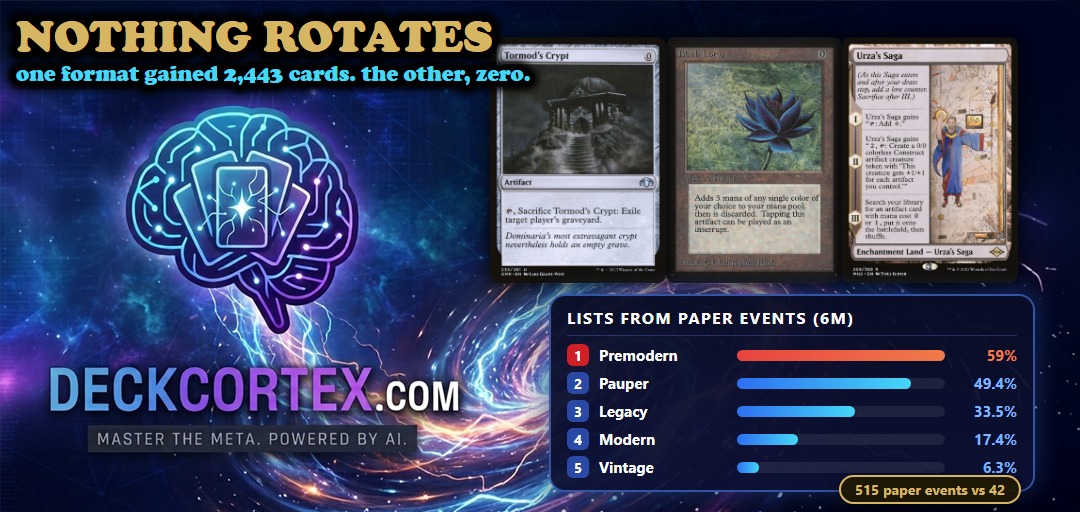
Here's the number we didn't expect. Our corpus records the event each list came from, and paper events in it are consistently named `<Event> @ <Store> (<City>)` while online ones never carry that marker. Split the last six months that way:
| Format | Lists (6m) | Distinct events | Paper events | Lists from paper | |---|---|---|---|---| | Duel Commander | 5,385 | 622 | 617 | 85.2% | | Premodern | 6,552 | 571 | 515 | 59.0% | | Pauper | 16,374 | 1,360 | 1,174 | 49.4% | | Legacy | 11,906 | 529 | 503 | 33.5% | | Standard | 13,541 | 340 | 324 | 22.4% | | cEDH | 57,492 | 3,566 | 1,136 | 17.8% | | Modern | 18,197 | 440 | 422 | 17.4% | | Vintage | 4,951 | 51 | 42 | 6.3% | | Pioneer | 8,568 | 83 | 75 | 5.4% |
Only Duel Commander draws more of its lists from store events than Premodern does, and only Pioneer draws fewer than Vintage. Look at the event counts rather than the percentages and the gap gets starker: Premodern's six months span 515 distinct paper tournaments, from Buenos Aires to Spezzina to a North American Championship in Cambridge, Massachusetts. Vintage's span 42 — and 2,921 of its 4,951 lists come from one recurring online tournament. One honesty note: this measures where published lists come from — play that never posts a decklist is invisible to any corpus, in both formats. Still: two formats where nothing rotates, at opposite ends of the "does anyone actually sit down with these cards" question.
It isn't a mystery why. Premodern's cards are cardboard you can buy. Vintage's are an asset class.
What it costs to show up
We priced four real lists from the window, card by card, at the cheapest tournament-legal paper printing of each (Scryfall paper aggregate, July 26, 2026 — not a live TCGPlayer feed):
| Deck | Format | Full 75 (USD) | |---|---|---| | Goblins (radegasek, MTGO League, July 24) | Premodern | $192.96 | | Stiflenought (Nhithold, MTGO League, July 23) | Premodern | $1,322.87 | | Dredge (therock988, Vintage Challenge 32, July 25) | Vintage | $8,340.71 | | Fleshraker MUD (tao_bye_bye, Vintage Challenge 32, July 25) | Vintage | $29,406.37 |
A couple of notes on those numbers, because they're doing a lot of work. Premodern's best deck costs almost seven times its second-most-played deck, and nearly the entire difference is four copies of Phyrexian Dreadnought at $277.53 each — $1,110 of a $1,323 deck. If Stiflenought is out of reach, Goblins is 463 lists deep in the same metagame for under $200.
On the Vintage side, Dredge's $8,341 is mostly four Bazaar of Baghdad at $1,925.24 apiece, and that's the budget option. The Workshop deck's $29,406 is the honest floor, not the ceiling: it excludes Black Lotus, Mox Sapphire and Mox Ruby entirely, because Scryfall carries no current paper price for any tournament-legal printing of those three. Four Mishra's Workshop alone are $12,004.
That's the answer to why fewer than one in fifteen of our Vintage lists comes from a store event. Nobody is sleeving up a five-figure deck for a Tuesday. The format is thriving — it just isn't thriving in a shop.
Two answers to the same question
Freeze a card pool and the format optimises inward: Premodern players are solving a puzzle that got its last new piece in 2003, and the solution so far is a nearly-universal sideboard plus fourteen distinct decks nobody can quite kill. Open the pool to everything and the format optimises outward: Vintage will play the strongest card printed last month regardless of what 1993 already offered, and then restrict it — Urza's Saga and Vexing Bauble are both restricted to one copy already, and both are still in more than two thirds of the field.
The one thing neither format does is stand still. If you want to see that for yourself, both corpora are in DeckCortex — every deck embedded above is clickable, sideboard and all. And if the "one card, several formats" angle is your thing, Consign to Memory turns up here at 36.1% of Vintage lists and it's the most-played answer in Legacy too: Consign to Memory, the One-Mana Answer.
The data. All DeckCortex figures are decklist-appearance shares over our own scraped tournament corpus (MTGO and MTGTop8 feeds), window January 27 – July 26, 2026. Card presence is quoted over n=6,552 Premodern and n=4,951 Vintage lists; archetype shares come from a separate aggregation with a slightly smaller denominator (n=6,550 and n=4,753) and are never mixed with card figures in the same claim. "% of 75s" counts a card appearing anywhere in main deck or sideboard; "% of main decks" excludes the sideboard. These are appearance shares, not match win rates — we don't track those — and not conversion rates, which aren't computable from placed lists. Vintage's three separate Lurrus archetypes were checked against each other and left unmerged: they share a companion, not a deck. Sub-0.5% figures in this corpus contain a little scraping noise, so we read near-zero as zero. The paper-versus-online split is a heuristic on event names and undercounts paper events named without a venue marker. Card pool sizes, legality and first-printing dates are Scryfall, July 26, 2026; prices are Scryfall paper market aggregate for the cheapest tournament-legal paper printing, same date, and will move.