Pioneer in July 2026: The Healthiest Format Wizards Aren't Watching
The June 29 B&R gave Pioneer a single line — "No changes" — and our 607-list June corpus shows why: post-Cutter-ban Pioneer has no deck above 15.2%, four different archetypes taking trophies, and real games again. It also shows what the announcement didn't say: Greasefang won six of the ten June events we can name a winner for at a 46.2% top-cut conversion, and the format's biggest problem isn't on the banlist — it's the empty premier-play calendar.
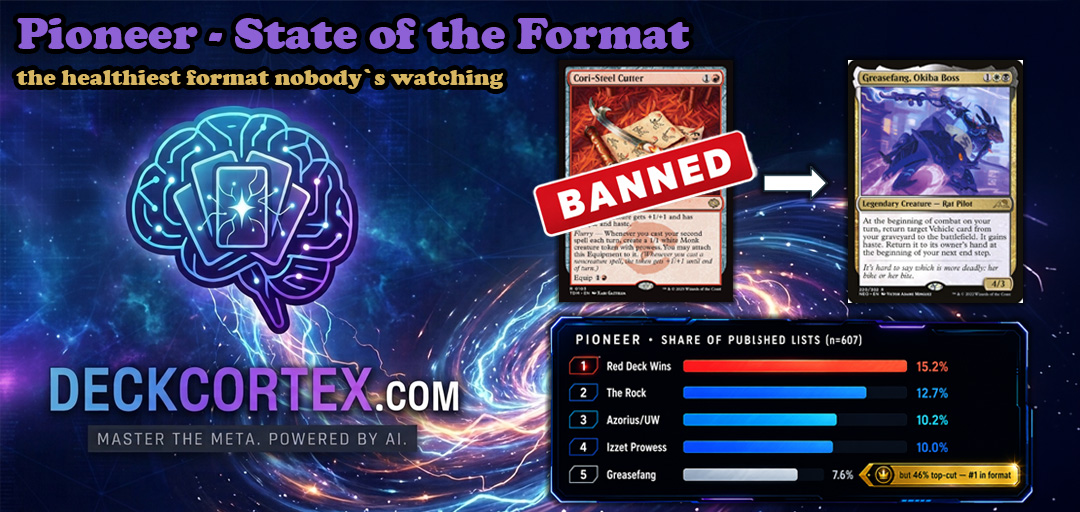
As of July 2, 2026. The June 29 Banned & Restricted announcement gave Pioneer exactly one line — "No changes" — and for once that reads as a compliment, not neglect. The announcement that actually built this format landed six weeks earlier: on May 18, Wizards banned Cori-Steel Cutter, and the Izzet deck that had spent spring compressing every game into the same fifteen minutes gave the format back. Our tracker's June window — 607 published tournament lists, June 2 through July 2 — shows what grew in the space: no deck above 15.2% of published lists, four different archetypes taking trophies, and a genuine argument about what the best deck even is. WotC's own June 29 note called it "a well-spread metagame with no single strategy running away with things." The shares agree. The trophies are less diplomatic: Greasefang pilots won six of the ten June events we can put a winner's name on, and the deck converts its counted entries into top cuts at 46.2% — nearly half. The metagame is wide open. The winner's circle has a rat problem.
Two announcements, one story
The May 18 reasoning was unusually blunt for a B&R note:
"Cori-Steel Cutter is the clear power-level and play-pattern outlier. The pressure and resilience this card provides the Izzet decks has compressed games too much, leaving decks in Pioneer insufficient breathing room."
Our label-level trend data is that paragraph in numbers. The classifier's "UR Cutter" archetype averaged 13.5% of published lists over the trailing six months and sits at 7.2% for June — the biggest fall of any label. Red Deck Wins went the other way, 8.9% to 15.2%, the biggest rise. The Rock climbed 9.9% to 12.7%, Azorius Control 4.0% to 6.4%. One ban, and every fair deck in the format exhaled at once.
June 29 then left Pioneer alone, with a sentence worth quoting because it names the new top dog: "Pioneer has been in a healthier place since the earlier ban of Cori-Steel Cutter, with Badgermole Cub midrange leading a well-spread metagame and no single strategy running away with things." The same announcement banned Candelabra of Tawnos in Legacy and Seeker of Skybreak in Pauper (we covered both separately) plus six cards in Brawl. Next scheduled window: August 10, four days before The Hobbit set releases.
One footnote on the rumor mill, because the pre-announcement discourse deserves a receipt: the ban-candidate lists floating around named Amalia Benavides Aguirre, Guide of Souls, and Treasure Cruise. Amalia has been banned for ages — Scryfall will happily confirm it. Treasure Cruise is real and doing Phoenix things in 27 of 32 lists. And Guide of Souls is a Modern Horizons 3 card that has never been legal in Pioneer for a single day. When a rumor list includes a card that can't legally be banned in the format, you're allowed to stop reading.
The map, once you fix the names
First, the methodological mess, because every Pioneer meta table you'll see this month — including ours — has it. Archetype labels fragment. Our classifier files the same deck under different names depending on which feed a list arrived through: PedraStone's June 28 third-place list is "UR Cutter" from the mtgo.com side, and his identical-core June 26 list is "UR Aggro" from the MTGTop8 side. It gets better: those forty-four June "UR Cutter" lists contain, as far as we can check, zero copies of Cori-Steel Cutter — the card has been illegal since May 18. The label outlived the card by six weeks and counting. (MTGGoldfish's default window doing the same thing at scale is how you get the "Izzet Prowess 36.9%" number still circulating — a merged, pre-ban-contaminated figure that describes a format that no longer exists.)
So we merged, and we verified every merge on distribution cores and cross-feed pilots before quoting it — same-core checks, same player under both labels. Here's Pioneer in June, one line per actual deck:
| Deck (labels merged) | Share of 607 published lists | Top-cut conversion | |---|---|---| | Red Deck Wins | 15.2% (92) | 27.8% (72 counted entries) | | The Rock (Golgari Midrange) | 12.7% (77) | 32.3% (62) | | Azorius/UW Control | 10.2% (62) | 29.3% (12 of 41) | | Izzet Prowess (incl. "UR Cutter"/"UR Aggro") | 10.0% (61) | 20.0% (9 of 45) | | Greasefang (Orzhov + Abzan) | 7.6% (46) | 46.2% (12 of 26) | | Dimir Aggro | 7.2% (44) | 19.4% (31) | | Izzet Phoenix (incl. "Arclight Phoenix") | 6.4% (39) | 33.3% (10 of 30) | | Devotion to Green | 3.3% (20) | 28.6% (14) | | Simic Scapeshift | 3.1% (19) | 10.5% (19) | | Lotus Field | 2.8% (17) | 0% (4) | | Izzet Control | 2.6% (16) | 31.3% (16) | | Selesnya (Company/Aggro) | 2.3% (14) | — |
Conversion is the share of a deck's counted entries that reached an event's cut — small samples, and not a match win rate, which we don't track. Below the table live Rakdos Midrange (a real deck on a fuzzy count, somewhere in the 2–4% band), Niv-Mizzet Reborn, Mono-Black Control, Boros builds, and one brave Spider-tribal White Weenie we'll get to.
Two honest deltas against the external trackers you may have read: their "2-month" and "90-day" windows straddle the May 18 ban, so their Izzet and Greasefang shares run hotter than our clean post-ban month. And Selesnya Company — 7% on mtgdecks.net's long window — is 2.3% in our June corpus. Some of that is window, some of it might be the deck cooling off; our data can't split those, so we say so instead of picking the convenient story.
The trophy case has a rat problem
Winners for the June events in our corpus, every one we can name:
| Date | Event | Winner | Deck | |---|---|---|---| | Jun 7 | MTGO Challenge | chevetteprateado | Izzet Phoenix | | Jun 12 | MTGO Challenge (44 players) | Mathilde8 | UW Control | | Jun 14 | MTGO Challenge | zippzipp_ | Greasefang | | Jun 14 | MTGO Challenge | taldoitalo | Greasefang | | Jun 19 | MTGO Challenge (46 players) | Hamuda | Greasefang | | Jun 22 | Weekly, Katowice, Poland (paper, 8 players) | Dariusz Pastuszka | Greasefang (Abzan) | | Jun 26 | MTGO Challenge (44 players) | rushi_00 | Greasefang | | Jun 27 | Spirit of Pioneer, Yaroslavl, Russia (paper, 16 players) | Dmitry Konoplev | Azorius Control | | Jun 28 | MTGO Challenge | kaikas | The Rock | | Jun 28 | MTGO Challenge | Hamuda | Greasefang (Orzhov) |
Six of ten to one family, including Hamuda winning twice in nine days on two different builds. Pair that with the conversion column — 46.2% of counted Greasefang entries reached a cut, thirteen-plus points clear of anything else in the top tier — and the "no runaway deck" framing needs a footnote: nothing is running away with the field, but something is quietly running away with the hardware, on a 7.6% share that means most rooms still aren't teched for it. That's the classic profile of the actual best deck.
For completeness: coverage of the June 21–28 stretch reports seven Challenges with six different winners, including UW Control (\VFS\), a "Tablet" control brew (\Batutinha\), Red Deck Wins (sandydogmtg), and two PedraStone wins on the Izzet shell. Our scraper holds three of those seven events, and where we overlap we mostly agree — rushi_00's and Hamuda's wins check out list-for-list. One correction from the primary source, though: in the second June 28 Challenge our scrape of the mtgo.com standings has kaikas winning on The Rock, with PedraStone fourth. And that diversity framing is real as far as it goes — across the three late-June events we hold in full, the top 8s contained eight-plus distinct archetypes, with Strongmind putting Dimir Aggro into both June 28 cuts (a second and a fifth). Wide field, narrow winner's circle. Both things are true, and a good July gauntlet plans for both.
The decks that matter
Red Deck Wins — 15.2%, the ban's biggest winner. Forget the list you played against in April. The hundred-list June core, present in literally every one: Emberheart Challenger, Monastery Swiftspear, Screaming Nemesis, Sunspine Lynx, Burst Lightning, Monstrous Rage, Reckless Rage, and Kumano Faces Kakkazan // Etching of Kumano. The two four-drops are the deck's whole thesis: any damage dealt to Nemesis gets thrown at something else, and a player hit that way can't gain life for the rest of the game; Lynx shuts off lifegain for everyone and fines greedy manabases on arrival — against a Rock board with four nonbasics in play it shows up with four bonus damage attached, and the point it deals you for your own nonbasics is a rounding error in a deck this fast. The Legend of Roku // Avatar Roku in 88 of 100 lists is the new grind engine (impulse three cards, ritual, then a 4/4 that makes every attack), and the tech riser is Hexing Squelcher at 47 of 100 — uncounterable itself, it makes all your spells uncounterable and taxes removal on your whole board. A two-mana 2/2 aimed straight at the format's rising control share, already a $19 card.
The Rock — 12.7%, the deck WotC named. "Badgermole Cub midrange" is accurate: Badgermole Cub is in 88 of 89 lists, and the announcement-name treatment has consequences — it's a $48.63 uncommon now. The Cub earthbends a land into a 0/0 creature with a +1/+1 counter and then makes every creature you tap for mana produce an extra , which turns a pile of removal and four-drops into a deck that's a turn ahead of its curve. Around it: Thoughtseize, Fatal Push, Sheoldred, the Apocalypse (a $95 card these days), and the two new engines — Professor Dellian Fel in all 89 lists (a Golgari planeswalker whose 0 is "draw a card, lose 1 life" and whose −3 is a clean Murder) and Unholy Annex // Ritual Chamber in 87. The Annex line is the cutest rules text in the format: the Room draws you a card on each of your end steps, and drains each opponent for 2 if you control a Demon — and an activated Mutavault is every creature type, Demon included, so the manland flips your end step from "lose 2" to "drain 2" without spending a card. Graveyard Trespasser // Graveyard Glutton (85 of 89, flagged as a top gainer) is the maindeck graveyard tax, Culling Ritual (84) sweeps the Izzet and Selesnya boards, and Emeritus of Abundance // Regrowth (79) staples an honest-to-goodness Regrowth to an elf. Here's kaikas' June 28 winner — note Invoke Despair and Extinction Event where the format expected more spot removal:
Azorius Control — 10.2% merged, and it's just UW. Coverage keeps talking about a red-splashing "Tablet of Discovery control" wave; there is no Jeskai label in our corpus and not one red card in either control distribution, so if that deck exists, it lives in events we don't scrape. What the 62 June lists actually play: Teferi, Hero of Dominaria, The Wandering Emperor, No More Lies and Dovin's Veto, Consult the Star Charts in 42 of 43 (the lands-matter dig that made draw-go good again), Stock Up in 33, and — the flagged gainer — Emeritus of Ideation // Ancestral Recall in 40 of 43, a 5/5 flying, ward wizard carrying a literal Ancestral Recall on its back face. The sweeper suite has splintered: Temporary Lockdown in 36 lists, Supreme Verdict down to 12, Farewell at 10. Dmitry Konoplev won the Yaroslavl paper event with it, and Mathilde8 took the June 12 Challenge.
Izzet, post-Cutter — three decks wearing one trenchcoat. The Prowess complex (10.0%) kept the bones — Monastery Swiftspear, Soul-Scar Mage, Stormchaser's Talent — and rebuilt the engine around Flow State (46 of 49, top gainer: dig three, and with an instant plus a sorcery in the yard it's dig-three-keep-two) and a Lesson package: Academic Dispute in 48 of 49 learns for Boomerang Basics out of the sideboard. The card the deck does not play is the one the content mill keeps listing: Slickshot Show-Off is in exactly 1 of 49 lists. PedraStone's back-to-back top-4s are the shell at its best:
Arclight Phoenix (6.4% merged) is the graveyard cousin — Consider, Sleight of Hand, Proft's Eidetic Memory, and Treasure Cruise in 27 of 32 lists — a full playset of a card the older formats ban or restrict, still absurd here. Post-ban tuning shows in the gainers, Prismari Charm and Prismari Command. And Izzet Control (2.6%) is a genuinely separate draw-go deck built on Avatar cards — don't let a merge-happy tracker fold it into Prowess.
Greasefang — 7.6% share, 46.2% conversion, six trophies. The engine is unchanged: Greasefang, Okiba Boss returns Parhelion II from the graveyard at the start of combat, the rat crews the boat, and the attack makes two 4/4 flying Angels — thirteen flying damage on the spot, with eight sticking around after the Vehicle bounces. What's new is that the format's two builds have specialized. The Orzhov version is the grindier one: Monument to Endurance turns every discard into a card, a Treasure, or three drained life; The Mycosynth Gardens copies it for the true degenerates; Iron-Shield Elf and Fleeting Spirit both carry "Discard a card:" activations that pitch a Vehicle while dodging removal; and Hamuda's winning list runs two copies of Ral Zarek, Guest Lecturer, whose −2 reanimates a creature card with mana value 3 or less — Greasefang costs exactly three. The sneaky one is Doorkeeper Thrull, a full playset in Hamuda's 75: "artifacts and creatures entering don't cause abilities to trigger" blanks Skyclave Apparition, Beza, Overlord triggers, the works — while Greasefang's own combo runs entirely on attack and discard triggers and doesn't care. Asymmetric hate in a deck that looks like the one being hated.
The Abzan version (rushi_00's June 26 winner, Pastuszka's Katowice winner) goes greener: Esika's Chariot as the fair Vehicle, Overlord of the Balemurk to mill Parhelion and pick Greasefang back up, Formidable Speaker — discard a card (say, a Parhelion II), search up any creature (say, Greasefang) — and Voice of Victory, whose "opponents can't cast spells during your turn" makes the combo turn quiet. That protection effect is apparently the archetype's love language: VitorCarvalho01 top-8'd both June 28 Challenges with Jennifer Walters // The Sensational She-Hulk in the 75, a two-mana Marvel legend with the same static stapled on.
Dimir Aggro — 7.2%, the honest tempo deck. Kaito, Bane of Nightmares ninjutsus in off Moon-Circuit Hacker and is a hexproof 3/4 on your turn; Floodpits Drowner stun-taps blockers, Enduring Curiosity pays you cards for connecting, and Sheoldred, the Apocalypse (48 of 52, top gainer) closes. Strongmind's double top-8 weekend says the deck is fine; the 19.4% conversion says it top-8s more than it wins.
The green section. Devotion to Green (3.3%) is the other Badgermole deck — all 22 lists run the Cub alongside Nykthos, Shrine to Nyx, with Craterhoof Behemoth, The Great Henge, and Nature's Rhythm all flagged as gainers. Simic Scapeshift (3.1%) and Lotus Field (2.8%) share a ramp spine — Lumra, Bellow of the Woods, Aftermath Analyst, Lotus Field itself — and both adopted Formidable Speaker for its other line of text: ", : Untap another target permanent" is a mana engine when the permanent is Lotus Field. Selesnya (2.3%) keeps the sweetest curve in the format — eight one-mana Elves into Badgermole Cub into Ouroboroid and a token-doubling Elspeth, Storm Slayer — but it's the one top-tier-billed deck our corpus just doesn't see much of, and even its namesake Collected Company is a flagged top-loser at 6 of 7 lists.
New cards: who's actually showing up
Rank the recent sets by June footprint in our data and the order is not the one the preview season promised.
Avatar: The Last Airbender is everywhere: Badgermole Cub anchors three archetypes, Boomerang Basics is the Izzet Lesson of choice, Roku grinds for mono-red, Ba Sing Se gives Devotion something to do with spare mana (earthbend 2 — and any land it animates taps for an extra once a Cub is out, since the Cub pays you for tapping creatures for mana), and an entire Izzet Control shell is built from the set's spell suite. Lorwyn Eclipsed is the stealth winner nobody's writing about: Formidable Speaker in three different shells for two different reasons, Hexing Squelcher spiking to 47% of RDW lists, Iron-Shield Elf as Orzhov Greasefang's discard engine, Emptiness as Abzan's flex reanimation. Secrets of Strixhaven supplied the format's two new signature planeswalker-and-DFC packages — Dellian Fel plus the Emeritus twins, and Flow State besides. (Tablet of Discovery, the card coverage crowned, appears in no distribution top-40 we hold.)
And Marvel Super Heroes? The set went live on MTGO June 23 per coverage, and the three Challenges in our corpus since then (June 26–28) put 80 published lists on the record — fifteen of them play at least one card from the release. Six of those are the same card — M.O.D.O.K., a five-mana artifact villain with lifelink, a pay-3-life connive engine, and a standing −1/−1 on your opponents' creatures that the Lotus Field and Scapeshift decks are using as a haymaker that also eats mana dorks. Jennifer Walters cashed twice in Greasefang, and the long tail is one-ofs: Speedball, New Warrior in a Boros list, Namor the Sub-Mariner in an Izzet sideboard, Baxter Building, The Mind Stone, two copies of The Soul Stone in Mono-Black, and one Weenie White list going full Spider-tribal with the Through the Omenpaths sheet. The set's advertised Pioneer plants — Super-Soldier Serum, Avengers Disassembled, The Vision, Shang-Chi — appear in zero of the 80 lists. Low impact, as predicted, just not where predicted.
The part that isn't fine
Everything above describes a format in excellent competitive shape. Now the asterisk: none of it is happening anywhere Wizards points a camera. Pioneer sits outside the 2026 premier-play structure — no Regional Championship seat, no Pro Tour, no Spotlight Series — a gap format commentators have been documenting since the RCQ season was announced without so much as a mention of the format (Paige Smith's March CoolStuffInc piece is the standard citation, and Cards Realm has run the "will WotC deprioritize Pioneer entirely" speculation, clearly labelled as speculation). Our corpus makes the consequence concrete: the entire paper Pioneer footprint in our June data is two weeklies — eight players in Katowice, sixteen in Yaroslavl. Everything else is MTGO Challenges fighting for slots against each other, plus an Arena Explorer ladder that's a different format in a trench coat (different card pool, best-of-one, and none of it in our numbers).
That's the real stakes of August 10 and beyond, and it's why the June 29 "no changes" cuts two ways. The gameplay needs nothing. The format needs a calendar.
Bottom line
If you're picking a deck for July: the volume pick is Red Deck Wins — biggest share, biggest post-ban gain, and Hexing Squelcher is positioned perfectly against the control uptick. The trophy pick is Greasefang, and it isn't close: six of the ten June wins we can verify, 46.2% conversion, and the field's hate is already priced in — of those 80 late-June lists, 28 carried Duress, 13 Unlicensed Hearse, 12 Rest in Peace, and the rat kept winning anyway. Copy Hamuda's 75 and learn the Monument lines. And the deck to respect is The Rock: second-biggest share, the announcement's chosen name-drop, and a June 28 trophy of its own.
The number to watch between now and August 10 isn't on the B&R page. It's whether Greasefang's conversion rate survives a month of being the known best deck — and whether anyone at Wizards notices that the format they finally fixed is worth an event.
The honest fine print: shares are decklist-appearance shares of 607 published Pioneer tournament lists tracked by DeckCortex, June 2–July 2, 2026 (MTGO Challenge pages from mtgo.com plus MTGTop8-hosted events, out of 28,658 Pioneer lists tracked overall). Published lists over-represent decks that finish well. Three early-June Challenges arrived through both feeds, double-counting roughly 40 of the 607 rows; archetype labels were merged only where we verified identical cores or cross-feed pilots (the Izzet complex, the Phoenix pair, Azorius/UW, the Greasefang family, Selesnya). Our mtgo.com scraper has a gap June 15–27 that the MTGTop8 feed only partly fills, so we hold three of the seven late-June Challenges coverage describes; those missing results, the WotC announcement quotes, the premier-play exclusion narrative, all Arena Explorer claims, the June 23 MTGO go-live and August 14 Hobbit release dates, and the Kyiv/98-player paper events are attributed to their sources and not independently verified. mtgo.com event pages report "32 players" as part of the event name, not attendance. Top-cut conversion is the share of counted entries reaching an event's cut — small samples, not match win rate, which we don't track. Card prices are Scryfall paper aggregates as of July 2, 2026. Cori-Steel Cutter and Amalia Benavides Aguirre are banned in Pioneer per the official B&R list; our proxy's cached legality data can lag announcements and was cross-checked against Scryfall. The Marvel scan covers exactly the 80 published lists from the three June 26–28 events in our corpus.