Pioneer at the Crossroads: Did the Field Finally Answer Greasefang?
Greasefang's share of Pioneer nearly doubled in July — and its top-cut conversion halved. We went through 1,201 published lists and every one of the 61 events with a named winner to settle the question our July piece left open, and the answer isn't a hate card: the rat got adopted, not answered. On the way we found the format's actual best deck (Izzet Prowess at 14.8%, hiding under three labels), a 4.2% Avatar Lesson deck that won four events after we dismissed it as a phantom, and a new Dimir deck casting a Vehicle-sacrifice edict on turn two. Plus Wizards' June 29 scorecard, graded line by line — including the one our data flatly contradicts, and the two things we got wrong ourselves.
Pioneer at the Crossroads: Did the Field Finally Answer Greasefang?
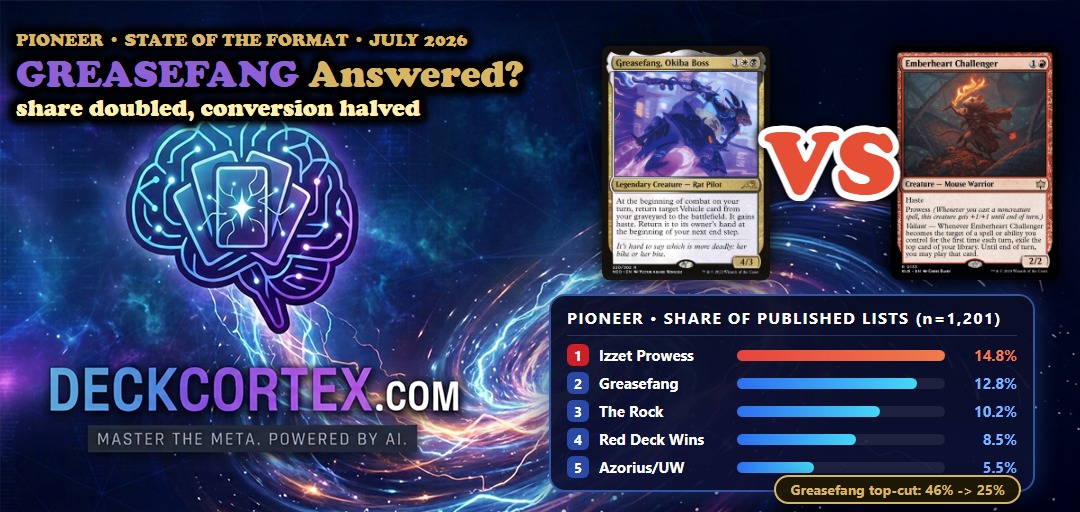
As of July 30, 2026. A month ago we told you Pioneer's best deck was a rat, and we closed on one open question: whether Greasefang, Okiba Boss could keep converting once everyone knew. The answer is in, and it isn't the one the hate-card discourse expected. Greasefang's share of our July window went up — 7.6% to 12.8% of published lists — while its top-cut conversion halved, 46.2% to 25.2%, and its trophy share fell off a cliff: six of ten nameable June events became nine of sixty-one. Nobody solved the rat with Rest in Peace. The format solved it by all playing it at once.
Meanwhile the deck that actually runs Pioneer now is a two-mana mouse, and it's wearing four different names across four different trackers.
A dollar twenty-seven of combo
Greasefang is a 4/3 Rat Pilot whose text does one thing: "At the beginning of combat on your turn, return target Vehicle card from your graveyard to the battlefield. It gains haste. Return it to its owner's hand at the beginning of your next end step." Point it at Parhelion II — a 5/5 Vehicle with flying, first strike and vigilance whose attack trigger creates "two 4/4 white Angel creature tokens with flying and vigilance that are attacking" — and crew it with the rat, whose power is exactly the 4 that Crew 4 wants. Five plus four plus four is thirteen damage in the air on turn three, out of a graveyard, for two cards that cost 34 cents and 93 cents.
That price tag is the whole problem with banning it and the whole reason it spread. This combo has been public knowledge since Kamigawa: Neon Dynasty; there is no secret left to keep and nothing to buy. What our July window shows is what happens next: 154 Greasefang lists across the two builds, up from 46, and a deck that now wins roughly as often as it shows up. 12.8% of the metagame, 14.8% of the trophies. In June it was 7.6% of the metagame and 60% of the trophies. That gap closing is the answer to the headline.
One honest caveat before anyone quotes the 6-of-10: our June winners table rested on ten events, because a scraper gap swallowed the back half of June. July's rests on sixty-one. The June number was real but thin, and part of what looks like collapse is a sample finally big enough to argue with.
What the deck did about it
The interesting half isn't the share. It's that Greasefang spent July rebuilding itself into a deck that doesn't need the combo to be a surprise — and the classifier's split tells you which version won. "Abzan Greasefang" as a label now has zero lists; everything green-white-black files under Greasefang Parhelion, 112 lists to Orzhov's 42.
The Abzan build's three biggest gainers all do the same job from different angles. Professor of Symbology (86 of 112) is a 2/1 that says "When this creature enters, learn" — a body that fetches a Lesson or, more usefully here, discards a card to draw one. Thundering Broodwagon (86 of 112) is the sharp one: a Vehicle with Cycling , which means you pay , discard it, draw a card — and then it's a Vehicle in your graveyard, which is to say a second thing for Greasefang to point at. When it does come back, "When this Vehicle enters, destroy target nonland permanent an opponent controls with mana value 4 or less" eats the Unlicensed Hearse that was supposed to stop you. Card selection, combo redundancy and removal in one uncommon.
And then there's the one that changed the matchup math. Jennifer Walters // The Sensational She-Hulk went from a two-of curiosity in June to 81 of 112 lists — a 2/3 whose only front-face static is "Your opponents can't cast spells during your turn." A two-drop that turns off every counterspell, every Fatal Push on the rat, every flash graveyard answer, on the exact turn the combo happens. The June builds protected the combo with a four-mana Voice of Victory effect or hoped. This one costs two and blocks.
The support cards are all graveyard plumbing that happens to be good Magic: Cache Grab (86) mills four and takes a permanent from among them; Overlord of the Balemurk (86) mills four and returns a non-Avatar creature card to hand, with Impending 5— so it's a two-mana enchantment on turn two and a 5/5 later; Yathan Roadwatcher (55) mills four and returns "target creature card with mana value 3 or less from your graveyard to the battlefield," which is Greasefang's mana value exactly. Here's jarold9's July 25 winner — and look at the sideboard, because the graveyard hate in a Greasefang 75 is now pointed at the mirror:
The Orzhov build (42 lists) went the other way and got grindier. Monument to Endurance is in all 42 — "Whenever you discard a card, choose one that hasn't been chosen this turn — Draw a card. / Create a Treasure token. / Each opponent loses 3 life." — and it's surrounded by three separate two-drops that each carry a discard activation to feed it: Iron-Shield Elf ("Discard a card: This creature gains indestructible until end of turn. Tap it."), Guardian of New Benalia with the same line stapled to enlist, and Fleeting Spirit, which discards to exile itself and come back at the next end step. The Mycosynth Gardens (46) copies the Monument for anyone who wants two. It's a real deck. It's also the one that's losing the internal argument, roughly one list to three.
What actually took over: Izzet, four ways
Here's the part every Pioneer metagame table you'll read this week gets wrong, ours included until we checked.
The format's top deck is Izzet Prowess at 14.8% — 178 of 1,201 lists — and getting to that number takes card-by-card work, because our classifier files it under three labels and one of them is a bucket with a different deck inside it. We read 24 "UR Aggro" lists: seventeen were Prowess, seven were something else entirely. The distribution splits at the same seam, exactly 60 lists carrying the Emberheart Challenger / Monastery Swiftspear / Soul-Scar Mage core and exactly 44 carrying Vivi Ornitier. Sixty plus forty-four is a hundred and four, which is the whole label.
The Prowess deck itself is the June shell with sharper tools. Flow State is in effectively every list — "Look at the top three cards of your library. Put one of them into your hand... If there is an instant card and a sorcery card in your graveyard, instead put two of them into your hand" — and the risers are all interaction: Spell Pierce up to 42 of 104, and Quantum Riddler, a 4/6 flier with Warp whose static reads "As long as you have one or fewer cards in hand, if you would draw one or more cards, you draw that many cards plus one instead" — an empty-handed aggro deck's dream, castable for two on the turn you need a blocker. Experimental Synthesizer is the deck's top loser, down to half the lists. PedraStone, who we flagged in June for back-to-back top-fours, won five events in July on this shell — more than any other pilot in the format:
The 44 lists hiding inside that label are a Vivi Ornitier midrange deck: a 0/3 that grows on every noncreature spell and pings each opponent, whose ": Add X mana in any combination of and/or , where X is Vivi Ornitier's power" turns a full turn of cantrips into a mana engine, paired with Agatha's Soul Cauldron and Proft's Eidetic Memory. It shares almost nothing with Prowess but the color pair.
Then there's the deck we owe you a correction on. Izzet Lessons — 51 lists, 4.2%, and a 30.8% conversion rate that's the best of any deck with a real sample — is filed in our corpus as "Izzet Control," and it is built out of the Avatar Lesson package: Firebending Lesson and Abandon Attachments and It'll Quench Ya! and Boomerang Basics, with Gran-Gran in all 51 as the engine — a 1/2 that draws-and-discards whenever she becomes tapped and makes your noncreature spells cost less once three Lessons are in the yard — and Ral, Crackling Wit in 41 as the payoff. Our July piece told you Tablet of Discovery appeared in no distribution we held, and dismissed the reported "Tablet control" deck as a phantom. It isn't a phantom, it just isn't Jeskai. It's this — four July trophies across three pilots, two of them elBB's — and the Tablet is in his 75:
Add the Arclight Phoenix deck at 3.2% and the total is stark: four genuinely different Izzet decks, 311 of 1,201 lists, a quarter of Pioneer. Wizards wrote on June 29 that the Izzet shells' "metagame share has dropped to a more appropriate number." That is the one line in the announcement our July data flatly contradicts.
Three feeds, three names, none of them the deck
If you want a single receipt for why archetype tables need reading rather than quoting, take makaaaa's July 9 Challenge win. Our mtgo-side scrape calls it Izzet Phoenix. Our mtgtop8-side scrape calls it UR Aggro. The research that came into this piece called it Izzet Midrange. Here is the list:
No Arclight Phoenix. No Treasure Cruise. No Prowess core. It's the Vivi deck, and three labels missed it in three different directions. The same story on a smaller scale: Arclight Phoenix itself is only in 34 of the 38 lists filed under its own archetype name.
The zombie labels are still shuffling around too, and there are two of them now. "UR Cutter" survives at 14 lists containing zero copies of Cori-Steel Cutter — banned on May 18, still `pioneer: banned` when we re-checked this morning, still naming an archetype ten weeks later, though at least it's down from 44. And joining it this month: "Dimir Yorion," in which Yorion, Sky Nomad appears in 3 of 44 lists.
The deck nobody named correctly, which is also the best new deck
Strip the wrong label off those 44 lists and what's underneath is the most interesting thing to happen to Pioneer in July: a Dimir tempo deck that went from one list in June to 3.7% of the format with a 28.6% conversion rate, and it is built almost entirely out of cheap enchantments and artifacts that replace themselves.
Momentum Breaker leads it, and read the trigger with Greasefang in mind: "When this enchantment enters, each opponent sacrifices a creature or Vehicle of their choice." A two-mana edict that names Vehicles out loud, in the format's breakout deck, in the month Greasefang stopped converting. Around it: Hopeless Nightmare (a enchantment that discards and drains 2, then scries 2 when it dies), Nowhere to Run (flash, −3/−3, and it switches off hexproof and stops ward abilities triggering — which is how you kill a warded creature at instant speed), Cryogen Relic (draws on the way in and on the way out, then stun-counters a tapped creature), Fear of Isolation (a 2/3 flier for two whose additional cost is returning your own permanent — so all those enchantments come back for a second trigger), and Thundertrap Trainer digging four deep for the next noncreature card. Kaito, Bane of Nightmares and Narset, Parter of Veils close.
It also runs Duress in 20 of 44 lists, which is the closest thing our data has to a field-wide hate count — and it's in the new deck, not the old ones.
What died
Two things fell hard, and one of them fell for a reason you can point at.
Red Deck Wins went 15.2% to 8.5%, and its conversion from 27.8% to 15.7% — the biggest drop of any deck in the format. The core is untouched (Sunspine Lynx, Screaming Nemesis, Kumano Faces Kakkazan // Etching of Kumano, all still effectively universal, with Bonecrusher Giant // Stomp the one real gainer at 42 of 102). What changed is the tech. The Legend of Roku // Avatar Roku went from 88 of 100 lists to 49 of 102. And Hexing Squelcher, the $21 two-drop we told you in June was "positioned perfectly against the control uptick" at 47 of 100 lists, is now in one list out of 102.
Because the control uptick is gone. Azorius/UW Control went 10.2% to 5.5%, the second-biggest fall in the format. Whether Squelcher's "Spells you control can't be countered" is what killed draw-go, or whether red players cut a $21 card once draw-go left on its own, our data cannot separate — decklist shares don't carry causation. What we can say is that the two numbers moved together, and the card aimed at the archetype went out with it.
What's left of control is worth a look anyway, because it un-learned June's lesson: Supreme Verdict was 12 of 43 lists a month ago and is 35 of 42 now, with Beza, the Bounding Spring at 39 and Temporary Lockdown rising. capellomauro's July 12 winner is also, for the third month running, straight UW with not one red card in it — whatever coverage keeps calling a Jeskai control deck does not exist in our corpus.
The Rock held up best of the old guard, 12.7% to 10.2%, with Sentinel of the Nameless City joining Professor Dellian Fel and Unholy Annex // Ritual Chamber in the core. One correction there, on us: we called Badgermole Cub "a $48.63 uncommon" in July. It's a mythic — `tla:167`, and $49.98 today. The price was right; the rarity wasn't.
The June 29 scorecard, and what it means for August 10
Wizards said four things about Pioneer on June 29 (the announcement is Arya Karamchandani's; we misattributed and paraphrased it last month, and both are worth fixing). Graded against our July window:
"Format diversity looks good, with a wealth of viable decks and new cards like Tablet of Discovery causing churn in the format."
Right, and we were the ones who missed the Tablet. Sixty-one events produced nineteen distinct winning archetypes plus one our classifier just files as Unknown, down to a five-list Ygra, Eater of All Cat-Oven deck and a paper Auras deck.
"Badgermole Cub midrange and ramp strategies rising to prominence as the format's most played decks"
Half right. The Rock is second at 10.2% and the ramp decks are real (Simic Scapeshift rebuilt into an actual Scapeshift deck at 3.2%, Lotus Field at 2.1%, MasterNeo7 taking three trophies between them). But neither is the most-played deck. Izzet is.
"combo decks like Greasefang have seen a downtick in play"
Wrong on play, right on outcome — and early. Greasefang's play rate went up 5.2 points. Its performance is what ticked down, and it did so after the announcement, not before it.
"The various Izzet shells... their metagame share has dropped to a more appropriate number."
This is the one that aged badly. A quarter of the format.
So: August 10. There is no attributable ban conversation for any Pioneer card as of today — not Greasefang, not Parhelion II, not the Cub, not Treasure Cruise, not Sheoldred, the Apocalypse. Wizards is on record as content, the format's numbers back the contentment, and the deck people were nervous about is converting at half its June rate. The base case is another one-line "no changes," and if you're building for the next three weeks you should build as though nothing moves.
The rumor mills will say otherwise, and the tell is the same as last month: any list naming Amalia Benavides Aguirre (banned) or Guide of Souls (a Modern Horizons 3 card, `pioneer: not_legal`, never legal a single day) is describing a format that doesn't exist. We re-checked both this morning so you don't have to.
Two weeks out: what The Hobbit actually does to Pioneer
The Hobbit releases August 14 — four days after the B&R — with prerelease August 7–13 and MTG Arena on August 11. Wizards has announced no MTGO date, and neither will we. As of this morning 128 of the 198 main-set cards are public, so this is a partial read, and every claim below is a design read: there is no Pioneer play data for an unreleased set.
The one card with a real case is The Queen of Dale, a 2/1 mythic reading "Whenever an opponent casts their first noncreature spell each turn, you recruit" — draw a card, discard a card, and if the discard was a nonland card, make a 1/1 white Human Soldier. Read the trigger carefully: it's on their spell, once per opponent per turn, which means it also fires on your turn when they hold up interaction. In a format whose top deck is a Prowess deck full of one-mana spells and whose third-best-converting deck is a Lesson pile, a two-drop that turns opposing cantrips into a card filter plus a blocker is asking the right question. Whether a 2/1 lives long enough in a format with Burst Lightning in every red deck is the release-data question, and at a $46 preorder ask you are paying for the optimistic answer.
The rest is thinner than the hype. Gollum and the Smaug package get named by preview coverage without anyone pinning them to a Pioneer shell. The new mechanics — storied, recruit, hone counters — read Limited and Commander. And the reprint sheet, which is genuinely deep, does nothing for you here: The One Ring, Orcish Bowmasters, Tom Bombadil, Delighted Halfling and Mox Amber are all in the HOC companion set, which is Commander- and eternal-legal. Not one of them lands in the Pioneer-legal main set.
The calendar, revisited — and a correction
We closed the July piece by saying Pioneer's entire paper footprint was two weeklies, eight players in Katowice and sixteen in Yaroslavl, and that the format they finally fixed wasn't worth an event. The first half was a coverage artifact of our own scraper gap, and we should say so.
The July window has eleven paper and non-MTGO events with a named winner. Katowice and Kyiv run weeklies. Yaroslavl is still going. Japan has two: the 9th and 10th Minato Mirai Open. There's an online series called Pioneer Spark!! on its 23rd and 24th event. Crew3 ran "2026 Savior of Pioneer Qualifier #7" — a numbered qualifier series, in 2026, for a format with no championship to qualify for. And the biggest paper Pioneer tournament in our data is the Emperor of Pioneer Tournament, 19th Season, in Osaka, 31 players, won on Greasefang:
Thirty-one players is not a Regional Championship. Nineteen seasons is not nothing either. The grassroots calendar for this format exists, it is small, it is mostly Japan and eastern Europe, and it is entirely volunteer-run — which sharpens rather than softens the structural complaint. Pioneer still has no seat in the 2026 Regional Championship, Pro Tour or Spotlight Series structure, and the people making the abandonment argument have not been answered. The MTG Hero's version, updated July 3, is the fair one: the format declined "because the competitive ecosystem surrounding it slowly disappeared," and what it's missing is "a spotlight," not gameplay. Our data agrees with the second half emphatically. Twenty winning archetypes in a month is not a sick format.
Bottom line
The volume pick is Izzet Prowess: biggest share, best conversion of the big decks, and PedraStone's five trophies say the shell rewards reps. The value pick is Izzet Lessons — 30.8% conversion on 51 lists means the field still isn't ready for it, and Wizards told you about it a month ago. Greasefang is still a fine deck and it is no longer a free win; if you play it, play the Abzan build with the full Jennifer Walters count, because the version that pre-empts interaction is the version that's still winning. And if you want the deck nobody has a plan for yet, it's the Dimir enchantment deck with the wrong name on it.
The number to watch isn't on the August 10 page, because August 10 is very probably blank for Pioneer. It's whether Greasefang's conversion keeps sliding now that a 3.7% deck is casting a Vehicle-sacrifice edict on turn two — and whether The Hobbit gives the Prowess mirror a two-drop that changes it.
The honest fine print: shares are decklist-appearance shares of 1,201 published Pioneer lists tracked by DeckCortex, June 30 – July 30, 2026 (mtgo.com Challenge pages plus MTGTop8-hosted events), out of 30,127 Pioneer lists overall. Published lists over-represent decks that finish well. Our sample nearly doubled from June's 607 because a June 15–27 gap in our mtgo.com scraper has closed, so month-over-month shares are comparable and raw list counts are not. Top-cut conversion is the share of a deck's counted entries that reached an event's cut — small samples, and not a match win rate, which we do not track; where a merged archetype spans a label whose conversion we can't isolate, we quote only the label we can measure and say so. Archetype labels were merged only after verifying identical cores or reading lists card by card; the "UR Aggro" split (60 Prowess / 44 Vivi) and every deck described above were checked list by list. The archetype distribution matches labels fuzzily, so presence can exceed 100% for lands — fractions here are quoted only where the deck count fits the sample. The 61-event winners count excludes MTGO League 5-0 postings, which have no cut; at most 3 of the 61 could be one event dated a day apart across our two feeds. External tracker figures (MTG Nexus 14.4%, MTGGoldfish 14.7% for Izzet Prowess) agree with our 14.8% in direction and are not blended into our numbers; any trailing-90-day window straddles the May 18 ban and describes a format that no longer exists. Prices are Scryfall paper aggregates as of July 30, 2026; The Queen of Dale's is a preorder ask. All Oracle text, color identities, rarities and legalities were validated card by card against live card data, including the Cori-Steel Cutter, Amalia and Guide of Souls legality checks. Wizards' quotes are from the June 29, 2026 Banned & Restricted announcement, verified against the primary source. The Hobbit spoiler count and every claim about its cards are as of July 30, 2026, with 70 main-set cards still unrevealed.