Sideboarding Against Combo in Legacy, Summer 2026: What the Winners Actually Board
Consign to Memory now sits in 49.2% of all Legacy decklists, hard graveyard hate is in free fall, and the winning Reanimator boards pack four Show and Tells and a flying car. A data-driven guide to sideboarding against Legacy's four combo pillars after the Candelabra ban — what actually interacts with each of them, how many slots the winning 75s really spend, and where Chalice of the Void belongs.
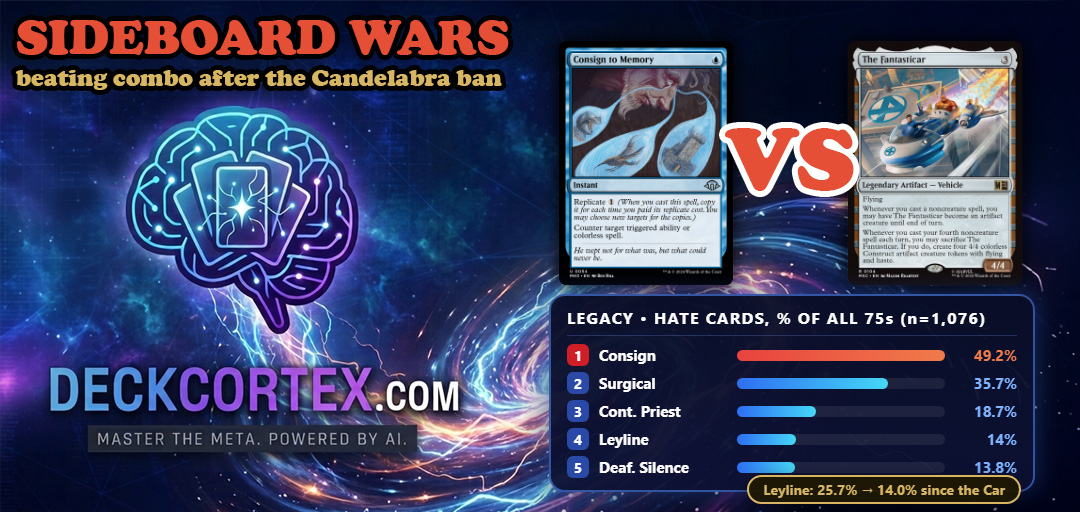
As of July 13, 2026. Here's the Legacy sideboard war in one number: Consign to Memory now sits in 49.2% of every published Legacy decklist we track — 529 of 1,076 lists over the past month, three points behind Force of Will at 52.2% and still climbing. A one-mana instant that can't counter a Brainstorm and can't kill a creature is about to catch the most famous counterspell ever printed. The format is telling you where the fight is: two weeks after the Candelabra of Tawnos ban, the top tables are 18.8% fast combo — Reanimator at 8.8%, The Fantasticar shells at 4.6%, Doomsday at 2.9%, Sneak Show at 2.5% (top-cut share, MTGTop8-sourced, n=1,059 decks, June 13–July 13) — and very little of it loses to the hate people were boarding in May.
So this is a sideboard guide with receipts. We looked up every anti-combo staple across all 1,076 published 75s, compared the month since the Car arrived against the ten weeks before it, and pulled the actual sideboards of this week's winning lists. The short version: hate is matchup-specific now, the combo decks sideboard harder than you do, and the format has already voted — trigger interaction up, hard graveyard hate down.
The market has spoken
Presence across all Legacy 75s (main plus sideboard), last month versus the ten pre-Car weeks before it:
| Card | Now (Jun 13–Jul 13) | Before (Apr 14–Jun 12) | Move | |---|---|---|---| | Consign to Memory | 49.2% | 46.2% | +3.0 | | Surgical Extraction | 35.7% | 27.2% | +8.5 | | Containment Priest | 18.7% | 16.0% | +2.7 | | Deafening Silence | 13.8% | 8.7% | +5.1 | | Stifle | 7.2% | 5.9% | +1.3 | | Grafdigger's Cage | 16.4% | 19.5% | −3.1 | | Mindbreak Trap | 15.7% | 18.6% | −2.9 | | Pyroblast | 18.9% | 23.4% | −4.5 | | Orcish Bowmasters | 14.5% | 21.7% | −7.2 | | Leyline of the Void | 14.0% | 25.7% | −11.7 |
Read the extremes first. Leyline of the Void lost almost twelve points of presence — the biggest drop of any card we measured — while Reanimator is the most-played deck in the format. Rest in Peace fell with it, 3.7% to 2.3%. Nobody unwinds their graveyard hate against a field of graveyards by accident; they do it because the four-mana enchantment stopped winning the games it used to win. We'll get to why in a moment (spoiler: the Reanimator players read your sideboard notes).
Meanwhile everything that touches a trigger or survives a plan change is up. Surgical Extraction is the format's most-played dedicated graveyard card at 35.7% because means any deck can pay 2 life for it and it's never fully dead. Deafening Silence gained five points because the new best deck needs to cast four noncreature spells in one turn and this stops it for . And Consign to Memory is Consign to Memory. The one number on the falling side that should surprise you is Orcish Bowmasters, down seven points — less a verdict on the card than on its host: Dimir Tempo, its main home, nearly halved from 6.2% to 3.5% of the top cut versus its six-month baseline. The fair decks are rotating too, and we'll get to where they went.
(Presence = share of decklists playing at least one copy, full 75, our scraped corpus. It's decklist share, not field share and not win rate — we don't track match win rates.)
Reanimator: the hate is mandatory and it still isn't enough
Reanimator is the format's #1 at 8.8% of the top cut with a 32.61% conversion rate across 46 counted entries — nearly triple its 3.2% share from the six-month baseline, and the deck Wizards themselves flagged in the June 29 ban announcement as "taking on more of an all-in combo shape." The maindeck is exactly what you expect: Animate Dead in 100% of the 93 lists, Shallow Grave in 83%, Grave Researcher / Reanimate in 69%, plain Reanimate rising fast at 34%, all pointed at Atraxa, Grand Unifier, Griselbrand, and — still the fastest-growing card in the archetype, in 84 of 93 lists — Raph & Mikey, Troublemakers.
Game one, the classic package does classic work:
Grafdigger's Cage shuts off every reanimation spell in the deck at once — creature cards in graveyards can't enter the battlefield under it — and postboard.gg currently rates it the best card in the matchup. Here's the bonus nobody prints on the box: the Cage also blanks Raph & Mikey's attack trigger, because the Turtles cheat the revealed creature in from the library, and the Cage stops library entries too. Containment Priest exiles any nontoken creature that enters without being cast — greensunszenith.com credits it with "more immediate concessions than almost any other sideboard card" — and it has flash, so the real cost isn't "must be in play by turn 2," it's holding up with a straight face. Surgical Extraction snipes the reanimation target the moment it hits the bin, and Faerie Macabre does budget Surgical work with a twist: discarding it is an ability, not a spell, so it costs zero mana and counterspells never see it.
Now the bad news, and it's the single most important thing in this article. We pulled the sideboards of the three most recent Reanimator wins in our data, and they all say the same thing:
- Matiuzzzo, 1st place, Campinas, July 9: 4 Show and Tell, 4 Stronghold Gambit, 4 The Fantasticar, 3 Surgical Extraction.
- Magic_Dads71522, 4th, MTGO Challenge, July 11: 4 Chain of Smog, 4 Witherbloom Apprentice, 4 Stronghold Gambit, 3 Surgical.
- Kim Hildeqvist, 1st, Stockholm, July 9: 4 Show and Tell, 3 Stronghold Gambit, 2 Surgical, plus artifact hate.
That's not "a few juke cards." That's eleven to twelve of fifteen slots committed to becoming a different deck. Your Leyline resolves, they nod politely, and games two and three they're a Show and Tell deck — or in the Challenge list's case, a Chain of Smog combo deck that drains you out with Witherbloom Apprentice's magecraft triggers and never touches a graveyard. The format-wide numbers confirm this is standard tech, not spice: Stronghold Gambit more than doubled to 6.5% of all 75s (70 decks — and the Sneak Show archetype only accounts for 26 of the 163 lists playing Show and Tell). The winning list even brings the Car as its own post-board combo. Cowabunga.
This is why Leyline collapsed and Surgical/Priest rose: the juke invalidates narrow hate and rewards cards that stay live through the transformation. Containment Priest is the star here — it exiles the Show and Tell creature and the Stronghold Gambit creature exactly as it exiles a reanimated Griselbrand, because none of them were cast. The Cage, note carefully, does not — Show and Tell and Stronghold Gambit put creatures in from the hand, the one zone the Cage doesn't police. Boarding both is playing rock and paper at the same time.
Doomsday, now with cup holders
Doomsday's label reads 2.9% (31 decks, and honestly-flagged: our probe has no conversion data for it this window), but that undercounts the family: Doomsday the card appears in 62 decklists, twice the archetype's count, because half the family now files under other labels — and 15 of the 31 Doomsday lists (47.9%) run The Fantasticar maindeck, usually the full four. The community named the hybrid "Vroomsday," and it won the July 11 MTGO Challenge in wonderPreaux's hands. Joe Dyer's weekly data has Doomsday as the most-played deck of his sample week at a 47.3% non-mirror win rate — his numbers, his caveat, and ours from the deck's side of the table: it remains genuinely hard to pilot.
Your graveyard cards are worth nothing here. The deck's engine is Dark Ritual into Doomsday, and the kill is a five-card pile topped by Thassa's Oracle cast off Cavern of Souls — which every single one of the 31 lists plays, precisely so the Oracle can't be countered. So counter what can be: the Oracle's enters-the-battlefield trigger. The win checks your devotion against library size when the trigger resolves; Stifle or Consign to Memory on that trigger, after they've spent their library building the pile, leaves them staring at an empty deck and a mandatory draw step. That — not "counters reanimation spells," which it can't do (Reanimate and friends are black spells; Consign counters triggered abilities and colorless spells) — is why Consign is in half the format's sideboards. Against Reanimator proper it has a parallel trick: Animate Dead's reanimation rides on an enters-trigger too.
The rest of the plan is proactive. Thoughtseize and Duress before the ritual turn beat protection you can't otherwise fight; the current lists defend with maindeck Flusterstorm (35% of them) and their own discard rather than the Veil of Summer of past seasons (we find Veil in the top-40 of exactly zero current Doomsday maindecks; it's at 5.5% format-wide). And know what doesn't work: the Doomsday community's own wiki cheerfully notes that "Chalice on 1 … does very little to prevent you from winning if you can actually cast Doomsday," and our numbers back the resignation — Chalice of the Void sits at 5.9% of all 75s and is flat month-over-month. One more heads-up from the winner's list: wonderPreaux maindecks three Stifle in a combo deck — fetch-land denial that doubles as mirror tech against the next deck down this page. The combo players are boarding interaction while you board hate. Let that sink in, then copy it.
The Fantasticar: your storm hate is pointed at the wrong thing
The Car needs one paragraph of rules text, because the rules text is the whole matchup. The Fantasticar is a three-mana colorless Vehicle: "Whenever you cast your fourth noncreature spell each turn, you may sacrifice The Fantasticar. If you do, create four 4/4 colorless Construct artifact creature tokens with flying and haste." Sixteen evasive power, often on turn one, in an archetype that went from zero to 16.4% of all Legacy decklists in four weeks (177 of 1,076 — it released on MTGO June 26). As its own archetype it holds 4.6% of the top cut and converted 5 of 9 counted entries — a 55.56% rate on a sample small enough that we'll just call it "scary" rather than quote it as gospel.
Here's the part that breaks twenty years of sideboard instinct: the tokens come from a triggered ability, not a spell. The trigger goes on the stack above the fourth spell and resolves first. Mindbreak Trap exiles spells — exile the entire chain and the four Constructs still hit you, because the trigger already happened the moment the fourth spell was cast. Dyer said it plainly in his July 8 column: you don't usually care if your third or fourth spell gets hit, "because you're almost never casting Car as your third spell." Our usage data shows the format learning this in real time: Mindbreak Trap fell three points in exactly the window the Car went from nothing to everywhere.
What actually interacts, in order of how the format has voted:
Counter the trigger. Stifle and Consign to Memory both do it for one mana, and Consign double-dips: it can also counter the Car itself on cast, since the Vehicle is a colorless spell. Dyer calls both "very good versus the Car" and credits them for Azorius tempo's 57.8% non-mirror week — his MTGO snapshot, small sample, but our own table agrees with the direction (more below). Kill the Car with the trigger on the stack. The sacrifice happens as the trigger resolves; Abrade the Vehicle in response and there's nothing left to sacrifice, so no tokens. Cardsrealm has been telling people to pack more instant-speed artifact removal for exactly this reason, and at 8.1% presence (down from 10.0%, oddly) the format hasn't listened yet — a genuine gap if you want an edge. Tax the turn. Deafening Silence caps everyone at one noncreature spell per turn, which reads the Car its rights; Dyer again: the line "still is prey to cards like Deafening Silence." Up five points to 13.8%, the biggest riser among prison pieces. (Its banned cousin from Modern Horizons 3, Vexing Bauble, is not an option — that one's on the Legacy banned list.)
And the Chalice question, which the research dump we started from answers with a blanket "set it to zero"? Our decklists say: read the build first. The archetype has an affinity-style wing — Mox Opal in 36.6% of the 49 lists, Lion's Eye Diamond in 27.8%, Urza's Saga in 31.2%, plus Lotus Petal, Mishra's Bauble and Urza's Bauble — where 15-plus zero-mana artifacts do double duty as mana and spell count, and Chalice on 0 (which costs you all of zero mana to deploy) strangles both at once. But the builds winning the actual Challenges are leaner Dimir shells: wonderPreaux's Vroomsday ran five zero-mana spells against nineteen at one mana; derlumberzack's 3rd–4th place Dimir Car from the July 12 Challenge ran eight against sixteen (Ponder, Brainstorm, Dark Ritual, Thoughtseize). Against those, Chalice on 1 hits three times as many cards. Either way, remember what Chalice never does: it doesn't touch the trigger. It's enabler denial only, the format plays it at 5.9% and falling slightly, and the revealed preference of every winning sideboard we opened is the counter-the-trigger plan instead.
Sneak & Show: the one matchup where the old rules still apply
Sneak Show sits at 2.5% (26 decks, 25% conversion of 12 entries, up modestly from 2.0%) and is refreshingly honest about what it does: every list plays the full four Show and Tell and Sneak Attack, all 26 play Emrakul, the Aeons Torn, and 25 play Omniscience. This is the matchup your Containment Priest dreams about — a creature put in by Show and Tell or Sneak Attack wasn't cast, so it's exiled on arrival. The Omniscience line is the exception: spells cast for free off the enchantment are still cast, so the Priest politely waves Emrakul through. Precision matters with Consign here too — Show and Tell is a blue sorcery, so Consign can't counter it (that's Flusterstorm and Pyroblast work); what Consign does counter is Atraxa's enters-trigger and Emrakul's annihilator trigger, so the cheated fatty at least arrives without the free card advantage or the six permanents it came to collect.
Karakas remains the quiet killer — every payoff in the deck is legendary, and bouncing Griselbrand with a land the UWx decks play maindeck (51% of their lists) is as clean as answers get. Emrakul's protection is from spells, and Karakas activates an ability, so even the big one goes back to hand. One wrinkle from the Reanimator side of the format that applies here too: Koma, World-Eater, now in 31% of Reanimator lists as a rising Show and Tell payoff, can't be countered and carries ward — your free Karakas activation suddenly comes with a four-mana tax. The arms race never sleeps. As for Null Rod and Collector Ouphe: fine cards, wrong era — they hose the Car's affinity wing and LED, but Sneak Show's fast mana is mostly lands, and both sat flat month-over-month.
Slot math: what the winning 75s actually spend
The theory consensus (Hipsters of the Coast, the ddft.wiki) says a fair deck spends three to four slots per major combo pillar and never transforms wholesale. The two freshest winning fair decks in our corpus agree with the theory almost to the card:
nekoyama2, UWx Control, 1st place, MTGO Challenge, July 12 — the deck that's quietly doubled to 4.1% of the top cut (from 2.0% six months back, with 3 of 4 counted entries converting — tiny sample, real trend), maindecking Stifle in half its lists. The board: 2 Consign to Memory, 2 Containment Priest, 2 Flusterstorm, 2 Erode, 1 Lavinia, Azorius Renegade, 1 Surgical Extraction, 2 Terminus, 3 Triumph of Saint Katherine. Count it: three graveyard-relevant slots (Priests plus Surgical, all of which stay live through the juke), five to seven stack/trigger slots depending how you count Lavinia — a two-drop that stops opponents from casting noncreature spells costing more than their land count and counters any spell cast without spending mana, which reads like it was designed with the Car and Force of Will in the room. Zero Leylines, zero Cages.
Kojima Kousuke, Dimir Tempo, 1st place, Nagoya, July 11, 51 players (paper) — 2 Consign to Memory, 2 Surgical Extraction, 2 Dauthi Voidwalker, 2 Engineered Explosives, 2 Sheoldred's Edict, and one-ofs including a Damping Sphere and a Harbinger of the Seas. Same skeleton, black paint: four graveyard-relevant slots, with Dauthi Voidwalker doing the Priest's job while also being a shadow clock that occasionally gets to cast their exiled Griselbrand for free. And once more: exactly two Consign to Memory. Both winners. Both colors. The card is the format's connective tissue.
The transform decks, meanwhile, are the combo decks — Reanimator's eleven-card jukes above, and even wonderPreaux's winning Doomsday board is half interaction (2 Consign, 2 Force of Negation, 2 Hydroblast) and half a grind package (4 Barrowgoyf, 2 Dauthi Voidwalker) for the games where comboing is off the table. Timing follows from all of this: against Reanimator, the Car, and Sneak Show you bring the hate in for game two, every time, no scouting required — the archetypes are known quantities and their game-one lists barely vary. Out go the slow removal spells that don't answer a trigger, in against combo generally; on the draw, respect that they'll play around Daze, and weigh your hand toward interaction that costs zero or one.
The package, and when to change it
If you're on a fair blue deck this summer, the two-lane package looks like this: 2 Consign to Memory (non-negotiable — it plays against all four pillars), 1–2 more trigger/stack pieces (Stifle or Flusterstorm by taste; Stifle if the Car and Doomsday are thick in your room), 3–4 flexible graveyard cards (Surgical Extraction plus Containment Priest in white, Dauthi Voidwalker in black — cards that survive the juke), and 1–2 instant-speed artifact answers (Abrade-class; the format is underplaying these at 8.1% and the Car keeps winning). White decks add Deafening Silence, the best-performing prison piece of the month. Chalice on 0 against the artifact Car builds, on 1 against the Dimir ones, and never as your main plan. Skip Mindbreak Trap unless actual Storm returns, and treat 4x Leyline as a metagame call for a graveyard-saturated room, not a default — the 11.7-point exodus happened for a reason, and the reason boards four Show and Tells.
Two dates matter. The next B&R lands August 10, 2026, with Wizards already on record watching The Fantasticar in Eternal formats; if the Car goes, the Stifle/Consign stock drops a notch and the freed slots flow back toward graveyard and Show and Tell hate. And whatever happens, watch our numbers rather than the vibes: a month ago the Car didn't have an archetype label, Stronghold Gambit was a trivia answer, and Leyline of the Void was the most-boarded hate card in the format. Four weeks. That's how fast this sideboard war moves.
The honest fine print: archetype shares are DeckCortex's own top-cut share (MTGTop8-sourced published results; n=1,059 decks, June 13–July 13, 2026), not field share. Card presence figures are decklist-appearance shares over all 1,076 scraped Legacy 75s in the same window (main and sideboard; the two denominators come from different counting paths in our pipeline and each figure is quoted against its own). "Before" figures cover the non-overlapping April 14–June 12 slice (n=3,978). "Conversion" is the share of an archetype's counted entries reaching an event's cut — small samples (4–46 entries) and not a match win rate, which DeckCortex does not track; all quoted win rates are Joe Dyer's single-week MTGO snapshots, attributed. Archetype card-distribution tables are maindeck-shaped, which is precisely why the sideboard evidence above comes from the actual fetched 75s of named finishes. External claims (WotC, MTGGoldfish, Cardsrealm, postboard.gg, greensunszenith.com, doomsday.wiki, ddft.wiki, Hipsters of the Coast) are attributed to their sources. Prices shown in card panels are Scryfall paper market aggregates, not a live vendor feed.