The Champion's 75: A Simic Neoform Deck Guide
Yuuki Ichikawa's Simic Neoform posted the best Modern numbers at Pro Tour Marvel Super Heroes and left with the trophy. We break down the champion's exact 75 card by card — the Neoform math, the Consign-your-own-Pact trick, the sideboard, and the matchup numbers — plus what our tracker watched the deck do in the four days since, including an MTGO Challenge win that re-flexed exactly the two slots our engine called flexible.
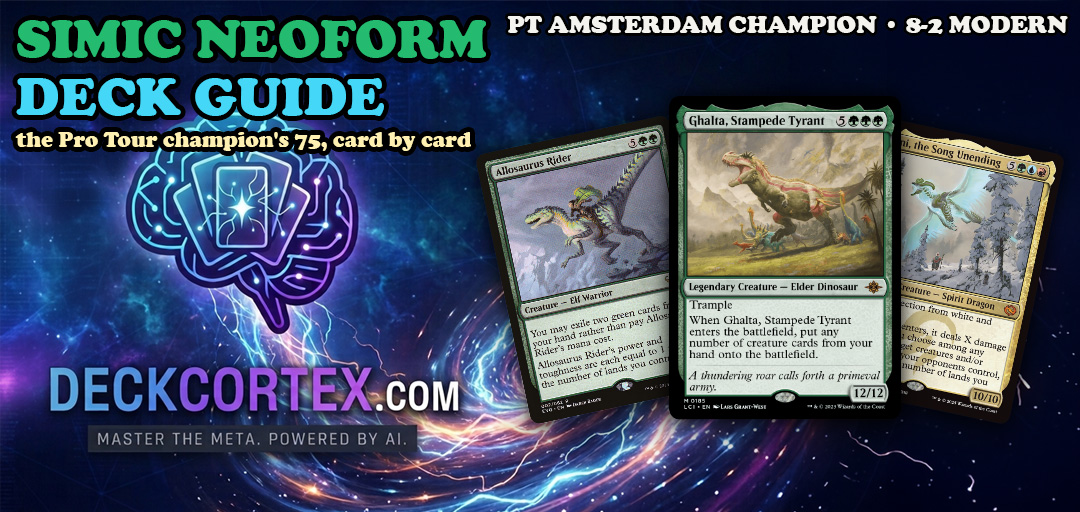
As of July 23, 2026. Yuuki Ichikawa went 8-2 in the Modern rounds of Pro Tour Marvel Super Heroes, snuck into the Top 8 as the No. 8 seed, and won the all-draft playoff — two five-game wars, then a 3-0 sweep of the final — for the trophy. The deck that carried him there was Simic Neoform — 14 pilots, 3.9% of a 362-player field, and the best Modern deck in the building by both ledgers the weekend produced: 60.6% on Wizards' official Day One sheet, 59.7% across the full event per the community matchup matrix. The event story is in our Pro Tour report. This is the other half: how the deck actually works, how to pilot the champion's exact 75, what the sideboard is doing, and what our tracker has watched it do in the four days since. Fair warning — his own build notes aren't public yet, so where we read intent into a card choice, we say so.
How the machine actually works
Everything starts with Allosaurus Rider, a card that spent two decades as a Coldsnap punchline. You may cast it by exiling two green cards from your hand rather than paying its mana cost, and its power and toughness are each 1 plus your land count. Nobody has ever cared about the body. What matters is the line under the name: mana value seven, on the battlefield, on turn one or two, for zero mana.
Neoform is the reason that matters. Sacrifice a creature as an additional cost, search your library for a creature with mana value exactly one more, and put it onto the battlefield with a +1/+1 counter. Seven plus one is eight, and the eights in this deck end games: Ghalta, Stampede Tyrant, Griselbrand, or Ureni, the Song Unending. Note what's missing from that list — Atraxa, Grand Unifier is mana value seven, same as the Rider, so Neoform can never chain Rider into Atraxa. That's Eldritch Evolution's job: it also sacrifices a creature, but searches up anything costing up to two more, so a Rider reaches everything up to mana value nine. Same engine, wider net, and the reason the deck plays four of each.
Ghalta is the premier target because of one sentence: when it enters, put any number of creature cards from your hand onto the battlefield. You just pitched two cards to the Rider, and your hand still holds monsters — that's the deck's whole construction. The menu:
- Griselbrand — a 7/7 with flying and lifelink that arrives as an 8/8 when Neoform's counter comes along. Pay 7 life, draw seven cards, find your protection and your next threat. The published guides call him the hardest payoff to race, and they're right.
- Atraxa, Grand Unifier — reveal the top ten, take one card of each card type. In a deck this dense, that's routinely three or four cards, including a land and another green pitch card.
- Ureni, the Song Unending — a 10/10 flier with protection from white and from black, which blanks most of the removal that matters. Its enter trigger deals X damage split among your opponents' creatures and planeswalkers, where X is your land count — a couple of blockers on a fast turn, a real sweep on a late one.
- Xenagos, God of Revels — at the beginning of combat on your turn, another target creature you control gains haste and gets +X/+X equal to its power. Ghalta attacks the turn it lands as a 24/24 with trample. Bonus: with the deck's low devotion to red and green, Xenagos usually isn't a creature at all, so removal can't touch him while the trigger keeps firing.
- Disciple of Freyalise // Garden of Freyalise — Frank Karsten's line from the official coverage says it cleanest: Disciple "can convert Ghalta into 12 life and 12 cards." Sacrifice the dinosaur that already did its job, refill completely.
There are smaller gears too. Generous Ent, Hooting Mandrills, and Disciple all sit at mana value six, so Neoform turns any of them into Atraxa — or into a fresh Rider — when the sevens line is better than the eights line. The deck isn't a two-card trick; it's a ladder, and every rung is climbable from somewhere. Our combo engine agrees, in its own dry way: it finds zero complete two-card combos in the champion's 75. The kill is a chain, not a loop.
The 75, and how welded it is
Here's the championship list, exactly as registered:
Two structural facts before the individual cards. First, the green math: 36 of the 45 nonland cards are green — everything except Griselbrand, the four Consign to Memory, the three Pact of Negation, and the one Preordain. The Rider's "exile two green cards" tax is cheaper than it sounds, but it's still the number that decides your mulligans. Second, the lands: fifteen real ones plus three modal double-faced backs — two Garden of Freyalise and one Tanglespan Bridgeworks — so the deck plays like it has up to eighteen while keeping its spell density. Bridgeworks Battle // Tanglespan Bridgeworks is the quiet star of that package: removal stapled to a land that's also a green card for the Rider.
The rest of the supporting cast, briefly: Planar Genesis digs four deep at instant speed for a land (tapped, onto the battlefield) or a card to hand; Generous Ent forestcycles for so it's a land when you need one and sacrifice fodder when you don't; Hooting Mandrills delves to nearly free off your cracked fetches; Endurance pitches to the Rider, blocks fliers with reach, and bottoms a graveyard — usually theirs. And the interaction is genuinely free: three maindeck Pact of Negation plus the full four Consign to Memory mean "tap out to combo" and "hold up protection" happen on the same turn.
Our tracker says this configuration is barely a choice anymore. Across the 36 Allosaurus Combo lists in our current one-month sample (up from 26 when the Pro Tour ended — appearance share of MTGTop8-placed lists, not field share), Rider, Neoform, Eldritch Evolution, Summoner's Pact, Atraxa, Griselbrand, Mandrills, Xenagos, maindeck Consign, Pact of Negation, Disciple, Bridgeworks, Misty Rainforest, Hedge Maze, and Breeding Pool appear in every single list, with Ghalta effectively there too and Ureni at 98.9%. The two fastest-climbing cards in the archetype are Ghalta and Ureni themselves — the newest parts of the kill. And when we ran our flex-slot engine over Ichikawa's own 75, it classified exactly two of its 32 card rows as flexible: Nature's Claim and Windswept Heath. Thirty core slots. For a "fringe" deck, this list is astonishingly settled — the archetype solved itself before the field noticed.
Piloting it: mulligans, sequencing, and the Pact trick
The published rule of thumb — from Lucas Giggs' mtgdecks.net guide and Rei Hirayama's Hareruya primer, both written on earlier builds of the archetype — is that a keepable hand has Allosaurus Rider, a way to sacrifice it, and at least two more green cards to pay for it. Count green cards before you count lands; the deck can operate on one real land for a surprisingly long time, but it cannot operate without Rider fuel. Both guides also agree you should mulligan aggressively against other combo decks — a slower seven loses to a faster six.
The play pattern that separates practiced pilots from tourists is the Pact math. Summoner's Pact finds any green creature now for , bill of due at your next upkeep; Pact of Negation counters anything now, due later. The trick — and this is a core line, not a corner case — is that both Pacts' "you lose the game" triggers are triggered abilities, and Consign to Memory counters triggered abilities. Can't pay? Consign your own trigger. Hirayama's primer spells it out: with replicate, a single Consign copies itself to counter multiple Pact triggers at once, which is exactly why the full four live in the maindeck. Kill turn: Pact for the missing piece, Pact to protect it, untap, Consign the bill collector. It feels like cheating the first time you do it.
Consign's other maindeck job is honest interaction. It counters colorless spells — Kozilek's Command headlined a package that showed up in 24.6% of Pro Tour decklists — and it answers the format's pile of enters-the-battlefield and attack triggers at one mana. The champion maindecking four wasn't a metagame gamble; it was reading the room.
Two more rules corners worth knowing cold:
- Ureni and Elesh Norn, Grand Cenobite never get cast. The mana base produces only and ; Ureni costs and Elesh Norn . They enter off Neoform, Eldritch Evolution, or Ghalta's trigger, or they stay home. Sequencing consequence: don't pitch your only put-effect while they're stranded in hand.
- Chalice of the Void on zero turns off both Pacts; on two it catches Neoform and Planar Genesis. The Rider itself doesn't care — an alternative cost doesn't change its mana value of seven. Answer on sight anyway: Nature's Claim and Boseiju, Who Endures exist for exactly this.
What actually beats it — and what only looks like it does
Grafdigger's Cage is the hate card everyone reaches for, and it's half right. The Cage stops creatures entering from libraries, so Neoform and Eldritch Evolution whiff. But Summoner's Pact puts the card into your hand — Cage doesn't care — and Ghalta's trigger deploys creatures from your hand, which sails straight through too. A resolved Ghalta empties your hand into play with the Cage sitting there doing nothing. Respect the Cage, don't fear it: Nature's Claim answers it for one mana (the 4 life they gain is irrelevant), Boseiju channels through it, and Into the Flood Maw bounces it — as long as you promise the Fish, since only the gift mode hits noncreature permanents.
The real problems, per Hirayama's primer and our reading of the list, are free interaction and discard. His line, translated: the deck is "especially vulnerable to pitch spells like Force of Negation and Subtlety that need no mana held up." A Thoughtseize taking your only sacrifice effect is the same story one turn earlier. That's what the maindeck Veil of Summer copies are for — one green mana that draws a card against blue or black, makes your spells uncounterable for the turn, and gives you hexproof from both colors. The sideboard doubles down on all of it.
The sideboard, card by card
One honesty note first: Ichikawa hasn't published his reasoning (his mtg-jp tournament column has no Amsterdam entry yet), so what follows is the cards' Oracle text, the specialist guides, and our read — labeled as such, not dressed up as the champion's own words.
- 4 Mystical Dispute — a tax counter, not a hard one: counter target spell unless its controller pays , and it costs just when it targets a blue spell. Four copies is a bet on a blue field — Izzet Affinity, Izzet Prowess, Esper Goryo's — where "one mana, protect the combo or stop theirs" is the whole matchup.
- 2 Thundertrap Trainer — the Bloomburrow Otter, and the champion's most personal-looking slot. When it enters, look at the top four and take a noncreature, nonland card — in this deck that's a sacrifice spell or a protection piece, never a brick. A 1/2 body that digs toward the combo is our read on a grind tool for slower matchups; nobody's published the definitive word yet.
- 1 Abhorrent Oculus — a 5/5 flier for that asks you to exile six cards from your graveyard, which seven fetch lands, Hedge Maze's surveil, and forestcycling fill faster than you'd think (mind the tension with Mandrills' delve). It attacks from a completely different angle — every opponent upkeep manifests dread — against opponents who boarded into graveyard-irrelevant attrition. Our read, low confidence.
- 1 Elesh Norn, Grand Cenobite — the put-only Praetor. Your other creatures get +2/+2, theirs get -2/-2, and entire token strategies just die: Boros Energy's Cat tokens, and every 0/1 Eldrazi Spawn that Broodscale's engine runs on. Evolution a mana-value-six body into her and some boards never recover.
- 1 Into the Flood Maw, 2 Nature's Claim, 2 Veil of Summer, 1 Pact of Negation — the flexible interaction pile: bounce, hate removal, anti-discard/anti-counter, and a fourth free counter for the matchups that go long on the stack.
- 1 Hooting Mandrills — the second Ape. Cheap threat density for fair games, and one more green card for the Rider. Unglamorous, correct.
Matchups, by the numbers that exist
The community matchup matrix from the Pro Tour (self-reported archetypes, both Swiss days; cells under 20 matches are directional at best) has Neoform positive against every major archetype it met: 64.7% vs Izzet Affinity (17 matches), 57.1% vs Boros Energy (14), 70.0% vs Broodscale (10), 63.6% vs Eldrazi Tron (11), 66.7% vs Esper Goryo's (15), 80.0% vs Amulet Titan (10). Giggs' guide — written on an older list, so treat it as archetype wisdom rather than the champion's plan — matches the numbers' shape: Boros is favorable because "a single Neoform into Ureni is enough" against a deck whose removal is white and red-black-blank, Eldrazi decks are favorable but respect the maindeck Consign count, and Storm is a pure race.
The one red cell is the one to take seriously: 20.0% against Izzet Prowess, on all of five matches. Directional, sure. But the mechanism is believable — Cori-Steel Cutter Prowess is the one popular deck that's simply faster underneath while holding cheap interaction. The published plan: race honestly, use Endurance's flash-reach body to block Slickshot Show-Off (a 1/2 flier that dies to a 3/4 every time), Flood Maw the threat that got through, and respect their post-board counters. Nobody's published dedicated anti-Prowess tech since the PT; if the matchup is your local nightmare, that second Endurance some lists board is where we'd start.
And the mirror? It's a Pact-math exam with two proctors. The player who can Consign the other's trigger usually wins.
From Neobrand to Amsterdam
The archetype is older than half its cards. In May 2019, War of the Spark's Neoform met the Coldsnap rare and became "Neobrand," popularized by Piotr "Kanister" Głogowski: turn-one Griselbrand, offset the seven-life payments with Nourishing Shoal pitching a fat green card, draw most of your library, win with Laboratory Maniac or Lightning Storm. Jim Davis titled his 2019 write-up "Killing People On Turn Two With Neoform," and that was underselling the good draws. It stayed fringe anyway — all-in, fragile, hated out by a single graveyard or library-search effect.
The February 2021 Simian Spirit Guide ban took the free red mana and most of the deck's dignity; the "NeoNeobrand" era limped along on Mox Amber loops. The rebuild came in pieces: Ghalta (The Lost Caverns of Ixalan, late 2023) gave the deck a payoff that never touches the graveyard or the library; Modern Horizons 3 (June 2024) delivered the entire modern support skeleton — Disciple, Bridgeworks, Planar Genesis, and Consign to Memory — and Ureni (Tarkir: Dragonstorm, 2025) added the finisher that ignores white and black removal outright. Somewhere along the way the deck stopped drawing itself and started just… attacking. Our combo engine tells that story in one datum: its nearest-miss suggestions for the champion's 75 are Griselbrand plus Laboratory Maniac and Griselbrand plus Jace, Wielder of Mysteries — the kills this deck used to play and deliberately left behind.
The results arrived before the respect did. MTGO Challenge finishes through 2025 (Giggs' Top 8 in May, Hirayama winning a Challenge 64 in July), 13 players at Pro Tour Edge of Eternities, and then 14 in Amsterdam — where Karsten's official breakdown noted the deck "proved especially popular among experienced competitors with four or more Top Finishes." Translation: the veterans tested it and believed. The field average didn't, and the field average paid for it.
One list question deserves its own paragraph: Wistfulness. Karsten counted 47 copies across the event's decklists, tied to Neoform and Living End shells — and the champion ran zero. The card is a 6/5 Incarnation with evoke for two hybrid mana, whose enter triggers key off the mana actually spent: exiles an artifact or enchantment, draws two cards and discards one. On paper that's exactly what this deck wants — a green pitch card that's also live against Chalice and Cage. Ichikawa preferred dedicated answers and a leaner curve, and won; the Challenge winner four days later put one back in the maindeck and one in the board. That argument isn't settled, and honestly, it's the most interesting open slot in the archetype right now.
The week after
The trophy did what trophies do. Our tracker logged twelve Allosaurus Combo placements in the three days after the Pro Tour (July 20–22): a win at the July 21 Modern Challenge 64 by JustAnotherGuy83, top-4s from MisterTwin (Challenge 96) and bananadisaster (Challenge 32), a top 8 at the 76-player July 20 Challenge, two Modern Last Chance finishes, a League 5-0 — and, in paper, a top 8 at a 22-player Champions Cup Store Qualifier in Chiba the day after the final. Here's the Challenge-winning list:
It is not a copy, and the differences are instructive. The winner cut the champion's two maindeck Nature's Claim and the Windswept Heath — which happen to be the only two rows our flex-slot engine classified as flexible in Ichikawa's 75 — for a Wistfulness, a Nourishing Shoal, a third maindeck Veil, and a reshuffled fetch suite, then rebuilt the board: out Thundertrap Trainer, Abhorrent Oculus, and half the Disputes; in a Dismember (castable off 4 life in a deck with no black source), a Quandrix Charm, a second Endurance, a second Boseiju, and a sideboard Atraxa. Same welded core, different answers — the engine's map of where the deck bends held up exactly.
Volume is following, with lag. Our one-month distribution sample grew from 26 lists to 36 in those same three days, but the archetype still sits below the top-19 cutoff of our top-cut sample — under 2.0% of 2,823 placed lists (June 23 – July 23), against a 2.1% six-month baseline. Results first, adoption second; that's what "arriving" looks like in appearance-share data, and it's also your window.
About that window: the market moved faster than the metagame. Named trackers reported Allosaurus Rider printing-spikes within 48 hours — Wargamer had Coldsnap copies going from $1.70 to $16.20, MTG Rocks measured the Duel Decks printing up over 314% ($0.92 to $3.81), Draftsim headlined roughly 800% — while our Scryfall paper aggregate for the default printing still reads $4.80 as of July 23. That spread is what a thin market on a rare first printed in 2006 looks like mid-spike; if you're buying, the aggregate hasn't caught up to the ask. The genuinely expensive part of the deck was always the mana anyway: Misty Rainforest at $35.71, Scalding Tarn at $38.49, Boseiju at $49.80, and $17.13 per Pact of Negation (all Scryfall paper aggregates, July 23). Ghalta at $26.39 and climbing — our distribution's top gainer — is the payoff tax.
August 10 is the next Banned & Restricted date. Nothing in the discourse we found points at Neoform — one Pro Tour is a data point, not a case file, and the scrutiny quotes from June all aim at other decks. Play it while the field is still learning which hate actually works (see: the Cage).
Should you pick it up?
Yes, if two things are true: your local field looks like the format's named decks — the matrix says Neoform was favored against every one of them except Prowess — and you'll put in the reps before it matters. This deck punishes autopilot harder than anything else in Modern: the green-card count decides your keeps, the Neoform-versus-Evolution choice decides your lines, and the Pact-plus-Consign math decides your kill turns. Budget your practice accordingly, and start with the two slots the data says are actually yours to tune: the maindeck Nature's Claims and the last fetch.
Hirayama's primer ends with the sentence every future Neoform pilot should read twice, so we'll end there too: "A roller-coaster of insane wins and hopeless losses — that's exactly the charm of Neobrand." The champion just proved which half of the ride shows up when the pilot is good enough.
Data notes: Pro Tour field shares, archetype counts, the Wistfulness copy count, and the Kozilek's Command package figure are Wizards of the Coast's official metagame breakdown (Frank Karsten, magic.gg; 362 decklists); the 60.6% figure is Wizards' official Day One infographic (Friday Modern rounds only); full-event win rates and matchup cells are the community matchup matrix compiled by Joan (@cross__entropy on X) from published results — archetypes self-reported, cells under 20 matches directional. Ichikawa's record and Top 8 path per magic.gg coverage. Piloting and matchup guidance attributed to Lucas Giggs (mtgdecks.net, May 2025) and Rei Hirayama (Hareruya, August 2025) was written on earlier builds of the archetype, not the champion's 75; Ichikawa's own reasoning is unpublished as of this writing. DeckCortex figures — the 2,823-list top-cut sample (June 23 – July 23, 2026), the 36-list Allosaurus Combo distribution and its trend slopes, the flex-slot and combo-engine reads on the champion's list, and all post-PT results — are decklist-appearance shares of MTGTop8-placed lists, not field shares; DeckCortex tracks no match win rates. Combo-engine output is a signal, not a bracket or power claim. Card prices are Scryfall paper aggregates as of July 23, 2026; spike figures are the named trackers' own, per printing. Card wording per current Oracle text.