Spider-Man 2099 Is Duel Commander's Deck to Beat — and the Committee Just Told You It's Staying
In our Duel Commander data, Spider-Man 2099 is the runaway deck to beat — 13.7% of the tournament lists we track, roughly 2.5× the next-best commander, built around a 45-cent rare. On May 25 the official Committee looked at exactly that and declined to ban it, and the next banlist window isn't until July 27. Here's what the deck actually is (a fair Izzet tempo-control shell, not the aggro pile most primers describe), why its end-step trigger only fires off a non-hand play — and the staged tech that actually beats it, including why Drannith Magistrate is a far better answer than advertised.
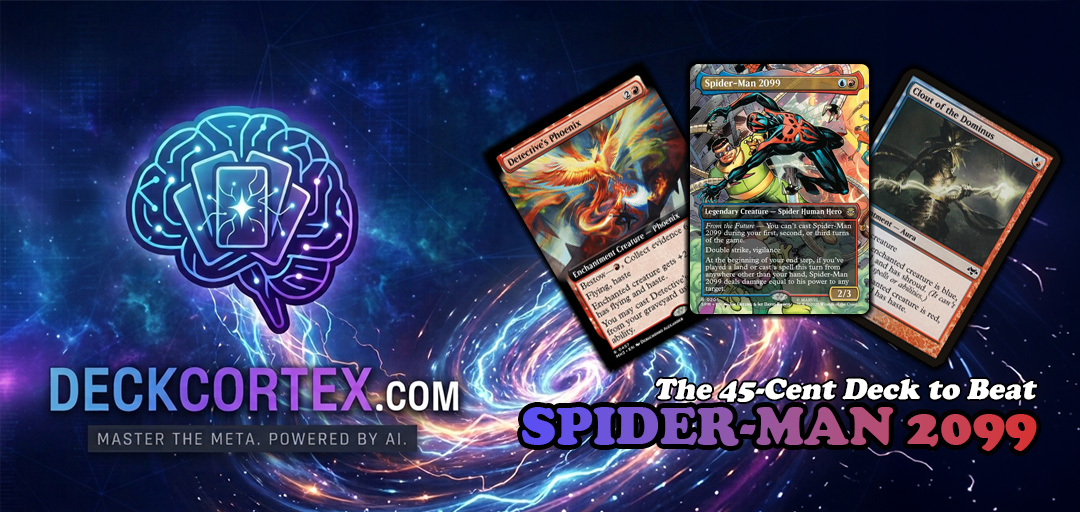
As of June 30, 2026. In our Duel Commander data, one commander sits a full notch above the entire format: Spider-Man 2099, a tempo deck built around a 45-cent rare. It's in 13.7% of the tournament lists we track — roughly two and a half times the next-best deck, in a format where nothing else even reaches 6%. And on May 25 the official Committee looked at exactly that picture and declined to ban it. With the next banlist window not until July 27, the deck to beat is locked in for the whole run-up to it. So let's talk about what it actually is, why the numbers look the way they do, and — the part most write-ups get wrong — how you actually beat it.
What our data shows
We pulled our own Duel Commander corpus — 2,444 scraped tournament lists from April 1 to June 30, 2026, all sourced from MTGTop8's placed Duel Commander decks. Spider-Man 2099 is the clear #1, and it isn't close:
- Spider-Man 2099 (Izzet tempo) — 13.7% (336 lists)
- Tasigur, the Golden Fang (Sultai control) — 5.5%
- Quintorius, History Chaser (Boros graveyard) — 5.0%
- Phelia, Exuberant Shepherd (Mono-White) — 4.3%
- Lumra, Bellow of the Woods (Mono-Green lands) — 4.2%
- Cloud, Midgar Mercenary (Mono-White equipment) — 3.6%
- Slimefoot and Squee (Jund) — 3.3%
- Aragorn, King of Gondor (Jeskai) — 2.7%
- Deadpool, Trading Card (Rakdos) — 2.6%
A note on the metric, because Spider-Man attracts a lot of differently-shaped numbers. Ours is a top-cut, decklist-appearance share — how often the deck shows up across the placed lists we scrape. It is not field share, and it is not match win rate (which we don't track). Read that way, the picture is stark: Spider-Man is ~2.5× the size of the #2 deck, the only deck near 6% is Tasigur, and nothing else clears ~4.5%. The popular shorthand that "it's about 14% of mtgtop8, almost double #2" is, if anything, slightly underselling the gap our data sees.
Two names on that list deserve a flag because they tend to get left out of the round-up pieces: Quintorius, History Chaser, a graveyard-and-Spirits planeswalker-commander, is our clear #3 at 5.0%, and Deadpool, Trading Card is a real presence in the top ten. The field under Spider-Man is broader than the usual three-pillar summary suggests.
The other thing the data kills is the "flash in the pan" read. Spider-Man's share is 13.7% now versus 13.3% across our six-month baseline — a +0.4-point move. This isn't a deck spiking on a new printing; it's a deck that has been parked at the top for months and simply hasn't moved. That stability is the strongest argument that what you're looking at is structural, not a fad.
The two-mana rare doing all of this
Here's the whole engine, and it costs less than a booster pack:
It's a 2/3 with double strike and vigilance. "From the Future" forbids casting it on your first, second, or third turns — so it's a turn-four-or-later play by rule. The payoff: "At the beginning of your end step, if you've played a land or cast a spell this turn from anywhere other than your hand, Spider-Man 2099 deals damage equal to his power to any target."
The math is brutal in a format that starts you at 20 life and ends the game at 21 commander damage from a single source. A naked 2/3 double striker is already four points of commander damage every time it connects, and the end-step trigger pings two more at any target — meaning it doubles as removal against the aggro decks and as reach to the face against control. Strap on Clout of the Dominus — an Aura that gives a creature +1/+1 and shroud while it's blue, and +1/+1 and haste while it's red — and because Spider-Man is both, he becomes a hasted, untargetable 4/5 that hits for eight a swing. Three connections kill a fresh opponent, the end step now throws four at whatever you like, and good luck pointing removal at it.
One disambiguation, because the two cards get mixed up constantly: this is Spider-Man 2099 (, spm:150), not Spider-Man 2099, Miguel O'Hara, a separate bounce-and-draw creature from Marvel's Spider-Man Eternal. The tempo all-star is the cheap one.
The deck the data shows — not the one most primers describe
Read most write-ups and you'll see Spider-Man billed as an aggressive "cheap beaters" deck — Dragon's Rage Channeler, Murktide Regent, True-Name Nemesis, that family. Our data says otherwise. Across the 336 Spider-Man lists we track, the consensus build is a lean **Izzet tempo-control deck**, and the near-universal cards tell you exactly what it's doing:
- A dense free/cheap counter suite — Mental Misstep (98.8%), Force Spike, Spell Snare, Mana Leak, Subtlety (98.6%), Counterspell (98.2%), Daze, and Force of Negation (91.8%). It wants to durdle on your turn and say no on theirs.
- Cantrips and card advantage — Expressive Iteration (98.0%), Gitaxian Probe, Preordain, Ponder, Brainstorm, plus Snapcaster Mage (96.9%) and Vendilion Clique (92.6%) for flashback value and disruption.
- Efficient burn that doubles as removal — Lightning Bolt (99.7%), Pyrokinesis (you may exile a red card rather than pay — free removal, 99.3%), Galvanic Discharge, and Ghostfire Slice.
But the cards that make this Spider-Man's deck, rather than a generic Izzet pile, are the enabler package — and they're near-universal for a reason most primers miss. Look again at the trigger: it counts a land or a spell played from anywhere other than your hand. A normal land drop out of your hand does not turn it on. You have to manufacture a non-hand play every single turn — and that's precisely what these do:
- Detective's Phoenix (in 100% of lists) — a bestow Aura you may cast from your graveyard. Casting it from the yard is a non-hand play (trigger satisfied), and it makes Spider-Man +2/+2 with flying and haste. Recursion, evasion, and the on-switch in one card.
- Wild Ride (99.5%) and Reckless Charge (98.2%) — each gives +3/+0 and haste, and each can be re-cast from the graveyard (harmonize / flashback). Haste enabler and non-hand play.
- Expressive Iteration — exiles a card you "may play this turn"; playing it from exile flips the trigger on.
So the "value" half of the deck isn't optional gravy — it's the ignition system. That reframes the whole archetype: it's not aggro that happens to play card advantage, it's a tempo-control deck whose finisher demands a non-hand play, built from the ground up to guarantee one.
Here's the version winning right now — Evan Colly's first-place list from the CdF Training at Artefacts in Bordeaux, June 28 (13 players):
We ran it through DeckCortex's deck engine, and the headline is what isn't there: zero complete two-card combos. This is a fair tempo-control deck, full stop — it wins with a commander and a counter suite, not a loop. The engine's flex read is interesting too: Traumatic Critique is flagged "rising tech," climbing from ~13% to ~30% of lists across our windows — the current tuning direction, if you want to be ahead of the curve. (The combo count is a signal, not the final 1–5 bracket, which DeckCortex assigns separately.)
And it's genuinely the global deck to beat: alongside Bordeaux, our June results show Spider-Man taking down events in Barcelona, Beijing (a 26-player Watermelon Cup), and MTGO Leagues, plus warm-ups for the Danish Nationals. France, Spain, China, Denmark, online — same deck, same wins.
Why the Committee won't touch it (and why that's defensible)
On May 25, 2026 the Duel Commander Committee published a dedicated statement and declined to ban Spider-Man 2099. The reasoning is worth reading straight, because it's better than the usual hand-wave: the deck "has firmly established itself as a tier 1 strategy," but "current data does not indicate a level of dominance that threatens the overall health or diversity of the format," and its combo elements "remain interactable through commonly played tools such as instant-speed removal and, to a lesser extent, graveyard hate."
Our engine read backs the "interactable" claim hard: there's no combo to disrupt — you interact on the stack, at the commander, and at the graveyard, all of which fair decks already do. And the Committee's historical point is the real one: "the presence of a leading blue interactive deck at the top of the metagame is not a new phenomenon." Duel Commander has been ruled by blue tempo for years — Raffine, Scheming Seer (eventually banned as commander), then Aragorn, King of Gondor, now Spider-Man. Ban the spider and you don't fix the format; you just coronate the next tempo deck. The concern is archetypal, not a single card — which is exactly why the more-floated intervention is a staple ban, not a Spider-Man ban.
The next banlist window is July 27, 2026, 8:00 PM Paris time. Nothing in the May 25 statement signals a change of heart, and the only Constructed marquee event before then — Pro Tour Marvel Super Heroes, July 17–19 in Amsterdam — is Booster Draft plus Modern, not Duel Commander, so it won't move this meta. Translation: the deck to beat will still be the deck to beat on July 27.
How to actually beat it
This is where the lazy advice ("just kill the commander") falls apart, because the deck is specifically armored against it. Here's the staged tech our data and the card interactions actually support:
1. Get under it. Spider-Man literally cannot be cast before turn four. Fast Mono-White is the cleanest answer in the format precisely because it's doing real damage on turns two and three while the spider is still stuck "in the future." Phelia, Exuberant Shepherd flashes in as early as turn two and exiles a nonland permanent each time she attacks — clearing a blocker out of the way, or blinking one of her own creatures to grow herself; Cloud, Midgar Mercenary tutors up an Equipment on entry and doubles its triggers. Both are top-six decks in our data for a reason.
2. Kill it on the turn it lands — and exile, don't destroy. Instant-speed removal is right, but timing and type matter. Once Clout of the Dominus is on it, Spider-Man has shroud and can't be targeted at all — so your window is the turn it resolves, before it gets suited up. And prefer exile: Swords to Plowshares removes it from the commander-damage math and denies the graveyard, where Detective's Phoenix and the rest of the recursion live. A "destroy" effect just feeds the engine you're trying to fight.
3. Bring graveyard hate. The Committee names it, and our decklist data is why: the recursion package (Detective's Phoenix from the yard, Snapcaster flashback, Wild Ride and Reckless Charge re-casts) is both the card-advantage engine and a big part of how the deck manufactures its non-hand play each turn. Exile their graveyard and you're attacking both at once.
4. Run Drannith Magistrate — it's better than advertised. Drannith Magistrate reads "Your opponents can't cast spells from anywhere other than their hands." Because a bare hand land-drop never satisfied Spider-Man's trigger, this shuts off the primary way the deck turns the commander on — every flashback, every cast-from-exile, every graveyard rebuy — while simultaneously strangling its card advantage. The only way around it is to play a land from a non-hand zone (off an Expressive Iteration exile, say), which is far less reliable. It's a two-drop that's already in every Cloud equipment list in our data (100% of them), and against Spider-Man it's close to a hoser.
Bottom line
If you're choosing a Duel Commander deck for the stretch into late July, Spider-Man 2099 is the safest pick on the board: the format's runaway #1 at 13.7% of our data, entrenched for six months, and just handed an official clean bill of health with no banlist threat until at least July 27. The commander is a 45-cent rare — the cost is the mana base (a stack of fetchlands and shocks runs the bill into three figures, all Scryfall paper) — and the list is, per our engine, a fair tempo-control deck with no combo to police. Want the exact 75 that won Bordeaux? It's embedded above; copy it in DeckCortex and start tuning your flex slots toward the rising Traumatic Critique tech.
And if you're aiming at it instead, the recipe is on the table: get under it with Mono-White before turn four, exile the commander the turn it lands and before Clout shrouds it, pack graveyard hate, and play Drannith Magistrate if you're in white. The one thing that resets all of it is the July 27 announcement — if the Committee changes its mind, or bans a staple instead, the math above changes overnight. Until then, build for the spider.
Data: DeckCortex Duel Commander corpus, 2,444 scraped MTGTop8 tournament lists, April 1 – June 30, 2026. Shares are top-cut, decklist-appearance shares — not field share and not match win rate. The six-month trend baseline is our own corpus. Card prices are Scryfall paper-market aggregates, not a live TCGPlayer feed. The deck engine's combo count is a signal, not a verdict — it found none in the featured list. Card text is quoted from Oracle (Scryfall). Banlist and Committee facts confirmed against the duelcommander.org announcements of March 30 and May 25, 2026; the next scheduled update is July 27, 2026.