Standard's Twin Pillars — and the Marvel Takeover Hiding in Plain Sight
"Izzet soup" is only half the story. Across 997 scraped lists from late June 2026, our data shows Standard is a two-pillar format — Izzet Prowess (193 lists) just pulled dead even with a Selesnya green counters deck (196) that nearly tripled in a month, once you merge the two labels our classifier splits it across — and the real Marvel impact isn't the Squirrel Girl combo everyone previewed but the Marvel staples (Namor, She-Hulk, Superior Spider-Man, M.O.D.O.K.) already maindecked in the best decks. A data-driven tour of the top five archetypes, their tech, and why June 29 left the format untouched.
As of June 30, 2026. Standard has a nickname right now — "Izzet soup" — and like most nicknames it's half true. Izzet Prowess — the Stormchaser's Talent spellslinger deck — really is the single most-played archetype in the format. But our own tournament data tells a sharper story: this is a two-pillar format, and the second pillar is bigger than its reputation. When you fold together the two labels our classifier splits one green deck across, the Badgermole Cub deck is sitting at 196 tournament lists to Izzet Prowess's 193 — a statistical dead heat at the top. And it became a dead heat this month: ninety days ago Izzet Prowess (23.4% of the field) towered over the green deck (under 8%); in the last thirty days Izzet cooled while the green deck surged roughly 2.5× to catch it.
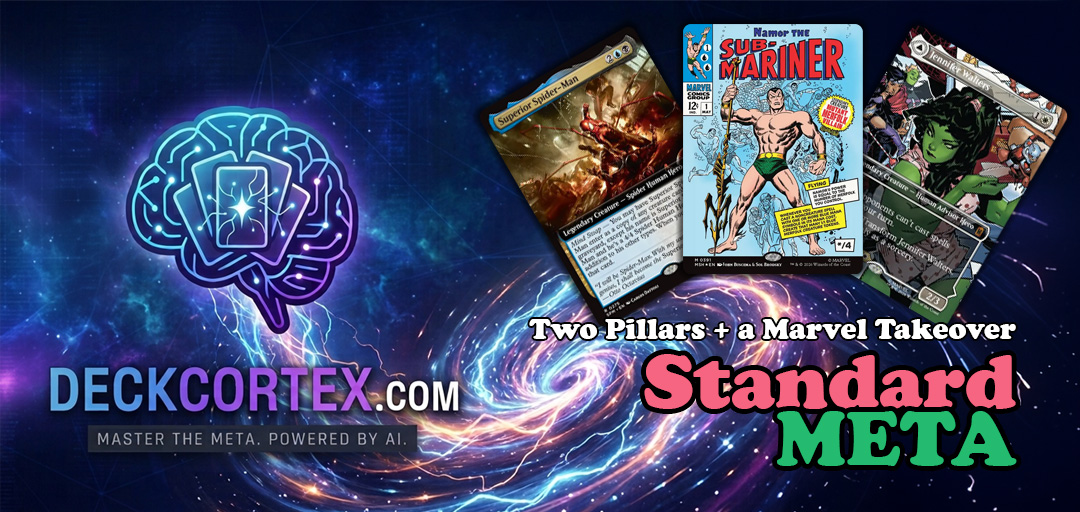
And underneath both pillars there's a quieter story the decklists themselves give away: Marvel is already everywhere. Not as the fringe Squirrel Girl combo every preview article promised — as maindeck staples in the decks that are actually winning. Wizards of the Coast just looked at this format on June 29 and decided it didn't need a single change. They were right, and not for the reason most people think.
What our data shows
We pulled our own Standard corpus — 997 scraped tournament lists from May 31 to June 30, 2026 (MTGO Standard Challenges plus scraped top-cut). Everything below is a decklist-appearance share: how often an archetype shows up across the lists we scrape. It reads a little lower than performance-weighted "metagame share," and it is a different thing entirely from match win rate, which we don't track. Here's the top of the format, with the 90-day window beside it so you can see which way each deck is moving — the momentum is the part static tier lists miss:
| Archetype | 30-day share (n=997) | 90-day share (n=5,857) | momentum | |---|---|---|---| | Izzet Prowess | 19.4% (193) | 23.4% (1,373) | cooling | | Selesnya green (merged) | ~19.6% (196) | ~7.9% (460) | surging (~2.5×) | | Izzet Spellementals | 9.8% (98) | 7.2% (419) | rising | | Jeskai Lessons | 7.3% (73) | ~2% | new, rising | | Superior Doomsday (Dimir Excruciator) | 6.7% (67) | 6.3% (371) | stable | | Mono-Green Landfall | 3.6% (36) | 6.6% (384) | falling |
(Azorius Momo 4.2%, Four/Five-Color Control ~6.4% — split across two casing-variant labels — and Mardu Aggro 2.1% round out the Tier-2 pack.)
Three things jump out of that last column. First, the twin-pillar race is a June development: a quarter ago Izzet Prowess was a runaway #1 and the green deck barely cracked 8%, and the gap closed almost entirely in thirty days. Second, Izzet is still everywhere as a color — Prowess, Spellementals and Izzet Lesson together are ~33% of the field, and counting the Izzet-rooted Jeskai Lessons, blue-red is roughly 40%. "Izzet soup" is fair at the color level even though no single Izzet deck owns the format. Third — a correction worth flagging — the green deck that's surging is not a Landfall deck. Actual Mono-Green Landfall is the one green strategy in decline (6.6% → 3.6%); the deck rocketing up the table wins with +1/+1 counters, which we'll get to next.
The merge is the part that needs receipts, so here they are. Our classifier files the green deck under two names — "Selesnya Nature's Rhythm" and "Selesnya Aggro" — but they are the same deck. Both run Badgermole Cub, Llanowar Elves, Surrak, Elusive Hunter, Practiced Offense, Leatherhead, Swamp Stalker, Pawpatch Recruit, Ouroboroid, Brightglass Gearhulk and Jennifer Walters — and they share a sideboard (Elspeth, Storm Slayer, Rest in Peace, Restoration Magic, Sheltered by Ghosts). Compare the #2 "Nature's Rhythm" list with the #1 "Aggro" list and notice how little actually changes:
So the honest headline isn't "Izzet is #1." It's "Standard has two co-equal best decks, both rising," with a flat, healthy spread of viable Tier-2 strategies behind them. That's almost exactly how Wizards described it on June 29 — more on that below.
One first-hand read before the deck-by-deck tour: the reason Izzet Prowess leads the play-rate charts but keeps coming up short of trophies — its Pro Tour Secrets of Strixhaven Day 1 share of 30.5% converted to a 49.4% win rate and zero Top 8 copies (magic.gg/Frank Karsten, May 2026) — is sitting right there in the matchup spread. Half the field is now built to punish it, and the green pillar in particular goes over the top of a tempo deck that's trying to win with 2/1s and burn.
1. Izzet Prowess — the spells-make-an-army deck
This is Arianne's first-place list from a June 27 Standard Challenge, and it's the cleanest snapshot of where the archetype actually is. The skeleton is a wall of one-mana cantrips — Opt, Sleight of Hand, Boomerang Basics, Flow State — in effectively every list, glued to Burst Lightning and Spell Pierce. What those cantrips do is feed a stack of spell payoffs at once:
- Stormchaser's Talent is a one-mana Class that makes a prowess Otter on entry and, once you've paid to level it up, another Otter every time you cast an instant or sorcery.
- Slickshot Show-Off and Colorstorm Stallion turn each spell into a temporary +2/+0 (Slickshot) or a permanent +1/+1 plus, on a five-mana spell, a free copy of the Stallion.
- And the new engine: Namor the Sub-Mariner, a Marvel card the #1 list runs in a two-of, whose power equals the Merfolk you control and who spits out a 1/1 Merfolk for every blue pip in each noncreature spell you cast.
The deck wins by casting two or three spells in a turn, making a board of pumped tokens, and pushing through with Secret Identity — a one-mana Spider-Man trick (in 65% of our Izzet Prowess lists) that either hexproofs your threat or flips it into a 3/4 flier for the alpha strike. Up top, Eddymurk Crab is a flash threat that costs less per instant or sorcery in your graveyard, and Ral, Crackling Wit is the grindy planeswalker that buries control decks. The weakness is exactly what the data implies: it folds to instant-speed removal and sweepers, and it does not enjoy racing a green deck that gets bigger every combat.
2. The Selesnya green deck — counters, not Craterhoof
Here's where I have to correct the brief I was handed. The popular write-up of this deck — "ramp with Badgermole Cub and Llanowar Elves into a Nature's Rhythm tutor for Craterhoof Behemoth" — describes a deck that, as far as our winning lists are concerned, does not exist. Look back at the two embedded lists: neither one plays Nature's Rhythm or Craterhoof Behemoth. The "Nature's Rhythm" name is a legacy label our classifier never shook off.
What the deck actually is: a +1/+1-counter midrange machine. Badgermole Cub is the engine — it animates a land on the way in and, critically, adds an extra green every time you tap a creature for mana, so a board of mana-dorks doubles up fast. Ouroboroid is the payoff that turns that mana into a blowout: at the start of combat it puts a pile of +1/+1 counters on each of your creatures equal to its own power. Practiced Offense anthems your whole team and hands one creature double strike, with flashback for a second helping; Elspeth, Storm Slayer doubles your tokens and pumps the board.
The disruption is what makes it more than a goldfish. Surrak, Elusive Hunter can't be countered and draws you a card whenever an opponent targets your creatures; Pawpatch Recruit turns their removal spell into a +1/+1 counter; Brightglass Gearhulk tutors two one-drops on arrival. And the Marvel payoff that ties it together is Jennifer Walters — a two-mana body that reads "Your opponents can't cast spells during your turn," shutting off instant-speed interaction during your alpha strike, then transforming into a damage-redirecting She-Hulk. That this deck is the format's fastest riser — the merged green archetype roughly tripled from ~7.9% of the field across the last 90 days to ~19.6% across the last 30, even as Izzet Prowess cooled off — is no accident. It is the single best answer to a field full of Izzet tempo and control.
3. Izzet Spellementals — the budget tempo bomb
WadeB's Challenge-winning list is the format's best-kept value: it's the cheapest deck near the top and one of the few with zero Marvel cards in it. The plan is pure Izzet tempo with a graveyard-cost-reduction twist. You fill the yard with cheap Prismari Charm, Traumatic Critique and Get Out, which makes your Elementals collapse in price — Hearth Elemental costs less per instant, sorcery, or Adventure in your graveyard, and Eddymurk Crab does the same.
The payoff card, in every single list, is Sunderflock. On paper it's a nine-drop. In practice it costs less, where X is the greatest mana value among your Elementals — so with an Eddymurk Crab (mana value 7) already down, Sunderflock is a two-mana one-sided board wipe that bounces every non-Elemental creature your opponent controls back to hand while leaving your team untouched. Against the counter-decks and the green go-wide pillar, that's backbreaking; against control, where there's nothing to bounce, it's where the deck gets soft.
4. Jeskai Lessons — Strixhaven control, Avatar engine
The breakout control deck of the season is a genuine hybrid: the payoff suite is from Secrets of Strixhaven, but the engine is the Lesson subtype from Avatar: The Last Airbender. The cheap interactive Lessons — Firebending Lesson, Combustion Technique (which scales with Lessons already in your graveyard), Iroh's Demonstration, It'll Quench Ya! — double as removal/counters and as fuel: Gran-Gran makes your noncreature spells cost less once three Lessons are in the bin, and Accumulate Wisdom draws deeper under the same condition.
Two cards turn that grind into a kill. Tablet of Discovery is a mana rock that taps for double red toward instants and sorceries, accelerating you to the deck's haymaker a turn or two early: Jeskai Revelation, a seven-mana instant that bounces something, deals 4, makes two prowess Monks, draws two, and gains 4 — a four-card swing on one card. Improvisation Capstone is the inevitability engine, free-casting spells off the top and recurring itself every turn. It's reactive, it's grindy, and it grinds the creature decks out with a stream of cheap removal Lessons backed by Revelation's card advantage — the green pillar's wide boards are exactly what Iroh's Demonstration is for.
5. Superior Doomsday — Dimir control with a six-pip wincon
The black-based control deck goes by two names — "Superior Doomsday" and "Dimir Excruciator" — for one deck. Antoxafk's first-place list shows the whole package. The card-advantage spine is Stock Up, Winternight Stories, and Emeritus of Ideation — yes, the back face is literally Ancestral Recall, "draw three cards" for . The board control is Day of Black Sun and Deadly Cover-Up, with Bitter Triumph and Requiting Hex for spot removal.
The win conditions are where it gets spicy — and Marvel. Doomsday Excruciator is a flier (six black pips, very on-theme) that, when it enters, mills every player down to the bottom six cards of their library and then gives you an extra card each upkeep — a Doomsday-on-a-body that wins the long game. Superior Spider-Man reanimates the best creature in any graveyard as a 4/4, and M.O.D.O.K. is a flying lifelinker whose static aura shrinks the opponent's whole board by −1/−1. Three of this deck's most important cards are Universes Beyond, and nobody blinks.
The Marvel factor: the takeover already happened
Now the part the brief got backwards. The going narrative is that Marvel Super Heroes (released June 26, 2026; the Arena and MTGO versions ship under the "Through the Omenpaths" banner) produced exactly one tournament-relevant deck — a Squirrel Girl combo — and that everything else is preview-season hype. Our data says the opposite: the dedicated Marvel combo deck is the one thing we can't find, while Marvel role-players are already load-bearing in the format's best decks.
Count them up from the lists above: Secret Identity in 65% of Izzet Prowess decks and Namor the Sub-Mariner in the #1 list; Jennifer Walters and Spider Manifestation in the green pillar; Superior Spider-Man (50% of its archetype) and M.O.D.O.K. in Dimir. Add the Spider-Man set from last September and the Avatar Lessons powering Jeskai, and 2026 Standard is the most Universes-Beyond-saturated the format has ever been. MSH's new mechanics — Plan, Power-Up, and Teamwork — didn't need to spawn a brand-new archetype to matter; they slotted role-players into existing shells, which is the healthier outcome anyway.
So what about Squirrel Girl? The pieces are real and Standard-legal — The Unbeatable Squirrel Girl doubles your Squirrels for , Shang-Chi, Master of Kung Fu and Enduring Vitality turn those Squirrels into mana, and Craterhoof Behemoth or a big Nature's Rhythm ends it — but in our entire Standard corpus, a search for "Squirrel Girl" returns zero decks (every "Squirrel" hit is the Crazy Squirrel Games Store venue). It's a real combo on paper; it has not converted to results in our data. Treat it as a spec, not a Tier-3 deck — and the same goes for the much-hyped Thor, God of Thunder, a slick Izzet/Jeskai payoff with no maindeck home in the winning lists yet.
June 29: Wizards looked, and left it alone
Every B&R window this spring brought the same speculation and the same result for Standard: nothing. The June 29, 2026 announcement made no changes to Standard, with Wizards stating flatly that "Standard is now more diverse than it was at the time of Pro Tour Secrets of Strixhaven." The May 18 update had also left Standard untouched — it was Modern that lost Phlage, Titan of Fire's Fury and Lotus Field. The next B&R is August 10, 2026, and that — not the Pro Tour — is the date Standard players should circle.
Because here's the fact-check worth printing in bold: Pro Tour Marvel Super Heroes (July 17–19, MagicCon Amsterdam) is not a Standard event. It's Marvel Super Heroes Booster Draft plus Modern Constructed, with a Booster Draft Top 8 (the first in fifteen years) and a $500,000 purse. Any "what will the Pro Tour do to Standard" speculation is aimed at the wrong target. Standard's next real test is the RCQ grind and the August 10 list.
Bottom line
If you're sleeving up for a Standard event this week, the read is simple. The two safest decks are the two pillars — Izzet Prowess if you want the most flexible, highest-floor tempo deck, or the Selesnya green counters deck if you'd rather be the one going over the top, and it's the field's fastest riser for a reason. If your goal is specifically to beat Izzet Prowess, the green pillar and the disruptive control decks already do; bring sweepers and you're most of the way there. On a budget, Izzet Spellementals is the cheapest competitive deck in the format and its Sunderflock plan eats the creature decks alive.
And don't overthink the Marvel angle. You're already playing it — Namor, She-Hulk, Superior Spider-Man and friends are in the maindecks that win. The combo decks the previews promised can wait until they actually show up in the results. Want the exact 75s? Every list above is embedded — copy one into DeckCortex and start tuning your own flex slots.
Data: DeckCortex Standard corpus, 997 scraped tournament lists, May 31 – June 30, 2026 (the 30-day window), with a 90-day baseline of 5,857 lists, April 1 – June 30, 2026, for the momentum column; shares are decklist-appearance shares (our classifier splits the green deck into "Selesnya Nature's Rhythm" + "Selesnya Aggro" — merged here, verified by identical cores and sideboards in the two embedded lists), not performance-weighted and not match win rate, which we do not track. `presence_pct` figures are copies-weighted, so a card "in every list" can read above 100% on basics. Card prices referenced are Scryfall paper-market aggregates, not a live TCGPlayer feed. Tournament finishes and embedded decklists come from our scraped results; numeric snapshot ids can change on re-scrape and were verified to resolve on June 30, 2026. External figures (mtgdecks.net play-rate, magic.gg/Frank Karsten Pro Tour and Regional Championship win rates) are labelled as such and are different metrics from ours. Banlist, set-release, and Pro Tour facts were web-verified against the June 29, 2026 B&R announcement and magic.gg/Wizards event pages on June 30, 2026. Every card named was validated against live Oracle text before publication.