Tarmogoyf Is Coming to Standard, and Modern Stopped Playing It
Tarmogoyf is a mythic in Reality Fracture's main set, which makes it Standard-legal on October 2 for the first time since 2008 and Pioneer-legal for the first time ever — and in the six months before that, it appeared in 11 of 14,317 Modern main decks and zero of 9,458 Legacy lists in our corpus. We ran the Standard it lands in through the same data: the most-played removal spell in the post-ban format, Requiting Hex, sits in 25.9% of lists and kills a mana-value-2 creature at any size for one mana; one list in five cracks Fabled Passage into its own graveyard, so "land" is not the rare type the consensus claims; battles are zero and kindred is one Firdoch Core. The realistic Standard Goyf is a 3/4 on turn three and a 4/5 in the grind — a fine two-drop, not the monster Modern quit on — and three numbers in the first month will tell you whether that read holds.
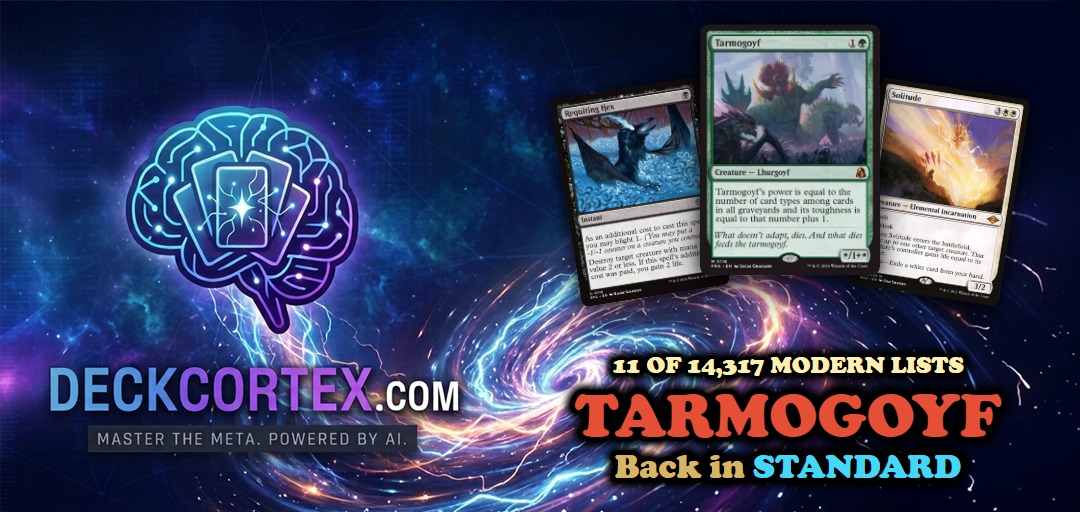
Eleven. That is how many of the 14,317 Modern decklists in our corpus since March 11 run Tarmogoyf in the main deck — 0.1%. Legacy is cleaner still: zero of 9,458 lists. The creature that defined two formats for a decade has, by the only measure that doesn't lie, left both of them.
Which is the context for this week's loudest preview. Reality Fracture's Tarmogoyf thread on r/magicTCG drew 620 comments, more than any other card in the set's preview season, and the thing being argued about is not the card text (unchanged) but the frame around it: mythic, main set, FRA #116. Not the Commander deck, not the Special Guests slot. A main-set printing means that on October 2 Tarmogoyf is legal in Standard for the first time since Future Sight rotated out in 2008, and legal in Pioneer for the first time ever. So the question is not whether Goyf is back. It's what it does in a format with no fetchlands, no battles, and a one-mana removal spell in a quarter of all decklists.
The card, and the nine types it counts
The Oracle text is the 2007 text: Tarmogoyf's power is equal to the number of card types among cards in all graveyards and its toughness is equal to that number plus 1. Two things about that sentence matter more in 2026 than they did when the card was a $190 mistake. First, "card types" now means nine: artifact, battle, creature, enchantment, instant, kindred, land, planeswalker, sorcery. Supertypes and subtypes never counted; kindred (the type formerly called tribal) and battle both do. Second, "all graveyards" — the opponent's yard counts, which in a Standard led by an instant-and-sorcery deck is not a footnote.
The design-mistake lore is true as far as it goes: the card was cut from Future Sight and re-added from memory with a cheaper cost than the version that had been removed, as Wizards' own designers have told it since, and it became the first card to reference the planeswalker type before a planeswalker had been printed. The market history is the part players remember — a peak around $190 to $200 in early 2014 per the trackers — and the current reality is the part they forget: on September 11 the cheapest printings sit at $5.20 (Time Spiral Remastered) to $6.35 (Modern Masters 2015) on Scryfall's paper aggregate, with the Future Sight original at $20.46 and its foil at $188. A mythic reprint in a Standard set is a large print run. Read the older copies accordingly.
The format that outgrew it: what actually replaced Goyf in Modern
The story usually told is power creep, and it is half right. In the same 14,317-list window where Goyf appears eleven times, the one-mana threats that took its slot are everywhere: Ragavan, Nimble Pilferer in 19.7% of Modern main decks, Psychic Frog in 13.4%, Dragon's Rage Channeler in 6.8% — a creature that reads Goyf's own text ("four or more card types among cards in your graveyard") and turns it into flying and +2/+2 for . Orcish Bowmasters sits in 8.3% and punishes exactly the card-advantage midrange decks that used to sleeve Goyf.
The other half of the story is the answers, and here the data corrects the narrative. Goyf's whole pitch was being the biggest body for two mana; Modern's removal stopped caring about size. Solitude is in 22.6% of lists and exiles anything. Prismatic Ending (16.6%) exiles by mana value — Goyf is a 2. Fatal Push (14.2%) destroys mana value 2 or less with no revolt required. Lightning Bolt (15.0%) and Unholy Heat (6.7%) are the only popular answers that check size at all, and Heat with delirium deals 6. A 5/6 that dies to the same as a 2/3 is not a 5/6; it's a 2/3 that cost you an extra card type. Even Murktide Regent, the delve dragon that took over Goyf's "biggest thing on board" job in 2021, is down to 1.5% of Modern lists in the window.
Legacy is the same lesson with the volume turned up: Murktide 21.1% of 9,458 lists, Bowmasters 20.9%, and the only Lhurgoyf anyone registers is Nethergoyf at 6.9% — a one-mana version that counts only your own graveyard and comes back from it. Tarmogoyf: zero. The reprint changes none of this. Nobody in Modern or Legacy was short of copies.
The Standard it lands in
Our post-ban window — August 11 to September 11, 1,367 canonical lists after we stripped the cross-feed duplicates — has Mightform Harmonizer's deck on top: Mono-Green Landfall at 14.8% of registered lists (three spellings of the label merged), Izzet Spellementals at 12.3%, then Dimir Aggro 5.8%, four- and five-color Control 5.0%, Mardu Aggro 3.8%, Superior Doomsday 3.7%. That is list share, not a win-weighted read; for calibration, the winner's-metagame figure Frank Karsten published for August 18 to 31 had Landfall at 27.8%, which tells you the same thing with a different weighting. The August 10 bans — Badgermole Cub, Stormchaser's Talent, Gran-Gran — were explicitly meant to slow this format down. A creature that grows on its own arrives into a metagame where the two best decks are a landfall pile and a spells pile.
Here is the number that decides how good Goyf can be there, and it is not a threat — it's the removal:
Requiting Hex is in 25.9% of the 1,390 Standard main decks in the window, the most-played interactive spell in the format. It costs , it destroys a creature with mana value 2 or less, and it has no revolt clause to work around. Tarmogoyf is mana value 2. The format's most common answer kills it for one mana at any size, on turn two, before the graveyard has a second type in it. Behind Hex: Bitter Triumph 18.4%, Erode 17.9% — a white instant that destroys a creature or planeswalker outright — and Shoot the Sheriff 17.5%, which kills any non-outlaw and a Lhurgoyf is not an outlaw. Get Out (12.4%) counters the creature spell. Deadly Cover-Up 10.2%, Day of Judgment 4.4% and Day of Black Sun 4.3% sweep. The only common answer Goyf actually beats is Burst Lightning, in 20.6% of lists: the spell goes to the graveyard as the last step of its resolution, state-based actions are checked afterwards, so a 1/2 Goyf dealt 2 damage becomes a 2/3 with two damage on it and lives. That interaction is real and it is the whole argument for the card in the Izzet matchup. It is also one card.
Compare the density. Modern's size-agnostic answers to a two-drop (Solitude, Ending, Push) sum to roughly one per deck across the format; Standard's (Hex, Triumph, Erode, Sheriff) sum to more than that per list among the decks that play black or white. Standard didn't get a slower Goyf. It got Goyf into a format where his headline stat is irrelevant to the most-played spell.
Goyf math with real Standard graveyards
The research consensus says Standard graveyards are type-poor: no fetchlands, no battles, no kindred, so the card tops out around 3/4. The list data agrees on two of those and disagrees on the third.
Battles: none. There are zero battle cards legal in Standard, so the ninth type is off the table until a set prints one. Kindred: marginal, not absent. Thirteen kindred cards are Standard-legal; the one that gets played is Firdoch Core, a Kindred Artifact in 3.7% of lists — and because it carries two types, one dead Firdoch Core is worth two points of Goyf. Nameless Inversion and Crib Swap, the kindred removal spells, appear in no list in the window. Lands in the graveyard: common, and this is where the consensus is wrong. "No fetchlands" is true. But Fabled Passage is in 20.9% of main decks, Escape Tunnel in 20.2%, Demolition Field in 15.7%, plus Elven Passage 3.3% and Promising Vein 3.2%. One Standard list in five cracks a land into its own graveyard by turn three, and Icetill Explorer (20.2%) mills a card on every landfall. Land is not the rare type. Planeswalker is: Kaito, Bane of Nightmares at 9.7% and Professor Dellian Fel at 3.3% are the only walkers above 1%, and walkers rarely die into a yard. Artifacts and enchantments are abundant in the lists — Lumbering Worldwagon 10.9%, Tablet of Discovery 9.4%, Earthbender Ascension 20.6%, Sapling Nursery 16.5% — but they reach the graveyard only when they die or get sacrificed, so they are late types, not turn-three types.
Put that together and the realistic Standard Goyf, read off what the lists contain rather than off a game state we don't track, looks like this:
| Stage | Types a graveyard realistically holds | Goyf | |---|---|---| | Turn 3 | creature + instant, or creature + land after a cracked Passage | 2/3, often 3/4 against a spells deck | | Mid-game grind | creature + instant + sorcery + land | 4/5 | | Late game | + enchantment or artifact (a dead Room, a sacrificed Core) | 5/6 ceiling; a Firdoch Core in the yard adds kindred for 6/7 as a curiosity |
Against Izzet Spellementals the opponent does the work — instants, sorceries and creatures pile up in their yard whether you want them to or not — and "all graveyards" turns a two-mana body into a 4/5 by the middle of the game. Modern's delirium decks hit four types by turn two off a fetchland and a cantrip; Standard gets there by turn five. That is the honest size comparison, and 4/5 for two mana in a format whose best deck doubles power and goes wide is a fine rate. It is not a format-warping rate.
The shell people will try first is the one that already exists. This is the highest-placed Golgari list of the window that fits the profile, McWinSauce's eighth place from the August 31 Standard Challenge:
Its sixty cards contain eight of the nine types — 25 lands, 13 sorceries, 6 instants, 5 artifacts (four of them Firdoch Core), 5 enchantments (Unholy Annex // Ritual Chamber and Nowhere to Run), 4 creatures and one planeswalker — and exactly four creatures. A Goyf slotted into that deck would be its biggest creature by turn four in most games and its only two-drop threat in all of them. The competing two-drops the format already runs tell you where the ceiling is: Marauding Mako and Moonshadow are each in 5.0% of lists, Enduring Curiosity in 10.6%, and all three do something Goyf does not — grow on their own terms, come back, or draw cards.
Pioneer, briefly
Pioneer gets the card for the first time and has even less use for it. Over the same six months (5,759 lists, main deck) the format's most-played spells are Thoughtseize at 35.1% and Fatal Push at 32.6%; Bitter Triumph 11.0%, Go for the Throat 9.8% and Burst Lightning 18.1% fill in behind, and Fabled Passage is in only 3.4% of lists. A two-mana creature in a format where one list in three runs Push and one in three runs Thoughtseize is Modern with fewer fetchlands. Goyf's Pioneer future is a Golgari or Rakdos midrange curve-filler with a target on it, not a reason to build.
What to watch
The verdict the data supports: Tarmogoyf is a real Standard card and a fringe one — a solid rate in green midrange, a 4/5 by the mid-game against the format's best deck, and dead to the format's most-played spell at any size. Three numbers would change that read, and all three are measurable in our corpus the week the set goes live:
- A Goyf deck above 5% of Standard lists in the first month. Any Golgari, Sultai or Jund shell registering Goyf at that share means the removal math above was wrong about how often Hex is actually held for a two-drop.
- Requiting Hex falling out of the top three. If Reality Fracture's threats push the format toward bigger creatures, Hex's mana-value cap starts costing black decks, and Goyf's best answer gets cut for Bitter Triumph — which still kills it, but at two mana on their turn instead of one.
- A Pioneer list, any list. Zero of 5,759 is the baseline. The first Challenge Top 32 with Goyf in it is a data point; the tenth is a trend.
Arena gets the card on September 29, paper on October 2, and the first Standard Challenges with Reality Fracture in them land the following weekend. Until then the only Goyf numbers that exist are the ones above: eleven Modern lists, zero Legacy lists, and a Standard whose most common answer was printed nine months before the question.
Card data validated against live Oracle text via the DeckCortex Scryfall proxy on September 11, 2026; Reality Fracture is unreleased and Tarmogoyf's Standard/Pioneer legality takes effect on release (Arena September 29, tabletop October 2). All decklist numbers are DeckCortex decklist-appearance shares over canonical tournament snapshots, main deck only, cross-feed duplicates removed: Modern n=14,317 and Legacy n=9,458 (2026-03-11 → 2026-09-11), Pioneer n=5,759 (same window), Standard n=1,390 for card presence and n=1,367 for archetype shares (2026-08-11 → 2026-09-11) — not field share, not win rates. "Size on turn N" statements are readings of list composition, not measured game states. Prices are Scryfall paper aggregates on September 11, 2026. Reddit engagement and the winner's-metagame figure are external signals, labelled where used.