The 49% Deck That Isn't: Dihada, Binder of Wills and How to Read a Conversion Rate
Our cEDH data says the best-converting deck in the format isn't Blue Farm or Kinnan — it's a 0.4%-share Mardu planeswalker deck, Dihada, Binder of Wills, topping out at 49.4%. It's also mostly a mirage: 81 counted entries, three recurring pilots, not a single win, and an independent tracker that puts the same deck at an ordinary 21%. Here's the real Bracket-5 deck under the number, why a conversion rate lies when you don't read its sample, and the cheap deck (Magda, ~$100) that actually beats the giants.
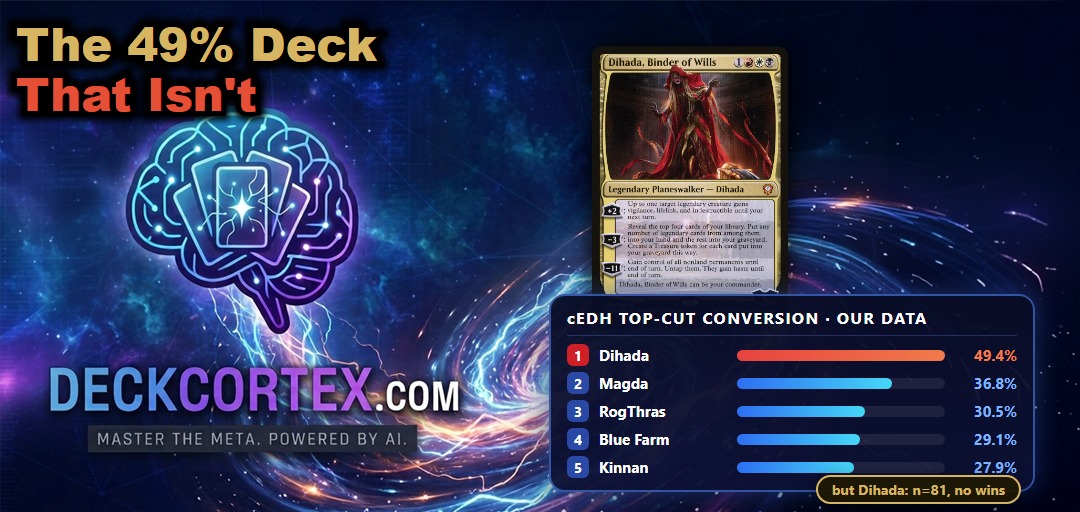
As of July 15, 2026. Everyone argues about the top of cEDH: Blue Farm versus Kinnan, which partner pile is a hair better than which. Here's a number that should end the argument, and the reason it doesn't. Across our last three months of tracked cEDH — 27,342 tournament entries from Topdeck.gg brackets — the single best-converting archetype isn't Blue Farm, isn't Kinnan, isn't even Magda. It's a 0.4%-share Mardu deck commanded by a planeswalker that most players will never sit across from: Dihada, Binder of Wills, converting to top cut at 49.4%. Every deck in the visible top ten lives in a 24-to-37% band. Dihada is twelve points clear of the best of them.
That's the kind of stat that looks like a discovery. It's mostly a lesson in how to read a conversion rate — and by the end of this piece you'll be able to take it apart yourself. But there's a real deck underneath the mirage, and a real "you don't need the expensive decks" story too. Let's do all three.
What the data shows
Two numbers per deck, both from our own cEDH corpus (27,342 entries, April 16 – July 15, 2026, Topdeck.gg-sourced). Share is decklist-appearance share — how often an archetype shows up. Conversion is our Top-Cut conversion rate — the fraction of that archetype's counted entries (the parenthesized n) that reached their event's Top Cut. Share is what you'll face; conversion is what beat the pod to get there.
First, the meta everyone actually talks about — the visible top ten by share:
| # | Deck | Share | Conversion (n) | |---|------|-------|----------------| | 1 | Blue Farm (Kraum + Tymna) | 7.4% | 29.05% (1,597) | | 2 | Kinnan, Bonder Prodigy | 7.2% | 27.93% (1,525) | | 3 | RogThras (Rograkh + Thrasios) | 5.4% | 30.47% (1,119) | | 4 | RogSi (Rograkh + Silas Renn) | 5.1% | 26.78% (1,042) | | 5 | Sisay, Weatherlight Captain | 3.5% | 28.04% (756) | | 6 | Ishai + Rograkh | 2.5% | 29.35% (511) | | 7 | Dargo + Tymna | 2.5% | 24.32% (514) | | 8 | TnT (Thrasios + Tymna) | 2.4% | 29.66% (553) | | 9 | Magda, Brazen Outlaw | 2.1% | 36.83% (429) | | 10 | Ral, Monsoon Mage | 2.0% | 28.24% (510) |
The whole visible field converts between 24% and 37%. Magda, Brazen Outlaw is the ceiling of what popular play produces, and we'll come back to her — she's the honest hero of this story.
Now drop below the 2%-share line, where the state-of-the-format articles stop looking. Rank the sub-0.5% decks by conversion, keep only the ones with at least 60 counted entries so it isn't pure noise, and a different picture appears:
| Deck | Colors | Share | Conversion (n) | |---|---|---|---| | Dihada, Binder of Wills | Mardu | 0.4% | 49.38% (81) | | Malcolm + Tymna | Esper | 0.4% | 36.08% (97) | | Kediss + Malcolm | Izzet | 0.3% | 36.00% (75) | | Tevesh Szat + Thrasios | Sultai | 0.4% | 33.70% (92) | | Nick Fury | 5-color | 0.3% | 31.15% (61) | | Crystal, Inhuman Princess | 4-color | 0.4% | 26.51% (83) |
Of the 300 archetypes our full-field pull returned, 247 sit under 0.5% share and only about sixteen clear 60 counted entries. Dihada is the clear outlier of that qualified set — the highest conversion and the second-largest sample in it. On paper, it's an apex predator hiding under the meta.
The honesty beat, before the deck tech
So let's be precise about what "49.4%" is made of, because the number does not mean what a first glance says it means.
Dihada shows up in 119 tracked entries. Of those, 81 come from events where we know the full standings — that's the denominator. About 40 of those 81 reached top cut. Forty finishes. Compare Blue Farm's 1,597-entry denominator or Magda's 429, and you can already feel the ground move: a deck this thin swings twenty points on a good weekend from a single dedicated pilot. And when you read the actual results, that's exactly what you find. In our corpus Dihada's finishes cluster on three names — Akira Kaneko, Brandon Erman, Ethan Costello — recurring across events from 17 to 44 players, and the best placement in the entire sample is a single 2nd place. Not one first.
Then there's the tell that settles it. Point an independent tracker at the same commander and the edge evaporates. On EDHTop16 (fetched July 15, its default conversion view), Dihada sits at 21.15% — on eleven top cuts total — wedged between Kinnan at 19.5% and Blue Farm at 21.6%. Dead in the pack. The 49% is not reproducible outside our corpus; it's a property of a small, specialist-piloted slice, not of the deck. That divergence is the whole story, and I'd rather show it to you than bury it: our number is real, it's just fragile, and one honest external check is enough to see through it.
Hold both of those thoughts, though — "fragile number" and "real deck" — because they're both true. Dihada is not a meme. It's a genuinely tuned competitive deck. Here's what it actually does.
Dihada, up close: a Mardu Breach deck wearing a planeswalker
That's Kaneko's 2nd-place list from the Oahu Commander Invitational Qualifier (18 players, July 13) — the best finish in our data, and a fully-built cEDH deck by every engine measure we have. DeckCortex reads it as a Bracket 5 (cEDH) floor carrying 14 Game Changers, eight complete two-card combos, thirteen tutors, and eight fast-mana pieces. This is not a durdle.
Start with the commander, because a planeswalker in the command zone is genuinely unusual and it's the point. Dihada, Binder of Wills is Mardu, and cEDH ignores her "legends matter" precon theme entirely to abuse one ability: her −3, which reveals the top four cards of your library, puts any legendary ones into your hand, dumps the rest into your graveyard, and makes a Treasure token for each card it put there. In one activation that's up to four cards milled and four Treasures made — a self-mill engine and a mana engine stapled to a permanent that creature removal can't touch and that ticks back toward another activation every turn. She enters the game as a threat a Swords to Plowshares simply can't answer.
The kill is an Underworld Breach storm shell, the same engine that shows up all over the top tier. Breach gives every nonland card in your graveyard escape — recast it by paying its cost plus exiling three other cards from the yard — and the deck turns that into a loop with Lion's Eye Diamond (discard your hand, sacrifice it, add three mana) and Wheel of Fortune to refill. Our engine flags eight complete combos in Kaneko's 99, and two of them are commander-specific, which is the part worth slowing down for:
- Dihada + Underworld Breach + Flicker. Flicker is a two-mana white sorcery that reads "exile target nontoken permanent, then return it to the battlefield." That "nontoken permanent" wording — a modern erratum; the card used to say "target creature" — is the whole trick, because it lets you blink a planeswalker. Blink Dihada and she comes back fresh: loyalty reset, activation available again. Under Breach you recast Flicker from your graveyard for its escape cost, paid with the very Treasures the −3 keeps making, and blink-and-−3 as many times as you like. The result is your library milled into your graveyard, a mountain of Treasures, and a storm count climbing toward a win. (This exact line is catalogued on Commander Spellbook, for the skeptics.)
- Dihada + Underworld Breach + Mayhem Devil. Same loop, different payoff: Mayhem Devil deals 1 damage to any target whenever a player sacrifices a permanent. Every Treasure you crack in the loop pings the table. That's the near-infinite-damage kill.
The cleaner combo in the list doesn't even need the commander — Dualcaster Mage plus Molten Duplication makes infinite hasty copies on its own — and Bolas's Citadel sits on top of everything as a card-advantage engine that lets you cast off the top of your library paying life instead of mana, then turns ten permanents into ten life lost by each opponent. There's even a cute win-condition heist: Praetor's Grasp reaches into an opponent's library, exiles a card face down, and lets you play it — so the deck runs Thassa's Oracle out of someone else's deck when it wants a clean empty-library win.
Now the detail I actually find interesting, and it's in our inclusion data. This is a combo deck that splashes white not for removal but for a Treasure-and-protection package, and it's nearly unanimous across all 119 lists: Lotho, Corrupt Shirriff (97.8%) makes a Treasure whenever any player casts their second spell in a turn; Voice of Victory (97.8%) is a two-mana body that flatly reads "your opponents can't cast spells during your turn" — a one-sided Silence you leave on the battlefield to shield the combo turn; and Esper Sentinel (97.8%) taxes and draws. Add Ancient Tomb, Bolas's Citadel and the ritual/tutor core — Dark Ritual, Demonic Tutor, Enlightened Tutor all at 97.3% — and you have a deck built to go fast and cast through resistance. As the LearnCEDH primer puts it, the Treasures let it push wins through soft taxes like Thorn of Amethyst or Sphere of Resistance and present a kill as early as turns two or three.
Its weaknesses are just as specific, and they're the honest counter to "why isn't it everywhere." Rest in Peace is a near-total blank check against it: exile all graveyards and Underworld Breach has nothing to escape from and Dihada's −3 stops making Treasures, because the milled cards get exiled instead of hitting the yard. One two-mana enchantment turns the deck off at both ends. Rule of Law effects hurt too — a deck that wins by chaining spells does not enjoy "each player can't cast more than one spell each turn," and it's the rare list that gets got by its own kind of lock. That fragility to hate you're already packing is a big part of why a 49% laboratory number doesn't survive contact with a prepared room.
So why the gap? The specialist effect, named
Put the deck tech next to the two conversion numbers and the explanation writes itself. Our 49% and EDHTop16's 21% aren't contradicting each other about the deck; they're measuring different pilots. Conversion rate is a blunt instrument — EDHTop16's own maintainers have an open issue (#29) to replace the raw metric with a smarter "conversion score," precisely because the current one weights a top cut at a 20-player local the same as one at a 200-player major. Strip the filters entirely, EDHREC's DougY notes, and you get sixty-eight decks tied at a "perfect" 100% conversion — a statistic that means nothing the moment you look at it.
Pilot quality is the confound, and it cuts both ways. The same analysis points out that Kinnan, Bonder Prodigy and Etali under-convert partly because they're the decks handed to newer players — good decks dragged down by their pilot pool. Dihada is the mirror image: a niche, demanding combo deck that essentially only its dedicated specialists register, so the handful of people playing it are exactly the people good enough to top with it. Forty top cuts, mostly from three names, no first place, on a metric that's shaky by design — that's not "the best deck in cEDH." That's a specialist effect with a number attached.
Which is not the same as saying the hidden tier is a mirage. It isn't. EDHREC's own under-the-radar picks for the year were Rocco, Cabaretti Caterer and Heliod, the Radiant Dawn // Heliod, the Warped Eclipse — real decks quietly punching above their share. There genuinely is a layer of tuned, specialist-piloted combo below the meta's waterline. Dihada is a proud member of it. It's just not the 49%-shaped poster child our raw table made it look like.
The rest of the hidden tier
A quick, honest tour of the other qualified niche converters, because a few of them are more repeatable than Dihada:
- Malcolm, Keen-Eyed Navigator partner decks are the substantial ones. Malcolm makes a Treasure whenever your Pirates connect, and that Treasure engine anchors an established family: Malcolm + Tymna the Weaver (Esper, 36.1% on 97) and the budget-favorite Malcolm + Kediss, Emberclaw Familiar (Izzet, 36.0% on 75), where Kediss copies your commander's combat damage to the rest of the table. The bigger Grixis build with Vial Smasher the Fierce converts a healthy 33% on a much sturdier 200 entries. These aren't spice — they're years-old combo decks, and Kediss even took a Store Championship on July 4 (Stephen Reynolds). Cheap, proven, punching up.
- Tevesh Szat, Doom of Fools + Thrasios (Sultai, 33.7% on 92) is the "tentacle" midrange-combo pile — a value planeswalker that draws off your own dying permanents next to Thrasios's inevitability. Old reliable.
- The Marvel commanders are, so far, noise — flag them as such. Nick Fury, Agent of S.H.I.E.L.D. (a one-mana five-color legend anchoring an Ad Nauseam shell) shows 31% and Crystal, Inhuman Princess (a four-color mana-dork that pings the table per noncreature spell, with an Isochron Scepter–Dramatic Reversal engine) 26.5% — but both commanders are barely a month old, on 60–85 entries, and those samples will move hard as the format actually figures them out. The only Marvel deck with a real trophy to its name won in Duel Commander, a different format. Treat "the Marvel set is seeding cEDH" as a question for August, not a finding for July.
The proven counterpoint: just play Magda
If what you actually wanted from that first table was "a cheap deck that beats the giants," the answer was hiding in plain sight at #9. Magda, Brazen Outlaw is the best-converting popular deck in the format — 36.83% on 429 counted entries, almost eight points clear of Blue Farm — and unlike Dihada it holds up to scrutiny. That's a 575-entry sample, not 81, spread across a real player base rather than three specialists. That's Vedder Balangue's 3rd-place list above.
Here's how it wins, and why it's the anti-Dihada on price. Magda reads "whenever a Dwarf you control becomes tapped, create a Treasure token," and "sacrifice five Treasures: search your library for an artifact or Dragon card, put it onto the battlefield." Make everything a Dwarf — Maskwood Nexus turns your whole board into every creature type — and then loop Clock of Omens (tap two artifacts to untap one) to tap a Dwarf, bank a Treasure, and stand it back up forever. Our inclusion data shows the shell is basically welded shut: Magda, Clock of Omens and Universal Automaton at 100%, Maskwood Nexus at 98%.
Now the prices, because this is the real "beat the meta" headline. Magda's combo core is Magda, Brazen Outlaw at $2.17, Clock of Omens at $4.27 and Maskwood Nexus at $2.21 — pocket change, and complete budget builds live around $100. Dihada's engine is the opposite animal: Grim Monolith at $472, Mox Opal at $244, Chrome Mox at $172, Imperial Seal at $163, Ancient Tomb at $135 — mtgdecks.net pegs a tournament Dihada list around $5,007. So if the story you liked was "you don't need the expensive top decks to win," Magda tells it far better than Dihada does: proven, reproducible, a fiftieth of the cost, and it out-converts every deck people actually respect.
Bottom line: how to read a conversion rate
The headline finding survives, in its honest form: below the 2%-share line, a layer of tuned specialist combo decks quietly out-converts the visible field, and Dihada, Binder of Wills is its most extreme reading at 49.4%. What doesn't survive is "Dihada is the best deck in cEDH." That 49.4% rests on 81 counted entries and about forty finishes, mostly from three pilots, with no win in the sample — and an independent tracker puts the same deck at an ordinary 21%, right in the pack. It's a real, Bracket-5, eight-combo Mardu deck that can absolutely steal a pod on turn three. It is not a giant-killer the play-rate charts are hiding.
So when you read any conversion rate — ours included — read three things at once: the share (how much play), the sample (how many counted entries), and the pilot pool (how many hands). A high rate on a tiny, specialist-driven sample is a hypothesis, not a verdict. Want to pressure-test this one yourself? Copy Kaneko's Dihada list above into DeckCortex and see how it feels against a room holding Rest in Peace — or copy Balangue's Magda, spend the $100, and go beat the giants for real. And keep half an eye on the next Commander Banned & Restricted update on August 10: nothing in it is likely to touch this shell, but if Dihada ever posts 30%+ across a 120-entry, broad-pilot window after it, come find me — I'll owe the specialists an apology.
Data: DeckCortex's own cEDH corpus — 27,342 tracked tournament entries, April 16 – July 15, 2026, sourced from Topdeck.gg brackets. "Share" is a decklist-appearance (metagame) share; "conversion" is DeckCortex's Top-Cut conversion rate, computed over the parenthesized counted-entry denominator (a different metric from share, and from match win rate, which we do not track for a multiplayer format). External figures are labelled as such: EDHTop16 conversion values were fetched July 15, 2026 from its default view and use a different corpus, window, and denominator than ours — they are not directly comparable, only independently corroborating; EDHTop16's own conversion metric is acknowledged as flawed (repo issue #29). EDHREC year-end analysis and banlist dates as cited. Combo counts (eight for the Dihada list) are DeckCortex engine signals of complete combos present — one input to its bracket-fit model, not the final 1–5 bracket. Card prices are Scryfall paper-market aggregates via our proxy as of July 15, 2026; the ~$5,007 Dihada figure is mtgdecks.net's. Embedded decklists are verified DeckCortex snapshots that resolved on July 15, 2026. Every card named was validated against live Oracle text before publication.