The Candelabra Ban: When the Numbers Correct the Narrative in Legacy
On June 29, Wizards banned a $2,275 Reserved List artifact out of Legacy — Candelabra of Tawnos, a four-of in 100% of the format's most-played deck. Our data on 856 tournament lists backs the "rapidly rising" story, but adds the twist: Trini Tron Karn converted top cuts at barely half the rate of Reanimator, the deck that rose just as fast and lost nothing.
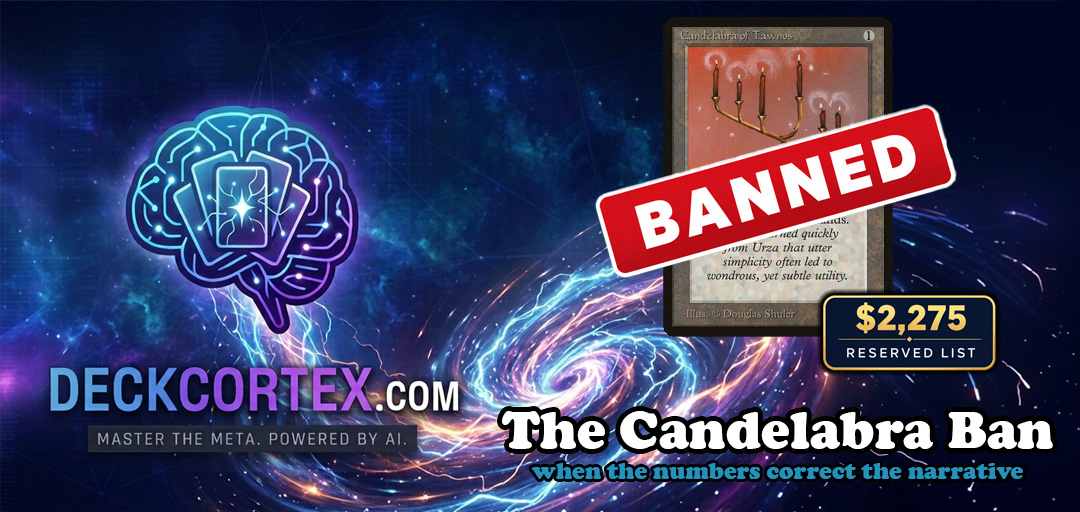
As of July 2, 2026. On June 29, Wizards of the Coast banned exactly one card in Legacy: Candelabra of Tawnos — a one-mana artifact from Antiquities, printed in March 1994, never reprinted in paper, and sitting on the Reserved List with a market price around $2,275 (Scryfall paper aggregate, July 2). Officially, the ban is aimed at the Colorless Tron deck our tracker files as Trini Tron Karn. Our own tournament data agrees with half of Wizards' story: the deck really was the format's biggest, and it really was exploding. But the data also adds the wrinkle the announcement skips — by our numbers, the most-played deck in Legacy was not its most successful. That deck rose just as fast, converts into top cuts nearly twice as often, and didn't lose a single card.
One ban, thirty years in the making
The June 29 announcement (the Legacy section written by Play Design's Carmen Klomparens) reads like a history lesson. Candelabra of Tawnos was on the banlist at Legacy's founding in 1996 and came off it in early 1999. Years later, after Mental Misstep was banned and Time Spiral was unbanned, the card powered the High Tide combo deck — High Tide makes every Island tapped for mana produce an additional , and Candelabra's ", : Untap X target lands" turns that into a geyser. (Time Spiral, for what it's worth, is back on the Legacy banlist today.)
This time the offender was Colorless Tron, and Wizards was explicit about what worried them: "we've seen the population of the deck increase without impacting its win rate, which is particularly concerning to us." Two copies met in the finals of the late-May Legacy Showcase Challenge, with a third in the Top 8. And on the card choice: "The core issue specific to Candelabra is that it rarely shows up unless it is in a problematically strong combo deck, where it is often the highest value-above-replacement card in the deck." The forward-looking logic is the most interesting part — "While we will continue to print exciting lands and card-draw engines, we are extremely careful about printing cards that untap your lands" — paired with a stated goal to "minimize the total number of bans" long-term. In other words: a design-risk ban on the one card Wizards can't out-design, not a punishment for last weekend's results.
What our numbers say
We pulled our own tournament data: 856 published Legacy decklists, June 2 through July 2 — MTGO Challenges and Leagues plus paper events. These are published (i.e., placed) lists, so read the shares as decklist-appearance shares of published results, not a full-field census. Here's the top of the format in the month leading into the ban:
| Archetype | Share of published lists | Top-cut conversion | |---|---|---| | Trini Tron Karn | 9.9% (85 lists) | 20.4% (10 of 49 counted entries) | | Reanimator | 9.0% (77) | 37.8% (14 of 37) | | Lands | 4.8% (41) | 8.3% (n=12) | | Ur Cori-steel | 4.1% (35) | 31.4% (n=35) | | Ub Tempo | 3.0% (26) | 36.0% (n=25) | | Sneak Show | 2.9% (25) | 12.5% (n=16) |
Two things jump out. First, the trajectory: against our six-month baseline, Trini Tron Karn went from 3.7% to 9.9% — up 6.2 points. Wizards' "population increase" isn't spin; it's exactly what our tracker shows. The deck was also completely solved: of its 85 lists, a sixteen-card core — Candelabra included — appeared in every single one, and Candelabra itself is flagged as one of the sample's top-gaining cards. When a four-figure Reserved List artifact shows up as a four-of in 100% of an archetype that just tripled its share, that's the kind of chart that gets a designer's attention.
Second, the wrinkle: Reanimator rose almost identically — 3.0% to 9.0%, up 6.0 points — and converts into top cuts at nearly twice Tron's rate (37.8% vs. 20.4%, as the share of each archetype's counted entries that reached an event's cut). Even Ur Cori-steel and Ub Tempo out-converted Tron. A caveat we'll repeat at the bottom: conversion is not match win rate. Wizards says Tron's win rate held up as it grew, and nothing in our data contradicts that — we don't track match results. But on the success proxy we can measure, the deck that ate the ban was the format's most-played deck, not its best-performing one. That's what makes this a preemptive ban, and Wizards more or less says so.
What four Candles actually did
The deck's DeckCortex label — Trini Tron Karn — is the deck in three words: Trinisphere, the Urza's Tron lands, and Karn, the Great Creator. The mana base is a colorless engine room: Ancient Tomb adds at the cost of 2 damage; assembled Tron makes Urza's Tower tap for ; Urza's Workshop has a metalcraft ability that taps for for each Urza's land you control. The quiet enabler is Planar Nexus: it is every nonbasic land type, which means it's simultaneously an Urza's Mine, an Urza's Power-Plant, and an Urza's Tower — whichever Tron piece you're missing — while also padding the Workshop count. Joe Dyer's point that Nexus, not Candelabra, is the reason to play Tron lands at all starts right here.
Candelabra was the multiplier on top. ", : Untap X target lands" is a rate card: every point of X aimed at a Tower returns three mana, at a Workshop potentially more, at an Ancient Tomb two. Voltaic Key and Manifold Key untap the Candelabra itself (and Grim Monolith), and the payoff end of that mana is brutal: The One Ring with protection from everything the turn it lands and an escalating draw engine, Karn's static shutting off your opponents' artifacts' activated abilities while his −2 fetches lock pieces from a wishboard — Mycosynth Lattice, Ensnaring Bridge, Pithing Needle — and Ugin, Eye of the Storms exiling a colored permanent on cast and again on every colorless spell after it. Trinisphere forces every spell that would cost less than three mana up to three while Disruptor Flute names the scariest answer and taxes it more, Kozilek's Command mops up, and Emrakul, the Aeons Torn — an extra turn on cast, annihilator 6 — or Cityscape Leveler closes.
Here's the shape of the thing at its best: AFX's runner-up list from the June 10 Legacy Challenge — four Candelabra, four Nexus, and only a 2/2/4 split of the actual Tron lands, because Nexus fills the gaps:
Was Candelabra the reason the deck won? That's the fight. MTGGoldfish's Joe Dyer, in his July 1 column "No More Candles," argues flatly that Candelabra was nowhere near the reason Tron was doing well — the threat density of The One Ring and Karn plus the mana efficiency of Planar Nexus carried it, and you never needed to mulligan toward Candle hands. Wizards' own wording half-concedes this: "highest value-above-replacement" is a statement about ceilings and future risk, not about what was winning games in June. Players on the June 30 WeeklyMTG stream were, per MTG Rocks' coverage, surprised the spared cards included Planar Nexus and The One Ring. Our data can't settle who's right — but it can tell us what to watch, and we'll get to that.
Reanimator: the riser nobody touched
Meanwhile, the format's #2 deck by share and #1 by conversion kept its whole toolkit. Legacy Reanimator has rebuilt itself since Entomb was banned (still banned today — and no, despite the folklore, Entomb is not a Reserved List card). Today's engine, per our data, leans black-red with a light blue touch: Faithless Looting and upkeep surveil fill the graveyard, and the actual reanimation comes from Animate Dead, Shallow Grave — the top creature card of your graveyard, hasty, exiled at the beginning of the next end step — and the format's new workhorse, Grave Researcher / Reanimate, the Secrets of Strixhaven card whose spell half carries the classic text: "Put target creature card from a graveyard onto the battlefield under your control. You lose life equal to that card's mana value." Effectively every list runs it.
The bodies coming back: Griselbrand ("Pay 7 life: Draw seven cards."), Atraxa, Grand Unifier refilling with her top-ten reveal, Archon of Cruelty draining on entry and attack, and the breakout Turtle Raph & Mikey, Troublemakers — trample, haste, and an attack trigger that reveals cards until it hits a creature card and puts it onto the battlefield tapped and attacking. Raph & Mikey is one of the fastest-growing cards in our whole Legacy sample. Backing it up: Unmask (in 97% of lists), Cabal Therapy and Thoughtseize — notably not Grief, which doesn't crack the archetype's top 25 in our data — and, in several builds, a Show and Tell / Stronghold Gambit plan B that skips the graveyard entirely.
To be clear, none of this is an argument that Reanimator should have been banned — a 37.8% conversion on 37 counted entries is a strong signal with wide error bars, not a conviction. It's an argument about what the June 29 announcement was: a bet on long-term design safety, not a strike against the deck our numbers grade as the format's most efficient.
The money: why this ban won't crash the card
Candelabra of Tawnos has exactly one tournament-legal paper printing: Antiquities, March 1994, collector number 43, Douglas Shuler art. It's on the Reserved List — Wizards' 1996 promise never to reprint certain cards in a functionally identical, tournament-legal form — so unlike every normal ban casualty, its supply is frozen forever. (The Masters Edition IV version you see online is a Magic Online-only printing; that's also why the card is cheap in tix and four figures in paper.)
The price story going in was steep: Wargamer noted the card "'only' cost $800 this time last year," and ICv2 tracked it from roughly $1,000 in early 2025 to over $3,500 by mid-2026 — a climb driven by the very deck that just got hit. At the Scryfall paper aggregate of $2,275.12 (July 2), the playset alone runs about $9,100 — more than twice everything else in AFX's 75 combined (the next-priciest cards in the deck: Grim Monolith at ~$472 and Ancient Tomb at ~$136). A Legacy ban deletes the competitive demand, but not the collector, Commander, and Vintage demand — the card remains legal in both of those formats — and Beckett's read matches the Reserved List pattern: scarcity holds the floor; don't expect it to fall out. The contrast case is instructive: when a card can be reprinted, the crash comes from supply — Quiet Speculation documented original Imperial Recruiter falling roughly 60% (about $350 to $138) when Masters 25 reprinted it. That mechanism simply cannot happen here.
Banning expensive Reserved List cards in Legacy isn't new, either. Earthcraft, Mishra's Workshop, and Time Spiral — all Reserved List — sit on today's banlist, alongside reprintable-but-banned staples like Entomb and Imperial Seal. What's new is the sticker: a card worth more than most complete decks, banned largely because of the deck that made it worth that much.
The rest of June 29, briefly
Legacy was the headline, but not the whole announcement. Pauper lost Seeker of Skybreak — because Hawkeye's Bow gives the equipped creature "Whenever equipped creature becomes tapped, it deals 1 damage to each opponent," and Seeker's ": Untap target creature" can simply target itself. Tap, ping, untap, repeat: a two-card infinite that Wizards said "can kill extremely quickly." Brawl (the casual Arena queue) took a six-card sweep: Force of Will, Subtlety, Wash Away, Ugin's Labyrinth, Time Warp, and Temporal Manipulation. And in Vintage, Wizards flagged The Fantasticar as a watch item — cast your fourth noncreature spell in a turn and it can sacrifice itself for four 4/4 colorless Construct tokens with flying and haste, which the announcement described as the potential to "attack for 16 damage out of nowhere on very early turns," noting it's immediately castable off Mishra's Workshop mana there.
Keep that last card in mind for Legacy too. It's not hypothetical.
July 1: the first post-ban data point
The ban took effect June 29, and the July 1 Legacy Challenge was the first Challenge on the other side. One event proves nothing — treat this as an anecdote with a timestamp — but the anecdote is loud. Of the 32 published lists: zero Trini Tron Karn. The trophy went to Dimir Tempo. Reanimator put four copies into the field, including the runner-up: Capitano_CL's list, which runs the full Grave Researcher / Reanimate playset, four Show and Tell, three Stronghold Gambit — and four copies of The Fantasticar, the card Wizards just said it's watching:
The detail we can't stop thinking about: AFX — the pilot behind Tron's June 10 Challenge runner-up finish above — was in that July 1 event too. On Beseech the Storm.
Bottom line
Read as a performance ban, June 29 looks strange: our data says Wizards hit the most-played deck's most expensive card, not the format's most successful deck, and left the better converter untouched. Read as what Wizards actually wrote — a design-risk amputation of an effect ("untap your lands") that gets scarier with every powerful land they print, executed while the deck was popular enough to justify it — it's coherent, and the 1996/1999/2026 history gives it a certain symmetry.
The scoreboard for who's right arrives fast. By the August 10 announcement: if a Candelabra-less Tron shell rebuilds around Planar Nexus, The One Ring, and Karn and stays top-tier, Dyer's "wrong card" critique is vindicated and the Nexus/One Ring conversation reopens. If Tron evaporates the way July 1 hints, the surgical bet worked. Watch Reanimator's share and conversion either way — a 37.8%-converting deck that just doubled its population is exactly the profile that gets the next letter. And watch whether Candelabra's paper price holds above roughly $2,000: if it does, the Reserved List scarcity thesis wins; if it slides, competitive demand mattered more than the collectors admit.
The honest fine print: our shares are decklist-appearance shares across 856 published Legacy tournament lists (MTGO Challenges/Leagues plus paper events, June 2–July 2, 2026) — published lists over-represent decks that finish well, and they are not a full-field census. "Top-cut conversion" is the share of an archetype's counted entries that reached an event's cut (Tron: 10 of 49; Reanimator: 14 of 37) — small samples, and a different metric from match win rate, which we do not track; Wizards' win-rate claim is neither confirmed nor refuted by our data. Card prices are Scryfall paper market aggregates as of July 2, not live vendor asks; the $800→$3,500 trajectory and vendor quotes are as reported by Wargamer, ICv2, and Beckett. The July 1 Challenge is a single event. And everything about August 10 is speculation except the date.