The Champion Will Be Drafting: The Complete Marvel Super Heroes Guide for Pro Tour Amsterdam
For the first time in fifteen years, a Pro Tour champion will be crowned at a draft table — and the format is Marvel Super Heroes. Live 17lands data (pulled July 9), every card checked against real Oracle text: why Azorius fliers sit at 59%, why red is a splash color, the bombs, the sleepers, the traps, and how to read the table when everyone forces the same deck.
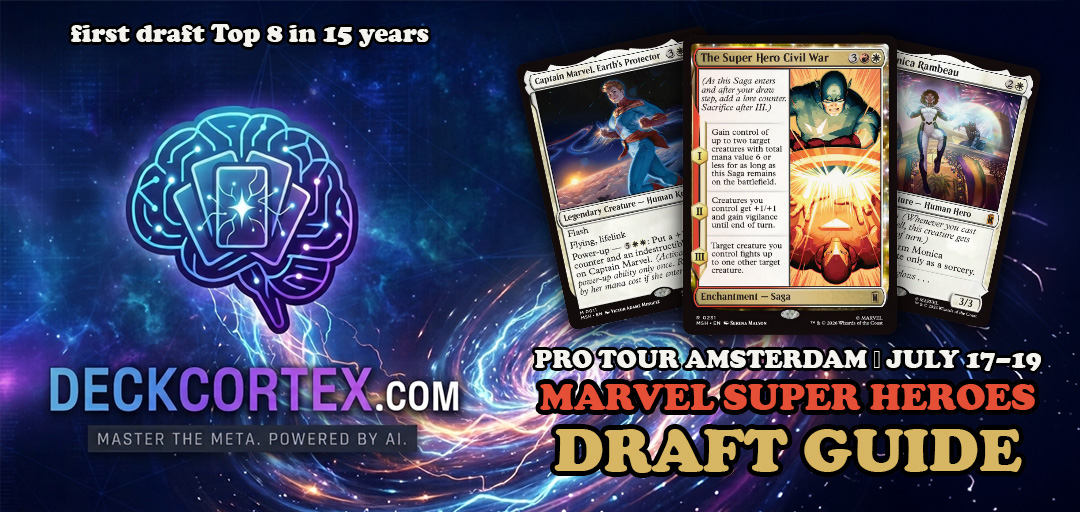
As of July 9, 2026. On July 17–19, Pro Tour Magic: The Gathering | Marvel Super Heroes runs at MagicCon: Amsterdam — three rounds of MSH draft plus five rounds of Modern on each of Friday and Saturday, and then the part that changes everything: Sunday's Top 8 is a booster draft, the first Limited Top 8 at a Pro Tour in fifteen years (per the event's own coverage docs and the MTG Wiki). For over a decade you could sleepwalk through a 4-2 Limited record and win the whole tournament on the back of your Constructed deck. Not this time. Whoever lifts the trophy — and the $50,000 that comes with it, out of a $500,000 pool — will have drafted a 3-0 deck at the final table while Marshall Sutcliffe and Paul Cheon call the picks. So this guide covers the half of the tournament that crowns the champion. We pulled 17lands' public Premier Draft data ourselves on July 9 (all players, 415,867 games since the June 23 digital release), validated every card below against live Oracle text, and ran our own DeckCortex tournament corpus for the Modern context and the "your draft bomb is also a Constructed card" crossovers.
One disambiguation up front, because two Marvel sets exist now: this Pro Tour drafts Marvel Super Heroes (MSH), the big June 26 expansion — not 2025's Marvel's Spider-Man (SPM). If your prep material talks about Spider-Man archetypes, you're reading about the wrong set.
The set on the table
The draftable pool is 296 cards: 91 commons, 100 uncommons, 60 rares, 25 mythics, and 20 basic lands (verified against Scryfall's set data). Play Boosters are the standard 14-card configuration, and per WotC's collecting article, 27% of packs carry a second rare-or-better, 2% a third, and under 1% a fourth. Two wrinkles matter for drafting:
- The Source Material sheet. Sixty comic-art reprints — the second wave of the "Marvel Universe" bonus series (`mar`, collector numbers 41–100, released June 26) — replace a common in 1 of 24 Play Boosters. Most are Commander bait, but three are genuine Limited lottery tickets: Extinction Event (choose odd or even, exile every creature of that mana-value parity), Sword of Fire and Ice, and Defense of the Heart. They're so rare that 17lands has 5–10 logged games apiece — if you open one, congratulations, there is no data, slam it anyway.
- Scene cards (3 common, 12 uncommon, 8 rare, 15 mythic, per WotC) are alternate-art treatments that assemble into six larger artworks. Pretty, occasionally confusing mid-draft, mechanically just the cards they depict.
And the headline trivia with real deckbuilding teeth: by our Scryfall count the main set holds 128 distinct legendary creature cards — 133 if you count both faces of the five transforming mythics; Draftsim tallies it at 132 — versus roughly 100 in Final Fantasy, the previous record holder. Every creature at uncommon and above is legendary. In practice: the legend rule is now a draft consideration. A second copy of a good uncommon is fine (you'll rarely have both in play), a third is usually one too many. Only two cards actually read the word "legendary" for value: Super-Adaptoid, whose power counts your legends, and the worthy condition on a certain hammer we'll get to.
The MSH Commander decks (MSC), Jumpstart, and Beginner Box are not in your packs. There's no companion set to memorize. One expansion, one bonus sheet, done.
Five mechanics, ranked by how much they'll decide your matches
Power-up (24 cards) is the one to respect. A one-shot activated ability that puts at least one +1/+1 counter on the creature plus a bonus — and if you activate it the turn the creature entered, the cost drops by the creature's mana cost. That's the fine print that makes it good twice: early, a Serpent Specialist is a one-mana deathtoucher; late, it's a 3/3 for plus . Every power-up creature is two cards on a curve, and the live data backs the mechanic across rarities — Aerial Doombot (57.6% GIH, n=1,950) and Ninja of the Hand (56.6%, wheeling at ALSA 6.4) are commons quietly beating cards picked three tables earlier. All win rates in this piece are 17lands games-in-hand win rate, all players, pulled July 9; the set average game is 55.8%.
Teamwork (12 spells, plus Agent Maria Hill as the lone payoff creature) is a tap-your-team kicker: "Teamwork N — tap any number of creatures you control with total power N or more." The spells are priced to be castable without it, so the bonus is upside, not a deckbuilding demand. The trap is drafting for the mechanic; there's almost no payoff beyond Maria Hill and Captain America, Living Legend untapping your tapped attackers-slash-teamworkers. Read the tempo cost honestly: tapping blockers to upgrade Cruel Alliance is sometimes a bigger swing for your opponent than for you.
Plan enchantments (7 of them) are quest cards: accumulate plan counters on a condition, sacrifice at the threshold for a payoff. Most are too slow. The two exceptions are real, though — Political Triumph (one white mana; scry 1 on every creature you play, then a card plus a team-wide counter when it pops — 57.4% GIH at n=859, white's second-best uncommon) and Doom Reigns Supreme in a dedicated Villain deck, where every body drains an opponent on the way in and the finale casts two free spells off their library.
Connive returns on 11 cards, blue-black plus one land. It's smoothing stapled to bodies — Red Room Recruit, A.I.M. Scientists, Madame Masque — and the density is lower than the Dimir signpost wants you to believe, which caps build-arounds like Kang, Temporal Tyrant and Construct a Cosmic Cube. Treat connive as a bonus on playable cards, not an archetype.
The five transforming mythics — Jennifer Walters // The Sensational She-Hulk, Bruce Banner // The Incredible Hulk, King T'Challa // Black Panther, Hope Enduring, Monica Rambeau // Photon, Living Light, Tony Stark // The Invincible Iron Man — are cheap, castable early, and transform into finishers from the battlefield for mana. Every one is a bomb; Monica is the best of them, because the back face, Photon, is a 4/4 flying hexproof prowess creature that pumps your whole board on every noncreature spell. Removal formats hate the word hexproof.
Three one-offs worth knowing before someone blows you out with them: Mjölnir, Hammer of Thor deals 4 to a creature on entry, doubles all damage its bearer deals, and has "Equip worthy " — worthy means a red and/or white legendary non-Villain, so Villains lift nothing. The Mind Stone is an indestructible mana rock whose Harness is paid once — after that it blinks one of your nonland permanents every end step for free. And Elektra, Daughter of the Hand carries the set's only Sneak keyword: cast her from hand for by returning an unblocked attacker you control to hand during the declare-blockers step — she enters tapped and attacking, and her enters trigger destroys an opposing creature with power 3 or less on the way in. We Say Thee Nay! and Hex Magic being Arcane, meanwhile, is pure Kamigawa fan service — nothing in the set splices.
How the format actually plays
MSH is a tempo-forward midrange format that stalls on the ground if nobody's winning the air. Creature-dense, low-curve decks outperform durdle piles; simultaneously, power-up means the board keeps scaling into turn ten, so the games you don't close early become absurd counter-covered standoffs. The two skills that decide close matches are combat math and recognizing the turn you become the beatdown.
It's also — unusually — a bombs format and a removal format at once. The community's early-July 17lands snapshots (Draftsim, CoolStuffInc) counted seventeen-plus cards above 63% GIH, several above 70%, numbers most recent sets never touch; today's all-player data can't re-verify the individual bombs (17lands suppresses rates under ~500 games, and every mythic sits below that), but the one bomb that clears the sample bar — Leader, Super-Genius at 66.6% (n=503) — is the highest live number in the set, so the shape of the claim holds. Meanwhile clean removal is scarce enough that the field is visibly over-picking it: Web Up goes around pick 2.3 on average and wins like a pick-six card (54.6%). Bombs first, removal second, and don't pay premium prices for mediocre answers.
Deckbuilding defaults: 16–17 lands (17 standard; 16 with two-plus of the cheap fixers below), 15–17 creatures, curve bent hard toward two and three. And take the play, every time — this is a tempo format whose best deck flies.
The color pecking order
White and blue are the best colors; red is having its second miserable Marvel Limited format in a row. That was the week-one read and the July 9 data still agrees — with one upgrade: green's commons are quietly excellent.
The clearest way to see it is what clears 17lands' 500-game sample bar. Exactly seven red commons and one red uncommon (Jessica Jones, Private Eye, 56.5%) have enough play to show a win rate at all — nobody is drafting the color. And red's best commons, Stark Industries Executive and HULK SMASH! at 56.5%, would be mid-pack in any other color: white's top three commons alone (Murdock's Crusade 58.7%, S.H.I.E.L.D. Spy Kit 58.2%, Hero in Training 57.6%) beat every red card in the set. There's a lovely tell in which red card wins most, too: Stark Industries Executive is a one-drop that makes Treasures. Red's best common is a fixer that helps you play other colors' bombs. The color knows what it is.
Ranking with live receipts: White first (deepest commons, the best removal suite, the most bombs). Blue second (the two best aggressive commons in S.H.I.E.L.D. Deployment Drone 59.9% and Trickster's Stratagem 59.4%, plus fliers to break the ground stall). Green third and climbing (Undercover Skrull is the set's best-performing common, full stop — 60.1%, and 62.5% when it's in your opening hand — plus the top two ranked uncommons). Black fourth (the best cheap removal, commons a clear notch below its uncommons). Red fifth by a mile — a support color you get paid to splash, not to base.
All ten pairs, with live win rates
The 17lands table, July 9, all players, main-colors-including-splashes. For context: the average two-color deck wins 56.2% (357,816 games); the average three-color deck 53.0%.
| Tier | Pair | WR (games) | Signposts | The plan | |---|---|---|---|---| | S | Azorius | 59.0% (99,222) | Captain America, Living Legend, Spider-Woman, Secret Agent | Fliers and tempo. Ignore the "Teamwork" label on the signposts — this is the best commons plus the best removal plus evasion over the board stall. Force-able, and everyone knows it. | | A | Selesnya | 57.3% (47,267) | Black Panther, Vanguard, Spider-Man, To the Rescue | Heroes go wide. Nearly every W/G creature is a Hero, so the deck assembles itself; Agent Phil Coulson, Avengers Assemble! and Origin of the Avengers pay it off, Borough Backup plus Training Regimen closes. | | A | Simic | 56.6% (28,680) | Ant-Man, Colony Commander, Beast, Erudite Aerialist | +1/+1 counters without a build-around tax — every power-up and connive card feeds it. Stature, Size Shifter (56.8%) overperforms here, and Absorbing Man's land-copy trick is ramp on a 4/4 vigilance body. Week-one tier lists had this pair a tier low. | | A− | Golgari | 55.9% (21,840) | Killmonger, Scourge of Wakanda, Titania, Rugged Rumbler | "Two creature cards in your graveyard" is a bar the game clears by turn five on its own. Killmonger is enabler and payoff in one card (57.9%, tied with Spider-Woman for the best-performing signpost in the set), and the deck grinds better than anything below it. | | A− | Orzhov | 55.8% (32,384) | Black Widow, Double Agent, U.S.Agent, John Walker | Attack alone, get paid — Agent 13, Sharon Carter (59.6%) investigates, S.H.I.E.L.D. Spy Kit untaps your attacker. Best removal package in one pair; Decoy Ploy rebuys whichever half of the Hero/Villain mix died. | | B | Boros | 55.1% (23,705) | Thor Odinson, War Machine, Legacy of Iron | Honest aggro wearing a spells costume. Thor Odinson literally has prowess twice; Iron Fist, Living Weapon turns every pump spell into a removal spell; Monica Rambeau // Photon, Living Light is the dream curve-topper. | | B− | Dimir | 54.5% (35,113) | Kang, Temporal Tyrant, Ghost, Spectral Saboteur | The contrarian's pick: the core cards (Leader, Super-Genius; both Kangs) are excellent and chronically underdrafted, but the shell is midrange in a tempo format and connive density runs out. Needs removal and a clock, not more card selection. | | C | Gruul | 53.5% (15,684) | Hulk, Gamma Goliath, Abomination, Terrifying Titan | Big power-up creatures with Hulk's activation discount; Wonder Man, Hollywood Hero lets each power-up fire twice. The mechanic is real, red's cards drag it down. | | C | Izzet | 53.2% (29,321) | Iron Man, Master of Machines, Speedball, New Warrior | Artifact-count payoffs (Machinesmith Automaton, Crimson Operative, Ultron, Artificial Malevolence) that are fine with critical mass and "Dimir Grizzly Bears" without it. Fun fact from the same lesson: Scientist Supreme of A.I.M. copies artifact abilities and is Dimir. | | D | Rakdos | 51.5% (24,600) | Madame Hydra, Bullseye, Death Dealer | The Villain deck, and the format's clear loser — 7.5 points behind Azorius. The Villain commons are weak and Madame Hydra is a four-mana 2/3 that does nothing the turn she arrives (her tokens only come from Villains you cast afterward). Good rares (Ares, God of War, The Ruinous Wrecking Crew) don't fix a bad shell. |
Two structural notes hiding in that table. First, the games column is a popularity poll: Azorius has been drafted more than six times as often as Gruul, so the "everyone fights over WU" problem at your Pro Tour pod is real. Second, if you must go three colors, base it on black-green — Sultai (55.1%) and Abzan (54.6%) are the only tri-color builds beating the three-color average, while Grixis is the single worst archetype in the format at 49.9%. The bad colors don't get better when you play three of them.
Pick one, pack one: the bombs
The hierarchy is simple: bomb > premium removal > best common in white or blue. Here's the bomb tier — colors corrected against actual card data, because the community lists get several wrong (The Super Hero Civil War is Boros, not white; Jennifer Walters is WG; King T'Challa is WU; The Mighty Thor, Jane Foster is WU, not red).
The early-July 17lands snapshots quoted by Draftsim and CoolStuffInc — treat them as directional, since today's public data samples them out — had The Super Hero Civil War at 71.2%, the best card in the set, and having read the Oracle text we believe it: the Saga steals up to two creatures with total mana value 6 or less for as long as it's on the battlefield, pumps your whole board, then has one of your creatures fight on the way out. That's a two-for-one theft, an anthem, and a removal spell for . Behind it: Captain Marvel, Earth's Protector (~69–70% in those same snapshots) — flash, flying, lifelink, 5/4, with a power-up that makes her permanently indestructible; Leader, Super-Genius (66.6% live, n=503 — the one bomb big enough to measure), who upgrades every connive into "draw a card first" and connives a creature free each combat; Doctor Doom (~66%), six mana for nine power across three bodies, drawing a card at each of your end steps for 1 life, indestructible as long as you control an artifact creature or a Plan — his own Doombots included; and Monica Rambeau, whose Photon face is the hexproof problem we already covered.
Rounding out the first-pick tier: Kang the Conqueror (a 4/5 flier whose power-up takes an extra turn), Jennifer Walters // The Sensational She-Hulk (~65%; the front face's "opponents can't cast spells during your turn" is quietly brutal in a combat-trick format — your combat is always safe), Mjölnir, Hammer of Thor, Thor, God of Thunder (red's best card by consensus — a 5/5 flier that turns every subsequent spell into a Lightning Bolt or better), Wolverine, Fierce Fighter (haste, fights on entry, and heals all damage whenever new damage comes in — functionally unkillable in combat), Elektra, Daughter of the Hand, and the colorless pair every deck plays: Iron Man Armor (auto-attaches, +2/+1 and flying, and for animates into a Construct that grows with your artifact count) and The Vision (2/5 flying vigilance that takes double strike, indestructible, or a card on each noncreature spell — each mode once per turn). Second tier, still early picks: Avengers Assemble! (~65% — a flash anthem that draws a card at each end step where a Hero entered or attacked), Secret Invasion (removal and a clone in one Aura), Moon Girl and Devil Dinosaur, The Mighty Thor, Jane Foster, King T'Challa // Black Panther, Hope Enduring, The Coming of Galactus (four turns of value ending in a 16/16), Tony Stark // The Invincible Iron Man, Cosmic Cube, Ultron, Artificial Malevolence, and Bruce Banner // The Incredible Hulk.
The commons that actually win games
Live per-color rankings, GIH win rate (n≥500). The story since week one: the blue and green workhorses passed the white ones, and several community darlings fell off a cliff.
| | Top commons (17lands, July 9) | |---|---| | | Murdock's Crusade 58.7% — teamwork sorcery, exiles a toughness-4-plus creature, both modes with teamwork · S.H.I.E.L.D. Spy Kit 58.2% · Hero in Training 57.6% — 2/2 cantrip that gains 2 with another Hero · Borough Backup 56.4% · Take Up the Shield 56.0% — counter + lifelink + indestructible at instant speed, the format's best trick · Brave Brawler 55.8% | | | S.H.I.E.L.D. Deployment Drone 59.9% — a 2/2 flier that brings a 1/1 Soldier; two bodies, one card, plays offense and defense · Trickster's Stratagem 59.4% — tempo removal (second-from-top or bottom!) plus a connive · We Say Thee Nay! 57.7% — Mana Leak that scales to "pay " with teamwork · Atlantis Attacks 57.7% · Aerial Doombot 57.6% · Giant-Sized Flying Ant 56.8% · Frozen in Ice 56.7% | | | Cruel Alliance 56.8% — exile, mana value 3 or less; any creature plus 3 life if you pay the teamwork. A sorcery, mind — it ambushes nobody · Ninja of the Hand 56.6% · Widow's Bite 55.2% — the actual instant · HYDRA Troopers 55.0% · Hour of Defeat 55.0% — instant, destroy anything, surveil 1 | | | Stark Industries Executive 56.5% · HULK SMASH! 56.5% — instant, artifact kill and/or one-sided power-fight · Crimson Operative 54.4% · Lightning Strike 54.3% — yes, the reprint; 3 damage anywhere, red's only unconditional removal · Repulsor Blast 52.8% | | | Undercover Skrull 60.1% — best common in the set; taps for any color, grows into a 3/3 all-creature-types once two creature cards hit your graveyard · Guerrilla Gorilla 57.2% · Rapid Rescue 56.6% · Serpent Specialist 56.4% · Go Nuts! 55.5% | | — | H.E.R.B.I.E. Scout Unit 56.3% — draws a card and drops a land from hand on entry; every deck's four-drop · Surveillance Room 54.6% |
The uncommon tier is headed by Ka-Zar of the Savage Land (60.5% — lands off the top plus a growing Zabu token; drops your land count comfortably to 16) and Justice, Vance Astrovik (60.4% — a flier that bounces something on entry and grows on every future bounce), with She-Hulk, Jade Defender 59.8%, Agent 13, Sharon Carter 59.6%, and — read this twice — Avengers Tower at 59.7%, a land. More on that in the splash section. Dark Deed (56.2%, instant, −4/−4) is the best uncommon removal and an automatic early pick at ALSA 2.5.
Removal, ranked for the table
What you actually want, in order — instants flagged, because the sorceries in this list can't ambush a teamwork tap or a power-up:
- Dark Deed — instant, −4/−4. Kills 90% of the format for two mana.
- Hour of Defeat — instant, destroy anything, surveil 1. Common. No conditions. Take it.
- Murdock's Crusade — sorcery; exiles the big thing (toughness ≥4), scales to two exiles with teamwork.
- Cruel Alliance — sorcery; exile at three-or-less mana value, or anything plus 3 life with teamwork.
- The Super Hero Civil War / Secret Invasion — removal stapled to bombs; listed so you remember they count toward your answer total.
- Lightning Strike — instant, 3 damage anywhere. Red's whole removal budget in one card.
- HULK SMASH! — instant; the power-fight mode is one-sided (your creature deals, theirs doesn't deal back).
- Web Up — exiles any nonland permanent while it sticks around, which is broader than the O-Ring memory suggests… and it still wins only 54.6% while being picked at 2.3. Good card, wrong price. Let someone else pay it.
- Punishing Punch — instant, your creature deals twice its power, one-sided; two mana cheaper with a stocked graveyard.
- Frozen in Ice / Trickster's Stratagem — blue's pseudo-removal; Trickster's second-from-the-top mode against an empty library-manipulation deck is close to exile.
- Widow's Bite — instant, deathtouch and/or −2/−2; the modal flexibility plays far above its stat line.
- Go Nuts! and Truck Toss round out the playables. Depower, despite the tempo text, is the worst blue common in the live data (53.1%) — a trick, not an answer.
Traps and sleepers: what two weeks of data corrected
The traps, with receipts. Ultron Drone is the single worst card in the set with a measurable sample — 50.1%, coin-flip Magic — and week-one guides had it as a top colorless common. Super Villain Lockup gets picked like removal (ALSA 2.6) and performs like filler (53.0%) — "exile target tapped creature" hands your opponent the timing. Red Room Recruit (52.1%) and the red "playables" Kree Sentinel (52.2%) and HYDRA Assault Robot (51.5%) are bottom-ten cards. And the format's newest signpost casualty: Spider-Man, To the Rescue at 51.0% — vigilance-reach bodies that protect non-attacking creatures are defense in a format that rewards offense.
The mechanically-confirmed trap shelf from the community lists holds up against the Oracle text: Thanos, the Mad Titan costs with a power-up — a mana base, not a card; The Ten Rings is eight mana that affects the board not at all; Baron Helmut Zemo wants fifteen black pips in your graveyard, which is a Commander night, not a draft; Multiversal Incursion is seven mana of win-more; Death to Our Enemies needs four noncreature casts in a 16-creature format; Quicksilver, Brash Blur is a free 1/1 haste — cute, still a Raging Goblin; Worlds Within Worlds resets a board you were supposed to be winning; and Super-Soldier Serum is the classic Aura two-for-one risk, though it's the one trap with a real home (it turns anything into a worthy, first-striking Mjölnir carrier, and its attack trigger re-attaches every Equipment you own for free).
The sleepers. Ninja of the Hand (56.6%, ALSA 6.4) and Rapid Rescue (56.6%, ALSA 7.9 — it nearly wheels every pack) are the two biggest gaps between table price and table performance. S.H.I.E.L.D. Spy Kit is a one-mana Equipment that untaps your lone attacker and scrys — the Orzhov deck's best common at 58.2%. Atlantis Attacks (57.7%, ALSA 5.3) reads clunky and plays like a two-for-one finisher. The three uncommon lands — Avengers Tower 59.7%, Villainous Hideout 58.1%, Baxter Building 56.0% — cost you nothing (they're lands!) and generate value all game; Tower digs for Heroes, Hideout connives your Villains every turn. HYDRA Troopers with any graveyard enabler is a 3/2 plus a 2/1 menace for three. Storm, Windrider (n=260, well under the sample bar) hard-counters the best deck in the format — "creatures with flying can't attack you or block creatures you control" is a sentence Azorius cannot beat without removal. And two attributed reads we can't yet measure but believe: Echo, Perceptive Prodigy, who copies any activated or triggered ability from your creatures — every power-up, every enters trigger — and Origin of the Avengers, a Saga that scries, deploys a free three-drop Hero, then pumps the team.
Drafting the seat, not the sheet
Force WU until the table says no. With a 59.0% pair win rate and the deepest common pool, Azorius is the correct default — but its 99,222 logged games mean your neighbors read the same data. The tell that it's actually open: premium white or blue commons (Hero in Training, Deployment Drone, Trickster's Stratagem) arriving pick 5 or later in pack 1. The tell that it's not: you're five picks in with no playable white. That's a real signal — pivot into the open base-white pair (Selesnya and Orzhov are both live), or into Golgari, which the data says is chronically underdrafted for how well it grinds. Red is, as always, "open" — the way an empty restaurant is open.
Commit to colors, not archetypes. This is a soft-synergy format; the archetypes are mostly "good cards in these colors plus a lean curve." That means staying flexible through pack 1 costs you less than usual, and hybrid signposts (Titania, Rugged Rumbler, Spider-Man, To the Rescue, Abomination, Terrifying Titan, U.S.Agent, John Walker and friends — each castable in seven of ten pairs) plus colorless cards (The Vision, Iron Man Armor, H.E.R.B.I.E.) hold your options open.
Splash aggressively — but splash, don't add a color. The infrastructure is absurd for a small set: one common basic-landcycler in every color (Borough Backup, A.I.M. Scientists, Roxxon Brutes, Kree Sentinel, Savage Land Dinosaur — the last three are weak cards but fine 23rd-card fixers that cycle for ), a common gain-dual for all ten pairs (Avengers Hangar, Birnin Zana Plaza, Fisk Tower, Hell's Kitchen and the rest), Surveillance Room (any color for , surveils on entry), Dependable Quinjet (an any-color rock that upgrades to a 3/3 flier — budget four power for the crew), Undercover Skrull, and Restorative Technique. The data draws the line clearly, though: two-color decks win 56.2%, three-color decks 53.0%. A splash is one or two single-pip cards off two duals and a cycler; a third color is a three-point donation. Green is the best splash base (Skrull plus Technique), and single-pip bombs and removal are the splash targets.
Know the miniature combos. Mjölnir, Hammer of Thor on Thor, God of Thunder — a worthy, flying 5/5 whose doubled spell-triggers start one-shotting creatures. Captain America's Shield on Captain America, Wings of Freedom — +0/+8 makes his attack trigger give every other Hero +9/+9. Hawkeye's Bow anywhere near Hawkeye, Young Avenger — the Bow pings on every tap and Hawkeye adds his power to each noncombat hit. Fin Fang Foom copying an Avengers Disassembled that touched a land — two 3-damage sweeps and a 5/7 Dragon. Undercover Skrull on two into Alien Invasion on three, after which the Aliens never stop. And on defense: track your opponent's untapped power for teamwork instants — Widow's Bite, Helicarrier Strike, HULK SMASH!, We Say Thee Nay! — the mechanic telegraphs its own tricks. (Cruel Alliance and Murdock's Crusade are sorceries; nobody's ambushing you with those.)
Sealed footnote for your last-chance qualifiers and prerelease habits: slower, more midrange, bombs matter even more (removal density per deck drops), WU aggro is harder to assemble from six packs, and you'll usually end up base-two-colors-and-a-splash goodstuff at 17–18 lands. Auras get worse, expensive value gets better.
The other half of the tournament (and your wallet)
You'll draft three rounds a day, then shuffle up Modern — outside this guide's scope, but here's the field the drafters have to survive, from our own scraped top-cut corpus (decklist-appearance share of 1,824 MTGTop8/MTGO top-cut lists, June 9 – July 9 — not field share, not win rate): the Boros Energy family leads at a merged ~10.1% (Boros Energy 5.6% + same-core Boros Aggro 4.5%), then Ruby Storm 4.7%, Boros Ponza 4.4%, Manufacturing Affinity 4.0%, Broodscale Bloodchief 3.7%, with Amulet Titan, UrzaTron, Grixis Reanimator, Eldrazi Tron and Pinnacle Affinity bunched at 3.2–3.3%. Frank Karsten will have the deep Modern numbers on the analysis desk; the short version is that the "Broodscale, Boros Energy, Eldrazi Tron performed" chatter from early July matches our data.
And a DeckCortex-flavored consolation if your draft pool disappoints: several of these Limited bombs are already Constructed cards, so the packs pay rent past Sunday. Jennifer Walters // The Sensational She-Hulk is in 12.0% of the last month's Standard top-cut lists (122 of 1,017 — up from 9.7% when we measured two days earlier; she is still climbing), Thor, God of Thunder in 1.8% of Standard lists, and even draft-common Lightning Strike rode the reprint back into 1.1% of them. In Modern it's The Ten Rings (1.8% — a trap in draft, a big-mana engine in 60-card decks; context is everything) and Mjölnir, Hammer of Thor (0.6%). In cEDH: Jennifer Walters 3.3%, King T'Challa // Black Panther, Hope Enduring 2.1%, and the Source Material sheet's Defense of the Heart in 34 lists. Open a Walters on camera Friday and you've drafted a Standard staple with a Pro Tour story.
Bottom line
Draft white-blue fliers until the table forces you off it, and treat "five picks, no white" as the real signal it is — Selesnya, Orzhov, and underdrafted Golgari are all honest homes. First-pick bombs over everything (they're historically dense in this set), pay fair prices for removal instead of panic prices, keep the curve at two-three with 16–17 lands and 15–17 creatures, and always be on the play. Splash your off-color bombs off the absurdly deep common fixing, but stay a two-color deck at heart — the three-color "goodstuff" pile is a 53% deck in a 56% world. And if you're watching instead of playing: Sunday morning, eight players, one draft table, fifteen years since the last one. Sutcliffe and Cheon calling picks for a title. Set an alarm.
Data: color-pair and per-card Limited win rates are 17lands Premier Draft data (expansion MSH, all players), pulled by us from 17lands' public data endpoints on July 9, 2026 — 415,867 games logged since the June 23 digital release; GIH = games-in-hand win rate; 17lands suppresses per-card rates under ~500 games, which excludes every rare/mythic bomb except Leader, Super-Genius (n=503). Early-window bomb figures (Civil War 71.2%, Captain Marvel ~69–70%, etc.) are quoted with attribution from Draftsim's and CoolStuffInc's early-July 17lands snapshots and cannot be re-verified on today's public data; the drift between their common/uncommon numbers and ours (uniformly 1–4 points lower now) is the format maturing. Untapped.gg trophy-tier references come from the raw research (~530,000 matches) and measure 7-win rates, not win rate. Modern archetype shares are DeckCortex's own scraped corpus: decklist-appearance share of 1,824 top-cut lists (MTGTop8-hosted paper + MTGO), June 9 – July 9, 2026 — not field share, not match win rate (we don't track match results); Boros Energy/Boros Aggro were merged after list verification. Constructed presence figures for MSH cards are the same corpus (Standard n=1,017; Modern n=1,972; cEDH n=8,453 lists), and MSH was legal for only part of that window, so they understate adoption. Event facts (dates, formats, Top 8 draft, coverage team, prizes) verified against magic.gg's viewer's guide and event page on July 9, 2026; set-structure counts verified against Scryfall the same day. Card prices, where mentioned, are Scryfall paper aggregates. Every card named was validated against live Oracle text before publication; several color identities and rules details in the source research were corrected in the process (The Super Hero Civil War is red-white, King T'Challa is white-blue, Cruel Alliance is a sorcery — the full correction log lives in the article dossier).