The Hobbit First Look: Standard-Legal Middle-earth, and What 71 Spoiled Cards Actually Say
The Hobbit lands August 14 as the first Standard-legal Tolkien set, and 71 of its 198 cards are already public. We pulled the live Oracle text for everything that matters and ran the marquee reprints through our own format data: Thranduil is the real story, the Arkenstone isn't for every deck, and the One Ring take everyone keeps repeating has the wrong format attached.
The Hobbit First Look: Standard-Legal Middle-earth, and What 71 Spoiled Cards Actually Say
Spoiler season for Magic: The Gathering | The Hobbit kicked off at MagicCon Amsterdam on July 18 and runs daily until the August 7 prerelease. As of today, 71 of the 198 main-set cards are public on Scryfall, plus 44 cards of the eternal-legal companion set. That's a bit over a third of the set: enough to know what it is, not enough to know everything it does. We pulled the live Oracle text for every public card people are talking about and ran the marquee reprints through our own format data, and a couple of the loudest talking points didn't survive the check. One of them involves a $105 card and a format it isn't even legal in.
The set hits tabletop August 14, 2026 (MTG Arena August 11, prerelease events August 7–13, Gen Con early prereleases July 30–August 2). It's the second Middle-earth set after 2023's Tales of Middle-earth — and structurally a very different animal.
The headline: Middle-earth is Standard-legal now
Wizards' product page states it flatly: the main set, code HOB, is legal in all formats. That makes The Hobbit the first Tolkien set ever to touch Standard — Tales of Middle-earth was Modern-legal only, so its cards skipped the format where new sets get the most reps. Every Queen of Dale and Smaug evaluation changes when the card has a two-year Standard runway instead of having to clear the Modern bar on day one.
The second code, HOC ("The Hobbit Eternal"), is the LTR-style eternal sheet: Commander, Legacy, and Vintage only, with each reprint staying legal wherever it already was. One note on timing so nobody panics at a deck checker: Scryfall lists all HOB/HOC cards as not legal anywhere until release day. That's normal for an unreleased set — the legality above is Wizards' announced state for August 14.
And there are no Commander precons. Wizards confirmed the omission is deliberate — the HOC cards ship inside boosters instead, and a Battle of Five Armies co-op product is slated for 2027. The precon-shaped hole is filled by two Scene Boxes ($41.99 MSRP): "Crack the Plates" and "Treasures of Smaug," each with three Play Boosters and six traditional-foil borderless scene cards that assemble into a panorama. Worth knowing: the three scene legends revealed so far carry HOC collector numbers — Gandalf, Party Guest, Thorin, King of Durin's Folk, Bilbo, Fellow Conspirator — which points at the scene cards being real, playable eternal cards, though Wizards' own product copy stops short of saying so outright. The rest of the lineup is standard fare: $6.99 Play Boosters, $37.99 Collector Boosters, a bundle, and a four-player Draft Night box.
Three new mechanics, straight from the reminder text
Storied is the set's "historic" reborn. The reminder text on Thorin Oakenshield — a 3/2 uncommon, and yes, this Thorin is Boros, not red — reads: "If you control three or more artifacts, legendaries, and/or Sagas, you have an enduring story for the rest of the game." The key phrase is for the rest of the game: once you cross the threshold, the designation sticks even if your board doesn't. Thorin then grants your artifacts and creatures ward ; Bifur, Melodic Rider goes further and makes every triggered ability of your Dwarves trigger an additional time while the story holds.
Recruit is the new keyword action: draw a card, then discard a card, and if you discarded a nonland card, create a 1/1 white Human Soldier token. Connive's civic-minded cousin, and the engine behind the set's best-hyped white card (more below).
Hone counters live on Equipment, and each one grants +1/+0 to the equipped creature. Sting, Bilbo's Sword is the debut: a two-mana Equipment with flash that enters with a hone counter for each creature target opponent controls and attaches free to one of your creatures. The more crowded their board, the bigger the sword — very "glowing blue when Orcs are near."
The primary returning mechanic, per Wizards' own mechanics article, is Adventure. Bilbo, Luckwearer // Burglar's Plot is the flavor win of the bunch: an unblockable 1/1 looter whose Adventure half swaps control of two nonland permanents that share a card type. Burglary, as printed. Amass returns retuned to Goblins, so Bolg of the North and the saga Down, Down to Goblin-town grow a 0/0 black Goblin Army instead of Orcs, and ferocious is back on the warg package (The Chief Warg draws you a card per attack at the cost of 1 life once you've got a power-4 creature). What is not here: any successor to "the Ring tempts you." The One Ring shows up strictly as a reprint. If you were waiting for Ring temptation two, this set says the Ring hasn't found its story yet.
The Constructed watch list
The Queen of Dale is the most interesting competitive card in the file, and for once the hype and the Oracle text agree. She's a 2/1 mythic: "Whenever an opponent casts their first noncreature spell each turn, you recruit." Read the trigger carefully — it's once per opponent per turn, on their spell, not yours. In a Standard or Pioneer metagame full of cheap-spell prowess and control decks she's a two-drop that turns every opposing cantrip into card selection plus a body, and she triggers on your turn too when they hold up interaction. In Commander she reads even better: with three opponents that's up to three recruits per turn, every turn, without you spending a card. The preview coverage flagging her for prowess-heavy formats has the right idea; whether a 2/1 body survives long enough is the release-data question. At a $46 preorder ask she's priced like the answer is yes — we'd let the market cool first.
Gollum, Riddle Master is the riddle game as a punisher card: as this 3/1 enters you choose odd or even (zero is even), and whenever an opponent casts a spell with the chosen parity, you pick a mode that hasn't been chosen yet — a +1/+1 counter, a two-life drain from each opponent, or a card. In Modern and Pioneer, where curves bunch at one and two mana, the choice is a real read: odd catches the one-mana interaction and cantrips, even catches the two-drops. The card text crosses off modes as you use them ("choose one that hasn't been chosen"), so the value is front-loaded rather than endless. Good role-player, not a format-warper — which matches the more sober takes.
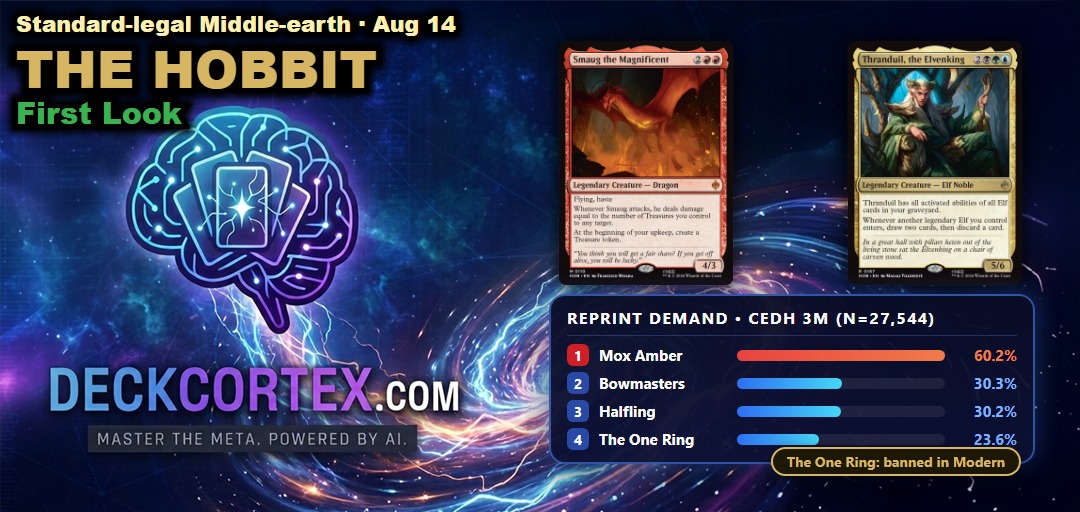
Smaug the Magnificent is the set's face and a genuinely aggressive rate: for a 4/3 flying, haste Dragon that makes a Treasure every upkeep and, on attack, deals damage equal to your Treasure count to any target. Untouched, he ships a growing Fireball at a face or a blocker every combat. Standard has to answer a hasty 4/3 on turn four that immediately starts converting the Treasures the rest of the set hands out anyway; Desolation of Smaug — three damage to each non-Dragon creature plus four mana of any colors restricted to Dragon spells, all on one sorcery — is transparently designed to sweep turn four and cast him turn five. That's a design read, not a measured number, and we'll say so until real results exist.
Commander: Thranduil is the story
Every preview season has one commander the internet builds before the set exists. This time it's Thranduil, the Elvenking — a 5/6 Elf Noble, reportedly the only three-color card in the whole main set, and the Sultai legendary-Elves commander that Elf players have been requesting for years. The Oracle text is short and a little scary: "Thranduil has all activated abilities of all Elf cards in your graveyard. Whenever another legendary Elf you control enters, draw two cards, then discard a card." Bin a Priest of Titania and your commander taps for per Elf on the battlefield. Bin a Lathril, Blade of the Elves and he taps himself plus ten untapped Elves to drain each opponent for ten. The graveyard becomes an ability buffet, self-mill becomes ramp, and every legendary Elf is a fresh two-card draw trigger. Elrond, Moon-Reader (a mono-blue 3/3, and yes, the final type line says Elf Noble, settling the early proof-sheet confusion) both triggers the draw and pays you a card the first time you activate a creature's ability each turn. EDHREC counted 324 Thranduil decks three days after the reveal and 618 by this week — preorder theorycrafting, not play data, but as a hype barometer it's screaming. Our own numbers get involved after release; the combo-density question (that ability-sharing line plus untappers is begging for a loop) is exactly what the DeckCortex engine will answer.
The supporting cast is deep. Bard, King of Dale is a 3/5 with reach and vigilance stapled to two replacement effects: every draw after your first each draw step becomes two cards, and every token batch you'd create is doubled. That's a draw engine and an anthem-adjacent effect on one legal commander — the obvious head for an Azorius value pile. Beorn the Fierce finally gives Bear typal a mythic: a 6/6 trampler that buffs the other Bears +2/+2, converts one non-Bear per combat into a Bear (with a trample counter as a parting gift), and draws two cards per combat once you control three Bears. Thorin, Mountain-king is the mono-red Equipment payoff — 3/4, and his enter trigger attaches any number of your Equipment to one creature, which then immediately deals its (newly buffed) power to a creature you point at. Suit up, fling, swing.
Two smaller legends deserve a line each: Tom, Bert, and William turn any creature into "draw its power, discard one" for a single generic mana and come back from death as an artifact statue — the trolls literally turn to stone, and some designer deserves a raise. And The Great Goblin, a 3/2, pings an opponent for 2 every time you put counters on a Goblin, Orc, or Army, which the amass-Goblins engine does constantly. The Sackville-Bagginses and Gandalf, Goblins' Bane // Flameshape round out the build-around tier — relatives who sacrifice your stuff for Treasure, and a mono-red Guttersnipe-adjacent Avatar whose Adventure half impulse-exiles two cards you can play as long as you keep a Wizard around.
The Adventure artifacts — check the color identity before you preorder
Here's the check the hype didn't run. The Arkenstone // Seek the Heart is being talked up as an artifact for "every Commander deck" — anthem, end-step draw, and a legendary-creature tutor on the Adventure half. But that Adventure half costs , which makes the card's color identity white . It slots only into decks with white in their identity, not into all of them. Same trap on My Precious // Allure of Power: the Equipment half is colorless (hexproof plus unblockable for a greedy equip cost of and 2 life), but Allure of Power is a instant, so this is a black-identity card. Neither of these is a Sol Ring-style universal include, and pricing that assumes otherwise — the Arkenstone preorder ask sits around $41 — is pricing in a mistake. Orcrist, Goblin-cleaver, for the record, really is colorless: a Equipment giving +2/+2 and trample, and on connect you name a creature type and mint a Treasure per creature you control of that type. In any typal deck that's a combat step that pays for the next two spells.
The reprints, run through our own data
HOC is the biggest reprint payload a Universes Beyond set has carried, and this is where we can finally use real numbers instead of design reads. All corpus figures below are decklist-appearance shares in DeckCortex's own scraped corpus, April 26 – July 25, 2026; prices are Scryfall paper aggregates from today.
Orcish Bowmasters is the reprint that matters most at actual tables: it appears in 20.3% of the 5,005 Legacy lists in our window, 8.6% of 8,842 Modern lists, and 30.3% of 27,544 cEDH lists. A $47 (€31) card with that footprint getting reopened is real supply relief — tempered by the fact that the HOC copies are box-topper-gated, so expect a dent, not a crash.
The One Ring is the correction we promised in the lead. Preview coverage keeps framing this reprint as pressure on "a Modern staple." The One Ring is banned in Modern and has been since the December 2024 announcement — our Modern corpus contains zero copies, for exactly that reason. Where it actually lives is Legacy (12.9% of lists in our window) and Commander (23.6% of cEDH lists), and that's the demand a $105 (€77) price tag hangs on. The reprint story is real; the format attached to it in half the write-ups is not.
Mox Amber is quietly the biggest Commander reprint in the set: it sits in 60.2% of cEDH lists in our window — forty times its 1.5% Modern share, and second only to Arcane Signet (68.4%) among the cards we checked. It's $76 (€54), it's been waiting years for a reprint, and Wizards put it… exclusively in Collector Boosters, printed in Dwarvish runes, as one of exactly five such cards alongside Treasure Vault (7.4% of cEDH lists), Arcane Signet, The Reaver Cleaver, and — delightfully — Dwarven Warriors, a $0.17 common. A rune-script Collector-only printing is a collectible first and supply second; the finance grumbling about that gating is fair.
Delighted Halfling (30.2% of cEDH lists, 2.9% of Modern, $28.60/€18.54) is the sneaky-broad one: a one-mana dork whose second ability makes the legendary spell it pays for uncounterable, reprinted into a set whose entire cast is legendary. And the box-topper sheet brings back Sauron, the Dark Lord, Tom Bombadil, Reprieve, plus the legendary lands — Rivendell, The Shire, Mount Doom, Minas Morgul, Dark Fortress — so the "biggest UB reprint wave yet" framing from retailers holds up against the checklist we can see.
Money and mood
Singles first: every HOB price right now is a preorder ask, and asks four weeks out are speculation with a decimal point. Smaug at $75, The Queen of Dale at $46, the Arkenstone at $41, Bilbo, Thief in the Night at $37 — history says most preview-season mythics land lower once boxes crack. Thranduil at $16 is the interesting one: rare, not mythic, and carrying the loudest Commander demand in the set.
Sealed is where the real oddity sits. US collector-box preorders are reportedly running $500–$780 at stores while German retailers hold near MSRP around €380 — if you're buying sealed in the EU, that spread is the whole story. The Scene Boxes are already trading above MSRP on the aftermarket ($76–$82 reported against $41.99), which tells you the market has decided the scene legends are playable cards before Wizards has finished saying so. And the chase is the Gleaming Gold Smaug: roughly 500 copies, English-only, Collector Boosters only, and — despite every "practically serialized" post you've seen — explicitly not serialized. It's a deliberately softer scarcity hook than 2023's one-of-one Ring, and the LTR market history (collector boxes dipping, then climbing once the Ring was found) may simply not repeat.
The mood has one genuinely dark thread: the box-topper One Ring uses the Dan Frazier art that was found in May to be painted over Marta Nael's 2023 One Ring piece. Frazier admitted it — "I made a mistake, and I feel awful" — and Wizards is crediting and compensating Nael on the digital versions while taking its share of the blame for not catching it. The community reaction has been rough on Wizards' art pipeline, and fairly so. A quieter footnote with some grace to it: Nael's own brush is in this very set — she painted Smaug the Impenetrable, the Rakdos scene-box Dragon that turns every burn spell pointed at it into Treasure. Beyond that, the discourse is the expected mix: fatigue about a second Middle-earth set, wariness about another sub-200-card small set after Spider-Man and TMNT set a shaky precedent, and honest enthusiasm for the mechanics — storied, the trolls, the scene-card panoramas — from the same people rolling their eyes at the product grid.
Bottom line
If you play Standard or Pioneer, this is the first Tolkien set that's ever been your business: watch The Queen of Dale, Gollum, and the Smaug package, and let release data sort the rest. If you play Commander, Thranduil is the event — the ability-sharing text is the most build-around line in the set — with Bard, Beorn, and the Dwarf-Treasure Thorins close behind, and one standing instruction: read the Adventure half before you assume an artifact fits your deck's identity. If you're here for value, the reprint sheet is legitimately the deepest a UB set has offered, and our corpus numbers say the demand behind Bowmasters, Mox Amber, and Delighted Halfling is real — just aim your One Ring expectations at Legacy and Commander, because Modern hasn't been allowed to play it for a year and a half.
We're at 71 of 198 cards. The back half of spoiler season, the full HOC checklist, and the draft-archetype grid all land in the next two weeks, and we'll re-run everything — including actual DeckCortex inclusion numbers once these cards start showing up in real decklists — after August 14.
Card data validated against live Oracle text via the DeckCortex Scryfall proxy on July 25, 2026; printed wording can still change before release. Format-presence figures are decklist-appearance shares in DeckCortex's scraped corpus, window April 26 – July 25, 2026 (Modern n=8,842 · Legacy n=5,005 · cEDH n=27,544) — not field share and not external aggregator numbers. Prices are Scryfall paper aggregates (unreleased-card prices are preorder asks and volatile). No play data exists for an unreleased set: every competitive claim about a new card is a design read, not a measurement. EDHREC deck counts are external hype signals, cited as such. Release facts per Wizards' official product coverage (tabletop Aug 14 / Arena Aug 11 / prerelease Aug 7–13).