The Seeker Ban: A 1997 Common Dies So a Marvel Card Can Live
On June 29, Wizards banned Seeker of Skybreak — a 1997 Tempest common — so Marvel's Hawkeye's Bow could stay legal in Pauper. Our tournament data tells the fuller story: a combo that was still winning Challenges on the eve of its ban, a first post-ban Challenge in which every Gates list cut the Marvel card anyway, and a post-ban meta led by Mono-Red Madness at 9.7% while Mono-Blue Terror quietly posts the best top-cut conversion in the format.
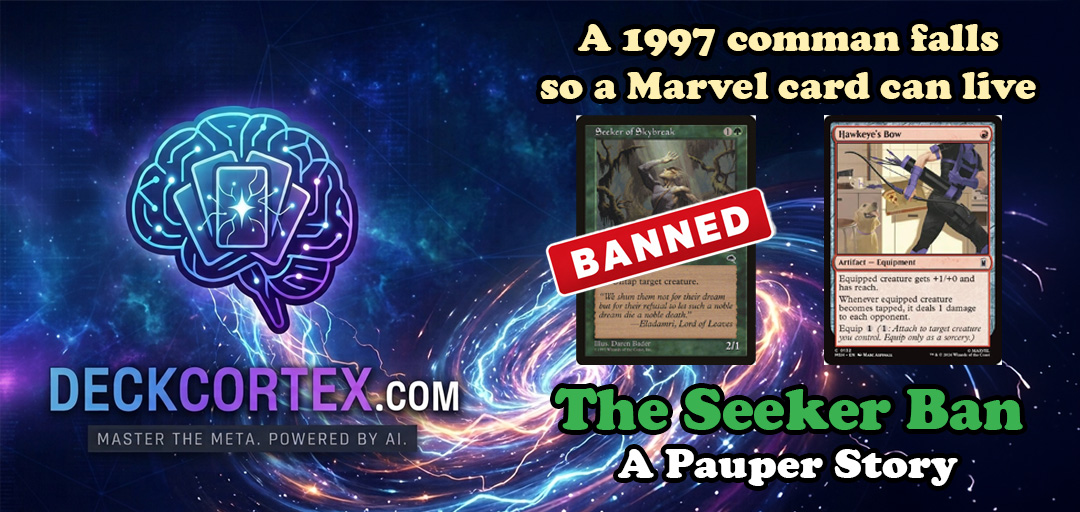
As of July 2, 2026. On June 29, Wizards banned exactly one card in Pauper: Seeker of Skybreak, a 2/1 Elf from Tempest — October 1997 — whose entire rules text is ": Untap target creature." It spent twenty-nine years doing nothing worth a ban. Then Marvel Super Heroes hit MTGO on June 23, Hawkeye's Bow gave any tapped creature a damage trigger, and within days the Pauper Format Panel was writing the old Elf's obituary so the new Marvel common could stay legal. Our tracker adds the punchline the announcement couldn't know yet: in the first post-ban Challenge on July 1, all three Gates lists in the field had cut Hawkeye's Bow too. The card the ban was written to protect didn't survive the deckbuilding it triggered.
Two commons, no game
The combo is embarrassingly clean. Hawkeye's Bow is a Equipment that grants +1/+0 and reach, with "Whenever equipped creature becomes tapped, it deals 1 damage to each opponent." Seeker of Skybreak taps to untap a target creature — any target creature, because 1997 templating didn't say "another." So it targets itself: tapping is the cost, the Bow trigger pings each opponent, the ability resolves and untaps the Seeker. Repeat until nobody else has a life total.
With no other cards involved, that's a turn-three kill — Seeker on two, Bow plus equip on three, and by then the Elf has shaken off summoning sickness. Add fast mana and it's turn two: a Forest and a Lotus Petal pay for Seeker on turn one, and Simian Spirit Guide happily covers the Bow's a turn later. The whole package costs eight-ish slots and about twenty dollars — the Bow is a $0.25 common, and even the freshly banned Seeker still carries a $4.67 sticker on the Tempest printing ($6.91 for 7th Edition, per Scryfall paper on July 2).
If this feels familiar, it should. The Panel's own comparison was Basking Broodscale plus Sadistic Glee: Glee turns every creature death into a +1/+1 counter, Broodscale turns every counter into an Eldrazi Spawn, and sacrificing the Spawn for is another death — infinite mana out of a creature and a Aura. Verhey's write-up drew the line plainly: "cheap and easy-to-run two-card combinations are not something we think are healthy for Pauper." Here's the detail we can't stop enjoying, though: when that combo got banned, the axe fell on Broodscale, the Modern Horizons 3 card — and Sadistic Glee, the Tempest common, is still legal today. This time the Tempest common died and the new card lived. The banlist giveth history no consistent mercy.
Why the 1997 card ate it
Gavin Verhey, writing for the Pauper Format Panel, made the case for banning the enabler instead of the payoff:
"It's the kind of effect we don't do anymore. Not just at common, but anywhere! These days, creatures that can tap to untap something else are limited to untapping another target permanent (like Forensic Researcher) or a card with a different name (like Clever Conjurer). Seeker of Skybreak is the kind of card that enables combos, and we will likely print more cards in the future that combo with Seeker of Skybreak... This one card potentially forcing other cards on the banned list is the wrong way to go."
The receipts check out. Forensic Researcher reads ": Untap another target permanent you control"; Clever Conjurer reads ": Untap target permanent not named Clever Conjurer." Modern templating fences off exactly the self-untap line Seeker enables. Ban the Bow and you fix one interaction; ban Seeker and you close the whole category, forever, including the versions Wizards hasn't printed yet. Verhey also noted that "while Seeker of Skybreak has seen some light play in places, most of the time if someone's playing it, it's because they're going to try and do some combo like this." Hard to argue — nobody was casting this Elf for the 2/1 body.
The other half of the reasoning is a calendar. The next scheduled announcement is August 10, and in between sit the format's two biggest paper weekends:
"…in the time between now and August 10, there's a lot going on with Pauper, including two large events: Paupergeddon in Italy and Paupergenesis in the US. Having these two events, which are great sources of information for the Pauper metagame and are tournaments that players are really looking forward to, impacted by a combination that is going to be removed from the format a few weeks later is a very unfortunate result."
So the announcement moved up a day to land on Monday, June 29, and the main B&R note kept it short: "we thought it was better to take action on this combo now rather than let it play out throughout July and impact some upcoming large Pauper tournaments." The rest of that announcement, for the record: Candelabra of Tawnos banned in Legacy (we covered that one separately), six cards banned in Brawl (Force of Will, Subtlety, Wash Away, Ugin's Labyrinth, Time Warp, Temporal Manipulation), and no changes anywhere else.
What our tracker saw
The official justification leans on Magic Online results: "In just a few days, this combo has already made a huge impact on the format. The Naya Gates deck has won all three Magic Online challenges at the time of writing this article, and sideboards are full of cards to help fight against this deck." Cards Realm's recap fills in the trophy case — two copies in the first Challenge's Top 8 (first and seventh), a second win with nine copies in the top 32, a third win with seven.
Honesty first: those three events were extra mid-week Challenges added specifically to generate data, and they never landed in our scrape — our corpus jumps from June 14 straight to June 26. So the combo's win streak rests on Wizards' own words and coverage, not our numbers. What our tracker does have is 1,026 published Pauper lists from June 2 through July 2 (MTGO Challenges and Qualifiers plus paper events and League 5-0s via MTGTop8, out of 37,451 Pauper decklists tracked overall) — and the weekend right before the ban, where the story gets more interesting.
And the June 27–28 weekend — the last one before the announcement — shows why they didn't wait. Across the three events we scraped (an RC Super Qualifier and two Challenges, 32 published lists each), nine Gates-family decks made the published standings, and the playoff brackets on the MTGO event pages settle what actually won: the 214-player Super Qualifier went to a Reaping the Song storm list, Saturday's Challenge to Azorius Familiars — with newbarola's combo build eliminated in the quarterfinals — and Sunday's Challenge, the final one before the ban, was won by a Temur build running the full four Seeker of Skybreak and four Hawkeye's Bow. The combo didn't fade out under all that sideboard hate; it stayed beatable, kept making playoffs anyway, and carried a trophy into the weekend of its own execution. Every 75 paying a Seeker tax and the combo still winning is the whole case for acting now instead of August 10.
Here's the shape of the thing, the list newbarola carried into the June 27 Top 8 — the full combo bolted onto a stock Gates midrange of Basilisk Gate pumps, Sacred Cat, and Prismatic Strands:
Two context points from the distribution data. First, Gates wasn't born with this combo: the archetype predates Marvel Super Heroes and even won the June 14 Challenge, nine days before the set went live. Second, the package's actual penetration was real but not total — of the 20 Naya Gates lists in our month window (which includes three pre-Marvel weeks), 9 ran Hawkeye's Bow, 8 ran Seeker, and 7 ran Writhing Chrysalis as the fair backup threat. The quiet riser in those same lists is Sneaky Snacker, up to 12 of 20 and climbing. Hold that thought.
July 1: the first receipt
The ban went live on MTGO June 30; the July 1 Challenge was the first one on the other side, and one event is an anecdote — but it's a pointed one. The bracket went to vini_torres on Mono-Red Rally, 2-0 over Jund Wildfire in the final — the fairest of fair red decks winning the first event of the post-combo world.
The semifinals are the good part. Our classifier still labels newbarola's list "Bow Gates," and it reached the top four — with neither Seeker of Skybreak nor Hawkeye's Bow anywhere in the 75. The label outlived the card. He rebuilt around Writhing Chrysalis and kept right on making playoffs, and the other two Gates lists in the published standings also showed up Bow-free. Verhey wrote that they wanted to ban the older card partly so players could keep exploring the new one; the first post-ban data point says the Gates players' exploration took about a day and ended with the Bow in the binder. A one-mana Equipment that pings on tap is, it turns out, not much of a Magic card once it can't go infinite.
And about that winner: vini_torres is a familiar name — his fifteen most recent finishes in our corpus are all red aggro, under one Rally label or another. Grixis Affinity and Mono Blue Terror both made the quarterfinals and both lost them. The specialist didn't miss a beat; he just cashed the first Wednesday the coast was clear.
The post-ban map
One methodology note before the table, because it matters. Our classifier is fine-grained and labels the same deck differently depending on the source feed — the same pilot's Kessig deck files as "Mono R Madness" from mtgo.com and "Madness Burn" from MTGTop8. We verified the big splits card-by-card (identical cores, same pilots under both labels) and merged them. That reconciliation dissolves most of the gap between our raw numbers and what other trackers report:
| Deck (merged labels) | Share of published lists | Top-cut conversion | Trend vs 6-month baseline | |---|---|---|---| | Mono-Red Madness | 9.7% (99 of 1,026) | 22.5% (9 of 40 counted entries) | MTGO-side label 2.4 → 3.9, +1.5 pts | | Grixis Affinity | 5.9% (61) | 31.3% (5 of 16) | 7.2 → 5.9, −1.3 pts | | Jund Wildfire | 5.0% (51) | 28.0% (7 of 25) | — | | Mono-Blue Terror | 5.0% (51) | 46.2% (6 of 13) | — | | Elves | 4.7% (48) | 35.0% (7 of 20) | 6.3 → 4.7, −1.6 pts | | Mono-Red Rally | 4.7% (48) | — | mtgtop8-side label 3.2 → 2.7 | | Snow Jeskai Ephemerate | 3.9% (40) | 23.8% (5 of 21) | — | | Dimir Control | 3.0% (31) | — | — | | Dimir Terror | 2.9% (30) | 33.3% (4 of 12) | — | | Gates (Naya + "Bow") | 2.6% (27) | — | — |
Conversion is the share of an archetype's counted entries that reached an event's cut — small samples, and not a match win rate, which we don't track. (Joe Dyer's The Power of Pauper, which does, puts Madness, Affinity, and Elves around 49–52% non-mirror and has called Mono Blue Terror the likely best deck in the format. Our conversion column quietly agrees with him.)
Mono-Red Madness is the deck to beat by volume, and the MTGO-side label is the sample's biggest gainer. The engine: Kessig Flamebreather (in 38 of the 40 MTGO-label lists) and Guttersnipe turn every Faithless Looting, Grab the Prize, and madness-cost Fiery Temper into face damage, with Lightning Bolt and Lava Dart doing the honest work. Grixis Affinity made the quarterfinals of the first post-ban Challenge, but don't miss the trend line — it's the only top deck falling (7.2 to 5.9 points) while everyone argues about whether it's the best deck. Mono-Blue Terror posts the best conversion in our table: Mental Note, Thought Scour, and Lórien Revealed stock the graveyard until Tolarian Terror — "This spell costs less to cast for each instant and sorcery card in your graveyard," plus ward — comes down for one or two mana, with Counterspell holding the fort and Deem Inferior as the new tempo tech our data flags as a top gainer. Jund Wildfire grinds through Ichor Wellspring and Fanatical Offering value loops, with Cleansing Wildfire as the land punishment against Gate and Tron manabases. And Elves is quietly the best pound-for-pound performer: 35% conversion, a mana engine of Priest of Titania, Quirion Ranger, and Birchlore Rangers into Lead the Stampede and Distant Melody refuels, Timberwatch Elf as the kill — and, in literally 48 of 48 lists, Nyxborn Hydra bestowed onto anything as a one-card army.
Snacker, the Ornament, and two July weekends
Verhey spent a paragraph of the ban article on a card he didn't ban: Sneaky Snacker. "It keeps slotting into more and more decks, including the very Naya Gates deck this combo was being played in." Our data makes the case starker than he did: Snacker is in 100% of both Madness-family labels — all 99 lists — 100% of the Bow Gates lists, and 12 of 20 Naya Gates lists as a flagged top gainer. The card is a 2/1 flier that mono-red decks never cast: they discard it to Looting and Grab the Prize, then it returns from the graveyard — free, tapped — the moment you draw your third card in a turn. A one-card engine tax on every discard outlet in the format is exactly the profile that gets the next letter. The Panel says the clean data from the July paper events decides Snacker's August 10 fate; Bonder's Ornament got re-examined and left alone for now.
Those paper events are the point of the early ban: Paupergeddon Summer Edition in Lucca, Italy (July 10–12, main event July 11–12, Competitive REL, capped at 1,300 tickets per the organizers) and Paupergenesis at CubeCon DMV outside Baltimore (July 11–12, run by the NYC Pauper League). If you're playing either: the field above says pack small sweepers and graveyard respect. Fiery Cannonade and overloaded Electrickery clean up Elves, Rally tokens, and Snackers; Breath Weapon does it at instant speed for ; and note that Affinity already maindecks the best one — Krark-Clan Shaman, which sacrifices an artifact to deal 1 damage to each creature without flying, no mana required, in 59 of 61 lists — plus Nihil Spellbomb in all of them. The mirror-adjacent hate war is pre-installed.
The Universes Beyond wrinkle
A 1997 common died so a 2026 crossover common could live, and the crossover common got cut from the winning shell within a day anyway. That's the ironic version. The structural version is one card over in the same Affinity deck that just won.
Utrom Monitor — affinity for artifacts, flying, and crucially an artifact creature itself, which is why it pushed the non-artifact Somber Hoverguard ($0.05) out of the deck — is in 60 of 61 Grixis Affinity lists and flagged as a top gainer. It has exactly one printing: the 132-card Teenage Mutant Ninja Turtles Eternal set from March. It's a $5.22 common, community writers have flagged that an "Utrom" is Paramount-owned IP with no clean functional-reprint path, and TMNT's fingerprints are already elsewhere in the deck (Sewer-veillance Cam in 34 of 61 lists, Toxin Analysis in 58). Pauper's sales pitch is that the whole format costs less than one Modern sideboard, and it's mostly still true — Tolarian Terror is $0.22, Snacker is a quarter, Elves runs about 10 tix online by community pricing. But the ceiling is creeping: Mental Note $9.13, Krark-Clan Shaman $9.00, Prismatic Strands $7.45, and now a single-printing crossover common at $5 that the format's reigning deck can't function without. Seeker of Skybreak got banned before it could force future cards onto the list. Nobody can ban Utrom Monitor's supply problem.
Bottom line
Read the June 29 Pauper ban the way Verhey wrote it and it's hard to fault: a two-card, twenty-dollar, turn-three kill built on templating Wizards abandoned decades ago, removed inside a week, timed so the paper crowds in Lucca and Baltimore get a real format instead of a lame-duck combo meta. Our data mostly backs the urgency — and adds that the field had already contorted itself into non-games trying to hold the combo to top-8 finishes by the final pre-ban weekend.
The scoreboard between now and August 10: whether Sneaky Snacker's 100%-of-99-lists footprint survives two clean paper weekends (if it does, expect the letter); whether Gates keeps converting without the Bow the way newbarola's July 1 runner-up suggests it can; whether Affinity's slide from 7.2 to 5.9 points continues even as it takes trophies; and whether Utrom Monitor's price makes the "budget format" conversation unavoidable. If you just want to win in the meantime: the volume pick is Madness, the conversion pick is Mono-Blue Terror at 46.2% (small n, big smile), and the value pick is Elves — 35% conversion for pocket change, with a 48-for-48 Hydra.
The honest fine print: shares are decklist-appearance shares of 1,026 published Pauper tournament lists tracked by DeckCortex, June 2–July 2, 2026 (MTGO Challenges/Qualifiers from mtgo.com plus paper events and League 5-0 dumps via MTGTop8) — published lists over-represent decks that finish well, the window straddles the June 29 ban and three pre-Marvel weeks, and archetype labels were merged where we verified identical cores (Madness Burn + Mono R Madness; three Terror labels; Rally Red + Red Deck Wins; Naya + Bow Gates). The three extra release-window Challenges the announcement cites (≈June 24–26) are not in our corpus; the combo's three wins rest on the official announcement and Cards Realm's coverage. Top-cut conversion is the share of counted entries reaching an event's cut — small samples, not match win rate, which we don't track; Dyer's win-rate figures are his. Card prices are Scryfall paper aggregates as of July 2; the Elves tix figure is community pricing. The July 1 Challenge is a single event. Event details for Paupergeddon and Paupergenesis are per their organizers, and everything about August 10 is speculation except the date.