The Two Decks Beating Modern's Top Tier
Two decks are quietly beating Modern's top tier heading into Pro Tour Amsterdam: Broodscale combo, whose Basking Broodscale + Blade of the Bloodchief loop posts a 57.7% weighted win rate against the six most-played decks (mtgdecks.net, 60 days), and Domain Zoo — 37 lists in our last 2,000 — the only deck positive against all of them. How they win, who's winning with them, and the one piece of anti-combo tech half the format is getting wrong.
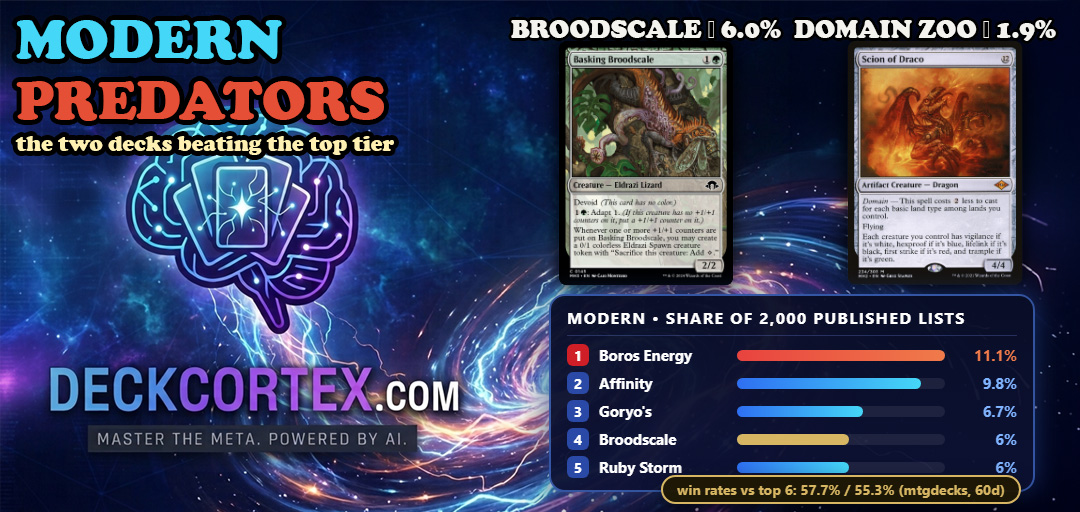
As of July 14, 2026. Modern decklists for Pro Tour Marvel Super Heroes are due in Melee tomorrow, and if the pros have done their homework, two decks should be keeping them up at night — neither of which is Boros Energy. On mtgdecks.net's match database (their numbers, not ours — DeckCortex doesn't track match results), the deck with the best record against Modern's six most-played archetypes over the last 60 days is Broodscale combo at a weighted 57.7% (350 matches against the top tier, 55% overall across 913). The only deck that posts a positive record against all six of those decks is Domain Zoo, at 55.3% weighted — a deck that makes up just 37 of the 2,000 most-recent published lists in our tracker. One predator is hiding in plain sight inside the top tier. The other is barely on the radar. This is a briefing on both: how they win, who's winning with them, what the numbers actually say, and what has to be true at RAI Amsterdam this weekend for them to keep it up.
The gauntlet, measured
First, what "the top tier" means. Our tracker holds 58,748 Modern decklists; the 2,000 most recent published ones (June 17 through July 14 — full MTGO Challenge standings, Leagues, and paper RCQs/festivals via MTGTop8) break down like this once you merge the classifier's split labels the same way we did in our State of the Format piece — card-for-card core checks, not vibes. Share is decklist-appearance share of published lists, top-8 rate is how often a deck's lists cracked an event top 8 (it runs hot for paper events that only publish a top 8; it is not a match win rate).
| Deck (merged) | Lists | Share | Top-8 rate | Wins | |---|---|---|---|---| | Boros Energy | 222 | 11.1% | 44.6% | 12 | | Affinity | 195 | 9.8% | 52.3% | 15 | | Goryo's Vengeance | 134 | 6.7% | 46.3% | 12 | | Ruby Storm | 121 | 6.0% | 37.2% | 10 | | Broodscale | 120 | 6.0% | 48.3% | 8 | | UR Prowess | 114 | 5.7% | 62.3% | 13 | | Boros Ponza | 101 | 5.0% | 39.6% | 6 | | Grixis Reanimator | 90 | 4.5% | 42.2% | 4 | | Amulet Titan | 68 | 3.4% | 58.8% | 7 | | Domain Zoo | 37 | 1.9% | 43.2% | 1 |
The six-deck gauntlet every number below is measured against: Boros Energy, Affinity, Goryo's Vengeance, Broodscale itself, UR Prowess, and Grixis Reanimator. External trackers see the same shape — Frank Karsten's July 9 Metagame Mentor on magic.gg has Boros Energy at 11.1% of the winner's metagame and writes that it's "not reaching the dominant numbers it once had." A light crown, in other words. Light crowns get knocked off.
Broodscale: the predator inside the top tier
Broodscale is the fourth-most-played deck in our window and simultaneously the best-performing deck against the field's top half. That combination is rare — usually the meta-killer is a fringe pick. Not here: 120 lists, a 48.3% top-8 rate, eight outright event wins in four weeks, and on the probe's top-cut sample (1,989 top-cut decks, June 14–July 14) it converts 27.8% of its tracked event entries into top cuts. And on July 6 it did something we haven't seen from any deck this year: three MTGO Challenge trophies in one day — littlebinboy won the 120-player Challenge 96, Thunus won the same-day rerun (with littlebinboy taking 8th in that one), and YungDingo won the 83-player Challenge 64. Our corpus settles a rumor while we're at it: the "littlebinboy won two Challenges" story going around conflates him with Thunus. One win and a top 8 for littlebinboy; the rerun trophy belongs to Thunus.
The loop, exactly
The engine is two cards and our combo engine confirms it as the deck's only complete two-card combo: Basking Broodscale plus Blade of the Bloodchief produces infinite colorless mana, infinite death triggers, and an arbitrarily large Broodscale.
Here's the loop, straight from the Oracle text. Broodscale is a two-mana Eldrazi Lizard with devoid and "Whenever one or more +1/+1 counters are put on this creature, you may create a 0/1 colorless Eldrazi Spawn creature token with 'Sacrifice this token: Add .'" Blade is a one-mana Equipment: "Whenever a creature dies, put a +1/+1 counter on equipped creature." Equip Blade to Broodscale, get one Spawn on the table, and:
- Sacrifice the Spawn for .
- The Spawn died — Blade puts a +1/+1 counter on Broodscale.
- The counter triggers Broodscale — make a new Spawn.
- Go to 1. Every lap banks a colorless mana, a death trigger, and a counter.
From a completely empty board the whole show costs six mana, two of them green — cast Broodscale (), cast and equip Blade ( + ), then activate adapt () for the first counter, and the loop feeds itself from there. With pieces already deployed it gets absurd: both permanents in play plus one Spawn means the kill costs exactly one mana. That's how this deck kills on turn three (the mana breakdown matches what LSV's TCGplayer guide and e4cards lay out; the loop itself we verified trigger by trigger).
Infinite mana still has to become a dead opponent, and the deck has four routes. Glaring Fleshraker is the clean one — "Whenever another colorless creature you control enters, this creature deals 1 damage to each opponent," so a battlefield Fleshraker turns the Spawn parade into lethal on the spot (and its other trigger hands you a Spawn every time you cast a colorless spell, which is most of the deck). Walking Ballista is the mana sink: cast it for a gigantic X and machine-gun the table. One correction to the community wisdom here, because it changes how you play the deck: Urza's Saga cannot fetch Ballista. The Saga's third chapter finds "an artifact card with mana cost or ," and the official ruling is explicit that a card with in its cost doesn't qualify — Saga gets Blade of the Bloodchief, Vexing Bauble, Springleaf Drum, Haywire Mite or Soul-Guide Lantern, never the Ballista. And Kozilek's Command has no tutor mode either — its four modes are X Spawn tokens, scry X plus a card, exile a small creature, or graveyard surgery. Ballista is a card you draw and cast, full stop. Route four is the honest one: a Broodscale with forty counters on it, attacking.
The deck around the combo is a ramp shell with a trick ending. Eldrazi Temple powers out Glaring Fleshraker and Writhing Chrysalis ahead of schedule, Malevolent Rumble digs four deep while stocking the graveyard, and that graveyard matters because Emrakul, the Promised End costs less per card type back there. The classic sequence — Kozilek's Command at your opponent's end step for a fistful of Spawn tokens, untap, sacrifice them all and cast a discounted Emrakul — ends fair games on the spot, since Emrakul's cast trigger takes your opponent's next turn away from them and hands it to you. That extra turn they get afterward rarely matters when you spent theirs pointing their removal at their own board.
Here's the list that won the 120-player Challenge on July 6 — littlebinboy's mono-green build:
Two things stand out in our data about how settled this deck is. First, the core is welded shut: across 36 lists in the probe's distribution sample, Basking Broodscale, Blade of the Bloodchief, Glaring Fleshraker, Kozilek's Command, Malevolent Rumble, Ancient Stirrings, Urza's Saga, Eldrazi Temple, Emrakul and Haywire Mite appear in 36 of 36, and our flex-slot engine scores Broodscale, Blade, Temple, Command and Saga at a perfect 1.00 core-lock. The only "core" card with any give is Walking Ballista (0.79 — some pilots trim it). Second — and this is the tell that the deck was built for this exact field — Vexing Bauble is also 36 for 36, main deck, with a 99% core-lock. Bauble counters any spell cast with no mana spent: an evoked Solitude, a cascaded Living End, a zero-mana Mox Opal. It's not a tax, it's a stone wall, and every list runs it like a land. The flex slots, for the record, are where you tune: Sowing Mycospawn and Dismember in the middle, Sire of Seven Deaths and Thief of Existence at the edges, Nature's Claim, Soulless Jailer and Grafdigger's Cage living in sideboards.
Broodscale's matchup card, with receipts
All win rates below are mtgdecks.net's aggregated match data, their 60-day window (May 15 – July 14, ~19,240 Modern matches total); cells under 50 matches are directional at best. Broodscale sits at 55% overall on 913 matches — and against the gauntlet it reads like a hit list: 72% against Affinity (90 matches), 59% against Grixis Reanimator (51), 57% against Goryo's (65), 54% against Eldrazi Tron (57), 50% against Boros Energy (94). The 180-day view says the same thing (54% overall on 1,389), so this isn't a hot month — it's a stable profile.
The Affinity number deserves its own sentence, because 72% is not a matchup, it's a mugging. Affinity is a board deck with almost no way to interact with a combo that ignores the battlefield, its clock is a half-turn too slow, and Broodscale's maindeck hoses it twice over — Vexing Bauble counters Mox Opal outright, and Haywire Mite eats whichever artifact matters most. Karsten's read that a turn-one Bauble "can wreck an Affinity player" is the polite version. Against Boros Energy, Skura's mtgdecks.net guide describes playing Broodscale "as a control deck" — trade early, lean on Dismember, and win the long game with Emrakul, because Boros can't actually stop the combo game one; LucasG1ggs's Boros guide concedes the deck "can go off unexpectedly if left unchecked." Against the reanimator decks it's simpler: they're racing you, their sideboard graveyard hate hits your Emrakul plan but not your primary combo, and you're faster on the draw more often than not.
Now the two soft spots, and they're both structural. Boros Ponza beats Broodscale 59-41 (32 matches) — that's the land-destruction deck at 5.0% of our lists, sixth trophy included, whose whole plan (Demolition Field, Field of Ruin, Avengers Disassembled, Blood Moon) happens to hit Broodscale exactly where it lives. The deck runs on Eldrazi Temple and Urza's Saga with a thin green base behind them, and Blood Moon is a disaster off the card text alone: Temple becomes a Mountain, the green spells go uncastable through it — and by official ruling, a Saga that loses its chapter abilities to Blood Moon is sacrificed on the spot. One enchantment, three cards of value. UR Prowess wins 54-46 (50 matches) the honest way: it's simply faster underneath — Monastery Swiftspear and Dragon's Rage Channeler don't care about your turn-three kill if you're dead on their turn four with Mutagenic Growth backup — and it packs Consign to Memory besides. More on that card in a moment, because it's the real Broodscale answer.
Domain Zoo: the deck that's positive against everyone
Domain Zoo is the opposite animal in every way that matters. Where Broodscale is 6% of the field, Zoo is 37 lists out of 2,000 — 1.9% — filed by our classifier under "4/5c Aggro," "Zoo," and "5c Domain Aggro" (we merged them after checking the cores card-for-card; they're one deck). Where Broodscale's engine flags an S-tier two-card combo, our combo engine scans the Zoo list and finds zero — not one complete two-card combo in the 75. It is the fairest deck in the format by that measure. And on mtgdecks.net's 60-day data it is the only archetype with a positive record against every member of the gauntlet: 53% vs Boros Energy (55 matches), 59% vs Affinity (49), 59% vs Goryo's (27), 61% vs Broodscale (18 — small, flag it), 50% vs UR Prowess (42), 53% vs Grixis Reanimator (15), for a weighted 55.3% against the top six on 206 matches, 53% overall on 512. The caveat is honest and important: over the 180-day window Zoo sat around 51% weighted. This edge is roughly eight weeks old. It's also accelerating — 28 of our 37 Zoo rows landed in July.
Two cards, five keywords
The package that carries the deck is Leyline of the Guildpact plus Scion of Draco, and the way they lock together is worth spelling out precisely, because half the write-ups get it backwards. The Leyline does two jobs from your opening hand: "Lands you control are every basic land type in addition to their other types" maxes out domain from turn zero, and "Each nonland permanent you control is all colors" is the half people forget. Scion of Draco is a **** artifact Dragon whose domain discount knocks it to with all five basic types in play — a 4/4 flier on turn two. Its text grants each ability by color: vigilance if a creature is white, hexproof if blue, lifelink if black, first strike if red, trample if green. Scion alone with a table of red-green creatures hands out two keywords. Scion with the Leyline makes every creature you control all five colors — so the entire team gets all five abilities. Hexproof blanks Galvanic Discharge and every other targeted removal spell in the format; first strike plus lifelink makes combat unwinnable for a fair deck. That's the "formidable combination that many Boros Energy decks can't answer," as Karsten put it, and our matchup line above (53% on 55 matches against the most-played deck in the format) backs the mechanism.
The rest of the shell is pure rate. Territorial Kavu is a two-drop whose power and toughness equal your basic land types — a 5/5 on turn two under a Leyline — that rummages or exiles a graveyard card every attack (incidental hate against a third of this metagame, stapled to a threat). Leyline Binding is flash removal that exiles any nonland permanent — for at full domain. Stubborn Denial is a one-mana "counter unless they pay " that upgrades to a hard counter the moment you control a creature with power 4 or greater, which in this deck is "always." Ragavan, Nimble Pilferer remains the best fair one-drop ever printed. And Nishoba Brawler — a two-mana trampler with power equal to your basic land types — quietly does a 5/3 impression for $0.19.
One deck, two builds — and the winner isn't the famous one
Here's where our corpus disagrees with the aggregate lists making the rounds, and it's the most actionable detail in this article. Karsten's write-up crowns Phelia, Exuberant Shepherd plus Quantum Riddler as the deck's post-ban engine — Riddler is a 4/6 flier that draws a card on entry, draws you an extra card whenever you're near-empty, and can warp into play early for (warp, per the official reminder text: cast it from your hand for the warp cost, exile it at the next end step, recast it from exile later). Phelia blinks it for a second draw trigger, Arena of Glory gives it haste for ambush attacks. That build is real and winning — Imaeda's July 10 Challenge list carries the full four Riddlers and three Phelias:
But the list that actually took a trophy last weekend runs none of that. Yunkoooo won the RCQ at Advantage Games in Westminster, Colorado on July 11 — 39 players, a Regional Championship invite on the line — with the leaner, meaner fork: four Doorkeeper Thrull, two Kroxa, Titan of Death's Hunger, two Winternight Stories and the Nishoba Brawlers, zero Riddlers, zero Phelias:
Thrull earns those slots against this exact field: "Artifacts and creatures entering don't cause abilities to trigger" turns off an evoked Solitude's exile, Affinity's Kappa Cannoneer value triggers, and — relevant below — Glaring Fleshraker's ping plan. Our flex engine confirms the fork: the 16-card core every build shares is the Leyline/Scion/Kavu/Ragavan/Denial/Binding shell plus Consign to Memory and the mana, while Riddler, Phelia, Thrull, Kroxa, Nishoba Brawler and Winternight Stories all float in the flex layer. The deck's identity is settled; its threat suite is a weekly metagame call.
Results beyond the trophy, from our rows: bomberboss — who plays the deck under both the "Zoo" and "4/5c Aggro" labels and is transparently its online specialist — took 2nd of 448 players at the July 12 MTGO Showcase Challenge, plus a second-place Challenge 32 finish the day before and five more top-32s in the window. Takeuchi Ryota reached the top 4 of The Last Sun 2026 Qualifier in Shizuoka; Landon Quick and Italo Silva Santos posted RCQ top 8s in Oklahoma City and Klagenfurt the same weekend. One trophy, but the depth chart is filling in fast for a 1.9% deck.
The Amulet problem
Domain Zoo's matchup card has exactly one horror show on it, and you should know it before you sleeve the deck: 27% against Amulet Titan on mtgdecks.net's 60-day data — 15 matches, so treat the precise number gently, but the mechanism is not subtle. Amulet doesn't play to the board Zoo attacks and doesn't care about five keywords: it ramps Primeval Titan into play with haste via Amulet of Vigor and Hanweir Battlements, and a resolved Titan invalidates every 5/5 you've made. Stubborn Denial is your only real interaction and their threats come down through it eventually. And here's the uncomfortable pairing: Amulet Titan is quietly excellent right now — 3.4% of our lists with a 58.8% top-8 rate, seven wins, and the single best top-cut conversion in the probe sample (44.4%). If Amsterdam's field leans into Amulet, Zoo's all-positive matchup card grows a hole. Ruby Storm (46% on 13 matches) and Boros Ponza (36% on 11) are the other two flags, both small samples, both the same story: decks that ignore combat.
What actually beats Broodscale (and what only looks like it does)
This section exists because the most-repeated piece of anti-Broodscale advice in circulation is wrong, and if a chunk of the Pro Tour field boards the wrong hate, Broodscale's weekend gets a lot better. The claim: "Torpor Orb turns the combo off." Read the cards. Torpor Orb says "Creatures entering don't cause abilities to trigger." Basking Broodscale's token-making trigger fires when +1/+1 counters are put on it — not when anything enters. Blade of the Bloodchief triggers when a creature dies. The loop runs straight through a Torpor Orb; all the Orb does is mute Glaring Fleshraker's ping trigger, i.e. it removes one of four kill routes and leaves infinite mana, a lethal Ballista, and a 40/40 Broodscale fully operational. Same math for Doorkeeper Thrull. Eldrazi Tron sideboards currently carry Torpor Orb next to Disruptor Flute — the Flute (name Basking Broodscale, its adapt ability can't activate) is the half of that package doing real work.
What actually answers the deck, in descending order of brutality:
- Artifact removal, instant speed, held for the equip. The combo has a single point of failure and it costs one mana: Blade of the Bloodchief. Meltdown for X=1 clears every Blade and every Vexing Bauble and Springleaf Drum on the table; Karsten calls it a standout, and our data agrees with the logic — it's in Prowess and Grixis boards already. Force of Vigor does it for free (though mind their own Bauble isn't out — a pitch-cast Force spends no mana and walks into it), Nature's Claim does it for one, Wear // Tear and Collector Ouphe do it in white-red and green. Kill the Blade with the equip trigger on the stack and they've spent their turn doing nothing.
- Consign to Memory, the format's Swiss-army answer. Counter target triggered ability or colorless spell, replicate . Against Broodscale it counters the Blade trigger or the Broodscale trigger to snap one loop iteration, counters Kozilek's Command, and — the fun one — counters a hard-cast Emrakul outright, because Emrakul is a colorless spell. Karsten reports it as the most-played card in Modern right now, main decks and sideboards combined, and it's the best single reason to expect Broodscale's numbers to compress at a high-preparation event.
- Attack the lands. Blood Moon turns Eldrazi Temple into a Mountain and, by official ruling, forces the sacrifice of an Urza's Saga on the spot. Boros Ponza's 59-41 edge is this plan with a deck built around it. If Broodscale is the field's boogeyman on Friday, expect Blood Moon counts to rise everywhere.
- What doesn't work: graveyard hate. The loop never touches a graveyard. Soul-Guide Lantern and friends only graze the Emrakul/Malevolent Rumble side plan. If your anti-Broodscale plan is Rest in Peace, you don't have an anti-Broodscale plan. (For the record, the deck's famous Pauper cousin — Broodscale plus Sadistic Glee — doesn't exist here: Sadistic Glee isn't Modern-legal. We checked.)
The Amsterdam angle
The tournament facts, per the magic.gg fact sheet: Pro Tour Marvel Super Heroes runs July 17–19 at RAI Amsterdam — sixteen Swiss rounds, each day three MSH Booster Draft rounds into five Modern rounds, with the Top 8 played as booster draft, the first Limited Pro Tour Top 8 in about fifteen years. $500,000 prize pool, $50,000 to the champion. Modern lists lock Wednesday July 15 at noon local and go public at the start of Round 4 on Friday. Neither predator, incidentally, plays a single Marvel Super Heroes card — we checked the winning lists card by card; the set's real Modern footprint is Hex Magic in Ruby Storm and Avengers Disassembled in the Ponza deck, which matches Karsten's line that MSH "has mostly strengthened existing archetypes rather than creating new ones."
The precedent that matters: the last Modern Pro Tour, Edge of Eternities in September 2025, was won 11-1 in the format by Tameshi Belcher — a proactive combo deck feasting on a fair field, while Boros Energy limped to a 43% event win rate (all of this per magic.gg's coverage). Pro Tour fields historically over-index on proactive combo and punish stock fair decks. That context cuts both ways here: it's the environment where a Broodscale-shaped deck shines, and it's also why every serious testing house will arrive with the hate section above fully internalized. Watch the Friday decklist reveal with one question: how many copies of Meltdown, Consign to Memory, and Blood Moon did the field bring? Under-preparation means Broodscale runs the tables. Over-preparation means the 1.9% deck nobody boarded against — the one that's positive into everything — has the best seat in the room.
One more date for the calendar: the next B&R announcement is August 10, three weeks after the Pro Tour. Wizards' June 29 note left Modern untouched and pointed its warning at decks that "regularly start with over half a dozen zero-mana artifacts" — that's Affinity's problem, not Broodscale's. A dominant combo weekend in Amsterdam is the kind of thing that changes an August calculus, though. It's happened before.
What to do with this
- Playing an RCQ in the next month? Broodscale is the pick if you'll practice it. Best weighted record against the top tier on real match data, welded-shut core (you can't build it wrong), turn-three kills, and at roughly $570–650 in paper (mtggoldfish/mtgdecks figures; Urza's Saga at $42.50 a copy is a third of the bill) it's the budget option of the two. The homework is the types-matter layer — knowing that Saga can't find Ballista, that Emrakul reads your own graveyard's card types, that the loop needs the token sacrifice and not just any death — because the pilots winning with it (littlebinboy, Thunus, YungDingo: three trophies in one Sunday) are winning on reps.
- Zoo is the read if your local field is the top tier in miniature. Positive into all six gauntlet decks, hexproof beaters against removal-heavy fair decks, and a real trophy plus a 448-player near-miss last weekend. Copy Yunkoooo's Thrull build into DeckCortex if your field is Affinity/Boros-shaped; take Imaeda's Riddler build if you expect grindier mirrors. Budget note: the five-color mana plus four Riddlers pushes it near $1,029 (mtggoldfish's figure) — and check Amulet Titan's local share first. Above its current 3.4%, think twice; the 27% cell is small-sample but the mechanism is real.
- Playing anything else? Board like Broodscale exists. One-mana instant-speed artifact removal and Consign to Memory, not Torpor Orb, not graveyard hate. And if you're on Affinity specifically: that 72-28 cell is your problem to solve this week, not theirs.
Data notes: deck shares, top-8 rates, event results and conversion rates are DeckCortex data — 2,000 most-recent published Modern lists (June 17 – July 14, 2026) out of 58,748 tracked, plus the probe's 1,989-deck MTGTop8 top-cut sample (June 14 – July 14); shares are decklist-appearance shares of published lists, not field share, and no DeckCortex number is a match win rate. All match win rates are mtgdecks.net's aggregated match database (60-day window May 15 – July 14, ~19,240 matches; 180-day cross-checks as noted); cells under 50 matches are directional. Combo confirmations are DeckCortex's spellbook engine on the two embedded lists. Card prices are Scryfall paper aggregates via our proxy as of July 14, 2026; full-deck totals are mtggoldfish/mtgdecks figures as attributed. Pro Tour structure and quotes are per magic.gg. Card wording per current Oracle text.