Why Your Combo Count Isn't Your Bracket
DeckCortex tells you exactly how many complete two-card combos are in your deck — and that number is not your Commander bracket. We run five real lists through DeckCortex's own bracket engine, including one commander whose *combo-heavier* build lands a whole bracket lower, to show why Game Changers, fast mana and tutors decide where a deck sits — and why the combo counter is just one vote out of six.
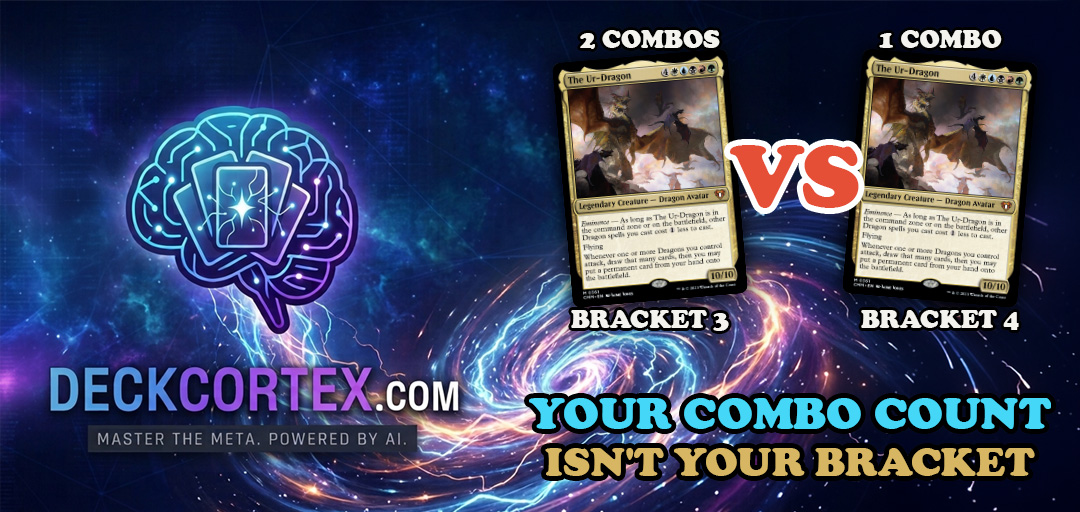
Your deck has three infinite combos. So it's Bracket 4, right?
Trick question — and the reason it's a trick is the most useful thing you'll learn about deck power this year. DeckCortex will happily tell you exactly how many complete two-card combos are sitting in your 99. It's a real number, computed the same way every time, and people read it like a bracket thermometer: more combos, higher bracket. That instinct is wrong, and the cleanest way to show it is DeckCortex's own engine, pointed at five real lists that run from a Marvel precon all the way up to the two most-played decks in competitive Commander.
The number DeckCortex actually gives you
When DeckCortex scores a list, one of the things it reports is `two_card_combos_present`: a flat count of the complete two-card infinite combos it finds. Not "combo-ish pieces," not "you're one card short" — both halves present and assembled, checked against the Commander Spellbook database. It's deterministic, and it doesn't care how you feel about your deck. Point it at Doctor Doom, King of Latveria's precon and you get 0. Point it at a tuned Kinnan, Bonder Prodigy list and you get 13.
That count is honest and it's genuinely useful. What it is not is the Bracket — because inside DeckCortex it's one of six signals feeding the bracket call, and it's usually not the one that decides.
The system it feeds
Quick refresher, because everything below hangs on it. Wizards sorts a Commander deck into one of five brackets — Exhibition, Core, Upgraded, Optimized, cEDH — and the main lever everyone talks about is the Game Changers list: cards deemed strong enough that a deck's count of them helps set its ceiling. That list sits at 53 cards on Wizards' official roster as of the February 2026 update (the live `is:gamechanger` count on Scryfall — Wizards names the cards it changes each update but never prints a running total). Brackets 1–2 allow zero Game Changers, Bracket 3 allows up to three, and Brackets 4–5 lift the cap entirely. Bracket 3 also draws a specific line at combos: no intentional early two-card infinite — a slow one that only comes together in the late game is fine.
Here's the part most people miss. DeckCortex doesn't hand-wave the bracket or ask a language model to guess it. It runs a deterministic threshold model over six inputs — Game Changers, two-card combos, mass land destruction, fast mana, tutors, and a 0–10 Power Level score — and takes the lowest bracket a deck fits under. The thresholds are public, and they look like this:
| Bracket | Game Changers | two-card combos | fast mana | tutors | |---|---|---|---|---| | 1 Exhibition | 0 | 0 | 0 | 0 | | 2 Core | 0 | 0 | 1 | 3 | | 3 Upgraded | up to 3 | no cap | no cap | no cap | | 4 Optimized | no cap | up to 2 | up to 5 | up to 6 | | 5 cEDH | no cap | no cap | no cap | no cap |
Read the combo column top to bottom and the whole thesis is right there: Bracket 3 has no combo cap, and Bracket 4 caps combos at two. A deck can carry more infinite combos at Bracket 3 than at Bracket 4. What actually separates those two brackets is the Game Changers count — three or fewer keeps you at 3, a fourth pushes you to 4. (One honest footnote: the list DeckCortex scores against is its own 44-card copy, updated 2026-06-05, running a little behind Wizards' 53.)
And the card that proves the model isn't just counting power? Sol Ring. The single most-played card in the format isn't a Game Changer at all — Wizards left it off on purpose, calling it too ubiquitous to restrict. The one artifact in nearly every deck you'll ever face contributes exactly nothing to its bracket.
Five decks, five verdicts
Five lists, run through DeckCortex's engine. Watch the combo count and the bracket move independently.
| Deck | complete combos | Game Changers | Bracket | |---|---|---|---| | Doom Prevails (Marvel precon) | 0 | 0 | 2 · Core | | The Ur-Dragon — "Upgraded" | 2 | 1 | 3 · Upgraded | | The Ur-Dragon — "Optimized" | 1 | 4 | 4 · Optimized | | Blue Farm (Kraum + Tymna) | 6 | 17 | 5 · cEDH | | Kinnan, Bonder Prodigy | 13 | 11 | 5 · cEDH |
Combo counts 0, 2, 1, 6, 13. Brackets 2, 3, 4, 5, 5. If the count set the bracket, that sequence would climb in lockstep. It doesn't — it wobbles, and every wobble has a reason.
The precon: zero combos, and that's the point
Doom Prevails is the honest baseline. DeckCortex finds zero complete two-card combos and zero Game Changers — the deck has combo pieces lying around (Kiki-Jiki and a clone, say), but never both halves of one line. On signals alone it floors at Bracket 1; the Power Level score is what nudges a real precon up to its true home at Core / Bracket 2, which is exactly where Wizards says the average precon belongs. Zero combos, Bracket 2. Hold that thought.
The Ur-Dragon, twice: more combos, lower bracket
Now the exhibit that should retire the "count = bracket" idea for good. Same commander, The Ur-Dragon, and EDHREC's two average lists for it — the community "Upgraded" build (aggregated from 4,620 decks) and the "Optimized" build (3,303 decks). Feed both through DeckCortex:
- Upgraded — 2 complete combos, 1 Game Changer → Bracket 3
- Optimized — 1 complete combo, 4 Game Changers → Bracket 4
The higher-bracket list has fewer combos. Read that again. The Optimized build is a full bracket stronger while running one less infinite, and the reason is sitting in its Game Changers column: it adds Demonic Tutor, Rhystic Study, Smothering Tithe and Vampiric Tutor where the Upgraded list runs only Smothering Tithe. That fourth Game Changer is the entire story — it trips the "more than three" line and bumps the deck from 3 to 4. The combos are almost a coincidence.
It helps that the shared combo isn't some turn-two kill. Dragon Tempest plus Ancient Gold Dragon is a real two-card line DeckCortex logs in 26,536 of the deck's tracked lists — but it needs the dragon to connect in combat first, and then its d20 roll spits out up to twenty flying Faerie Dragon tokens, each one entering and pinging a target for your ever-climbing dragon count. It's a table-ending swing when it lands, and it's slow and telegraphed enough that Wizards is comfortable with it at Bracket 3. The Upgraded list even packs a second combo the Optimized list drops — a three-card Miirym, Sentinel Wyrm loop — and it's still the lower bracket. More combos, lower bracket. The counter simply isn't driving.
Blue Farm and Kinnan: same bracket, double the combos
At the top of the table sit the two decks you actually have to beat in competitive Commander. Over the last three months of top-cut results (26,146 lists, Topdeck tournaments, 2026-04-07 to 2026-07-06), Blue Farm — Kraum, Ludevic's Opus and Tymna the Weaver — is the #1 archetype at 7.6% of the top cut, and Kinnan is #2 at 6.9%. Both land at Bracket 5. Their combo counts are not close.
Blue Farm runs 6 complete combos — headlined by the cleanest kill in the format, Demonic Consultation into Thassa's Oracle: name a card you don't play, exile your entire library, then land the Oracle with nothing left to draw and win on the spot (145K of the deck's lists run it, more than any other line). It also carries 17 Game Changers, 7 fast-mana pieces and a pile of tutors. It doesn't reach Bracket 5 by combo volume — it trips the model's cEDH safety net, the "real win + fast mana + tutor density all at once" fingerprint that says this is a competitive deck no matter how you slice it.
Kinnan gets to the same Bracket 5 from the opposite direction. DeckCortex's raw signal is 13 — though three of those are single-card artifacts the engine double-lists, so the real number is closer to 10 complete combos, still nearly double Blue Farm's. Many of them run straight through the commander: tap Basalt Monolith for three colorless, Kinnan adds a fourth off the trigger, pay three to untap, net one mana a loop — infinite, forever. Thirteen combos blows past Bracket 4's cap of two on its own; Kinnan is Bracket 5 because it's drowning in combos.
So here's the punchline of the whole table. Blue Farm has 6 combos and Kinnan has ~10, and they're the same bracket. The deck with fewer combos (Blue Farm) is carrying more Game Changers (17 vs 11) and more tutors. Combo count and bracket aren't just loosely linked here — they don't even rank the two decks in the same order.
Why the counter loses the vote
Step back and the pattern is clean. Combos only cap brackets — zero for 1 and 2, unlimited for 3, two for 4, unlimited for 5 — so past a point the count stops mattering and the other five signals do the work. Game Changers are what actually walk a deck up the low-to-mid ladder: the jump from the Ur-Dragon's Upgraded list to its Optimized list was one extra tutor on the list, nothing more. At the top, the cEDH safety net catches decks like Blue Farm that don't lean on raw combo count at all — Force of Will, Fierce Guardianship, Gaea's Cradle, The One Ring and a tutor suite say "competitive" far louder than a combo tally does. And the Power Level score quietly handles the floor, which is why a zero-combo precon still reads as Core instead of Exhibition.
The combo count is a real, honest signal. It's just answering a narrower question than "what bracket is this" — it's answering "how many complete two-card kills are in here," and a deck's bracket is a verdict on its whole game plan: how fast it goes, how hard it tutors, how many format-warping cards it leans on, and yes, whether it combos. One input, six votes.
How to read your own bracket
Next time DeckCortex hands you a combo count, treat it like a smoke detector, not a scoreboard. Three combos in a Bracket 3 shell full of slow, telegraphed lines and one Game Changer is a perfectly fair Upgraded deck. One combo wrapped in four Game Changers, fast mana and six tutors is an Optimized deck that will end games well before yours gets going. If your list jumped a bracket and you're not sure why, don't count combos — count Game Changers first, then look at your tutors and fast mana. That's the order the engine reads them in, and now you can too.
Data: DeckCortex bracket-fit engine + Commander Spellbook combo detection, run 2026-07-06. Bracket signals reproduced from DeckCortex's public thresholds (`GAME_CHANGERS` = 44 cards, 2026-06-05; official WotC/Scryfall list = 53); the model's Power Level input isn't reproduced here, so a signal-only bracket is a floor — it only shifts the precon from 1 to 2. Combo counts are DeckCortex's deterministic two-card signal, not the final bracket. Metagame shares are top-cut appearance across 26,146 Topdeck cEDH lists (2026-04-07 to 2026-07-06), not field share or match win rate. The Ur-Dragon "Upgraded"/"Optimized" lists are EDHREC average decks (n = 4,620 / 3,303), not DeckCortex tournament data. Prices are Scryfall paper aggregate.