Our Solver Built a Bracket 3 Deck With 263 Combos. DeckCortex Calls It cEDH.
We gave our solver all 110,447 combos in Commander Spellbook and one job: pack a Bracket 3 deck. It built Gwenom, Remorseless with 263 of them, 202 running through a single 1998 enchantment, Mortuary. Commander Spellbook's estimator finds nothing Bracket 3 forbids. DeckCortex's engine calls it cEDH, and one two-card combo decides it.
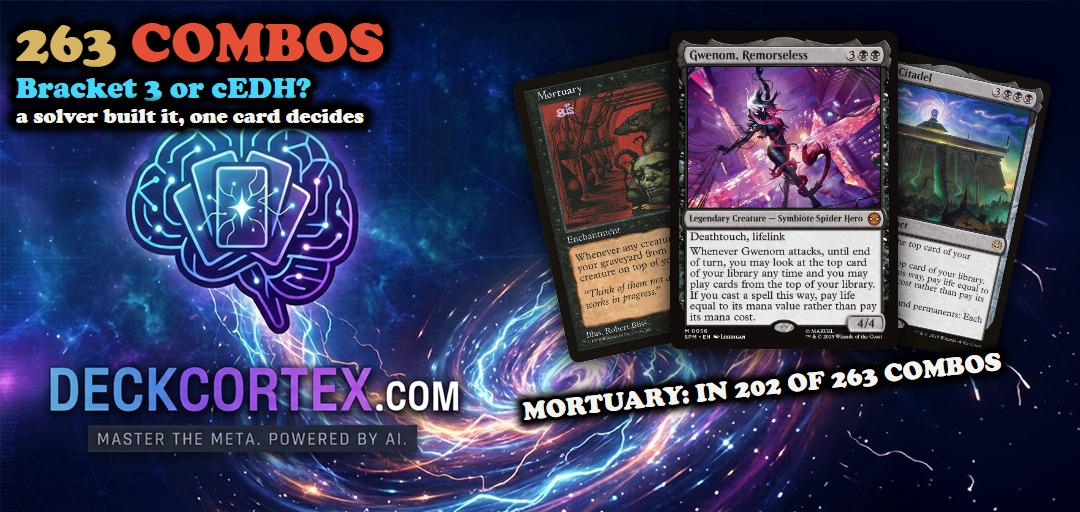
Gwenom, Remorseless attacks. Its trigger resolves, and for the rest of the turn you may look at the top card of your library any time and play cards from there, paying life equal to a spell's mana value instead of its mana cost. After combat, sacrifice Viscera Seer to its own ability. Two things trigger. Mortuary puts the Seer back on top of your library, and Blood Artist makes an opponent lose 1 life while you gain 1. The scry resolves, you leave the Seer where it is and cast it again for 1 life. You're back where you started, and an opponent is 1 life lower. Repeat until the table is dead.
That's one combo. The deck it comes from holds 263 of them, and it was put together by a solver. We gave our in-house solver every combo in Commander Spellbook, 110,447 Commander-legal variants as of September 29, 2026, and one job: pack as many as possible into a deck that still plays like a real deck and still passes the Bracket 3 checks. It worked through 50 commanders. A $4.80 mythic from Marvel's Spider-Man won.
Commander Spellbook's own bracket estimator looked at the finished 100 and found nothing Bracket 3 forbids. DeckCortex's bracket engine calls it cEDH. They're both right about something, and the gap between them is the most useful thing in this piece.
The brief we gave the machine
"Most combos" on its own produces garbage, as the first runs proved (more on that below). So every commander's deck started from how competitive players actually build that commander: the most-played cards on its EDHREC cEDH page, which for Gwenom counted 444 decks when the run pulled it. Fast mana played by at least 30% of those lists was locked in, the most-played cards filled every nonland slot but 30, and those 30 were the solver's to spend.
The rest were rules the solver couldn't break:
- 29 lands, at most six of them utility lands.
- At least 10 ramp cards, 8 tutors, 12 pieces of interaction and 4 card-draw cards, counted by the same card classifier that powers DeckCortex's deck analysis.
- An average mana value of 2.1 or lower across the nonland cards.
- Bracket 3: no more than three Game Changers, no mass land denial, at most one extra-turn card, and no combo that Commander Spellbook's deck estimator rates "Ruthless", its tier for Bracket 4 and up.
That last rule has a catch, and it caught us first. Spellbook's estimator treats your commander as always available, so inside a deck, "commander plus two cards" counts as a two-card combo. The solver judged every line that way. For Gwenom, 117 of the combos it could reach rate above Bracket 3 (for five-color Najeela it was 6,310), and each became a card set the deck was not allowed to complete. The solver could play some pieces of such a combo, never all of them.
How a solver scores a combo
To a solver, a combo is a number. Here are five lines from the finished deck and what each one was worth:
| Combo in the Gwenom deck | Pieces in the 99 | Ends the game? | Decks playing it | Points | |---|---|---|---|---| | Sensei's Divining Top + Aetherflux Reservoir (+ Gwenom) | 2 | yes | 5,815 | 1.15 | | Warren Soultrader + Gravecrawler + Blood Artist | 3 | yes | 45,809 | 0.67 | | Mortuary + Viscera Seer + Blood Artist (+ Gwenom) | 3 | yes | 820 | 0.49 | | Gravecrawler + Phyrexian Altar | 2 | no | 75,694 | 0.34 | | Mortuary + Phyrexian Walker + Yahenni, Undying Partisan + Bolas's Citadel | 4 | no | 2 | 0.03 |
Four rules produce those numbers. A line that ends the game is worth four times one that doesn't. Every extra card a line needs from the 99 halves its value, and the commander doesn't count, since it's always there. Lines that need a lot of mana to run count for less. And popularity scales everything on a log curve, using the deck counts Commander Spellbook attaches to each combo.
That last factor matters more than it sounds. Of Spellbook's 110,447 variants, 44,295, about four in ten, sit in zero decks, and the median combo is played in exactly one. Counted equally, those phantom lines would drown the real ones. So a combo nobody plays keeps 40% of its value, one in 1,000 decks keeps all of it, and the most-played lines get about half again on top. Format staples in more than 100,000 decks are tripled.
The other side of the ledger is the curve. Every mana a chosen card costs subtracts 0.2 points, so a six-drop has to bring at least 1.2 points of combos with it. Bolas's Citadel brought 111 combos. Add up all 263 lines in the finished deck and you get 69.21 points, the number that decided the ranking below.
The full scoring formula and every setting
Each Commander Spellbook variant the deck contains completely scores (1.0 if it wins, 0.25 if not) × 2^(2 − n) × (0.5 if it needs an unnamed "template" card) × speed × popularity × (3 if 100,000+ decks), where n is the number of cards outside the command zone. A line "wins" when Spellbook lists a result like infinite damage, infinite life loss, infinite mill or "win the game".
- Speed, by the mana Spellbook says the line needs to run: up to 2 mana 1.0, up to 4 mana 0.8, up to 6 mana 0.55, more 0.3, unknown 0.8.
- Popularity: 0.4 + 0.6 × ln(1 + decks) / ln(1,001). That's 0.4 at zero decks, 0.8 at 100, 1.0 at 1,000 and about 1.5 for the most-played variant (353,948 decks).
- Curve: average mana value of the nonland cards at most 2.1, at most two solver-chosen cards at mana value 5 or more, and a penalty of 0.2 points per mana point of every chosen card.
- Template: 29 lands (at most six utility lands), quotas of 10 ramp, 8 tutors, 12 interaction, 4 draw and 3 free spells. Gwenom's pool held a single free spell, Deadly Rollick, so that quota dropped to one.
- Skeleton: fast mana at 30%+ inclusion on the commander's EDHREC cEDH page is forced in, then the most-played nonland cards until 30 slots remain. Game Changers are never forced, since they're the scarce resource. Commanders without a usable cEDH page (fewer than 20 decks) were skipped.
- Bracket 3: at most three Game Changers, no mass land denial, at most one extra-turn card, and no complete combo that Spellbook's estimator tags above "Spicy", judged with the commander always available. Our reproduction of that estimator agrees with 110,014 of the 110,016 combo tags Spellbook stores.
- Solver: 150 seconds per commander. Annealing gets 40% (four rounds of 16 parallel chains), then CP-SAT starts from the annealed deck. Models are capped at the 40,000 heaviest variants.
An explorer and a prover
Gwenom's candidate pool held 1,083 cards and 3,986 combos it could possibly reach. There are roughly 10⁵⁸ ways to pick 30 cards from a pool that size, so nothing checks them one by one. The solver runs two very different methods, one after the other.
The explorer is simulated annealing. It starts from a quick greedy deck and swaps cards at random, keeping every swap that raises the score. Early on it also accepts some swaps that lower it, the way hot metal can still shift before it sets, so it can climb out of dead ends. Sixteen of these chains run side by side for four rounds, each round restarting from the best deck so far. For Gwenom, that came to about 36.5 million attempted swaps in a minute.
The prover is CP-SAT, the open-source constraint solver in Google's OR-Tools. It sees the deck as 1,083 yes-or-no switches, one per card, plus one switch per combo that may only turn on when all its cards are in. Then it closes in on the best deck from both sides: better decks from below, a provable ceiling from above. When the two meet, the gap is 0% and no better deck exists under these rules. For Gwenom the explorer had already found the best deck. The prover confirmed it, and the whole candidate took 73 seconds.
You need both because each fails where the other shines. Najeela's five colors reach 106,033 combos. In one development run, CP-SAT spent 36 minutes on preprocessing alone. In another, it was still sitting on its greedy starting deck after 6,000 seconds, at 69 combos. Annealing found a 146-combo deck in 300 seconds, because it stumbled onto a package that turns Najeela's Warrior tokens into mana, something the exact solver never reached. On small models it's the other way round: CP-SAT finishes and hands you a proof, which no amount of random swapping can.
What we didn't use is a genetic algorithm. Combos only count when all their pieces sit in the same deck, and crossover, which splices two decks together, tears exactly those groups apart.
What the first runs got wrong
It took four weeks of runs and rule changes to get to the deck in this article. The mistakes are the best explanation of why every rule above exists:
- The first run crowned Najeela with 777 combos at an average mana value of 2.60. It had no popularity factor and no cEDH template: a combo pile, not a deck.
- The interaction quota filled up with the wrong cards. Our classifier gives combo pieces side roles, so Tuktuk Rubblefort, a wall that gives your creatures haste, and Maestros Diabolist counted as interaction.
- Profane Tutor beat Demonic Tutor into the deck, because the only thing favoring Demonic was a tie-breaker. That's why every deck now starts from what cEDH players actually play.
- Our first Bracket 3 test on Eirdu came back from Commander Spellbook as Ruthless. Spellbook stores Eirdu, Carrier of Dawn // Isilu, Carrier of Twilight + Marionette Apprentice + Hammerhead, Maggia Boss as a "Spicy" three-card combo. In an Eirdu deck, though, the commander is always there, so it's a fast two-card combo. We rebuilt Spellbook's deck estimator to judge every line in context.
- Gwenom left a Game Changer slot empty, even though 97% of its cEDH lists run Vampiric Tutor. The solver only buys Game Changers for combo points. A clean-up step now fills leftover Game Changer room by popularity, and only by swapping out cards that sit in no combo.
- The mono-black mana base got fetchlands and not a single Swamp. It now plays as many basics as the average cEDH Gwenom list: eight.
- Annealing at a "temperature" of 0.1 never left its first deck. At 0.5, one chain in three or four found the jump within 40 seconds.
Five commanders, counted down
Same rules, same 150 seconds, 50 commanders: the top 40 of a pre-ranking on how much combo weight runs through the commander, plus a dozen of cEDH's most-played commanders that the pre-ranking missed. Here's the top of the final table, and a pattern the solver kept stumbling into.
5. Kraum, Ludevic's Opus + Tymna the Weaver · 234 combos, 92 of them end the game. Kraum, Ludevic's Opus and Tymna the Weaver are the most-played pair in our cEDH data this quarter, 1,685 of 24,430 tracked tournament lists, yet the pre-ranking missed them, because hardly any combo needs the commanders themselves. Their 99 packs Underworld Breach + Lotus Petal + Brain Freeze, which the format-staple rule forces in, and a card you'll see again: Eirdu, in 105 of their combos.
4. Slimefoot and Squee · 256 combos, 111 end the game. Slimefoot and Squee's deck leans on Scurry Oak and Herd Baloth, each in about 50 lines.
3. Dargo, the Shipwrecker + Tymna the Weaver · 242 combos, 95 end the game. Eirdu again, in 94.
2. Najeela, the Blade-Blossom · 262 combos, one fewer than the winner, but only 100 end the game. Najeela, the Blade-Blossom brings the biggest model in the field: the solver only looked at the 40,000 heaviest of Najeela's 101,310 lines and stopped with a 46.7% gap, so this deck is not proven best. An earlier 900-second test didn't move it off the 150-second result either. Eirdu sits in 116 of its combos.
The pattern is Eirdu's back face, Isilu, Carrier of Twilight: "Each other nontoken creature you control has persist." Add a sacrifice outlet and a way around the -1/-1 counters, and creatures return forever. That makes it a combo engine in any deck with white and black, so the solver put it in the 99 of the second, third and fifth deck. As a commander it has more combos than anyone, 317, and still finishes 12th, largely because only 77 of them end the game.
The biggest faller was Sefris of the Hidden Ways, which topped the pre-ranking and finished 49th with 30 combos and a 110.8% gap after 150 seconds. Read that as "not found in time", not "impossible".
1. Gwenom, Remorseless · 263 combos, 201 of them end the game. It's the only deck in the top five the solver proved optimal.
One enchantment, 202 combos
Mortuary is a four-mana enchantment from Stronghold, printed in 1998, $19.44 today. "Whenever a creature is put into your graveyard from the battlefield, put that card on top of your library." On its own, that's a drawback: your next draw is the creature you just lost. Next to anything that lets you cast from the top of your library, it's a loop, because the creature that just died is the next card you can cast.
Gwenom is one of those, for one turn, after it attacks. Bolas's Citadel is the other, all the time and without attacking: "You may play lands and cast spells from the top of your library. If you cast a spell this way, pay life equal to its mana value rather than pay its mana cost." The solver spent one of Bracket 3's three Game Changer slots on the Citadel, and it paid off. Mortuary sits in 202 of the deck's 263 combos, and they split exactly in half: 101 run through Gwenom, and every one of them has a twin that runs through Citadel instead.
Most of those lines are the same combo in different clothes. Pick one card from each row:
| Slot | What the deck plays | |---|---| | The engine | Mortuary | | Cast from the top | Gwenom after it attacks, or Bolas's Citadel | | A free sacrifice outlet (9) | Viscera Seer, Carrion Feeder, Woe Strider, Umbral Collar Zealot, Yahenni, Undying Partisan, Altar of Dementia, Ashnod's Altar, Phyrexian Altar, Blasting Station | | Something worth killing every loop (8) | Gray Merchant of Asphodel, Cauldron Familiar, Serrated Scorpion, Fear of Lost Teeth, Ornithopter, Memnite, Phyrexian Walker, or Bontu's Monument with any cheap creature |
Nine outlets times eight is 72 lines through Gwenom alone, 51 of which end the game by themselves. The misses are mostly the zero-mana artifact creatures, which loop for free but deal no damage without the right outlet or a drain effect on the board. The rest of the Mortuary lines swap in payoffs like Blood Artist, Zulaport Cutthroat, Vein Ripper and Sephiroth, Fabled SOLDIER // Sephiroth, One-Winged Angel. This is why the count gets so big: 263 lines, but only a handful of engines with interchangeable parts. Pull Mortuary and 202 of them are gone.
The deck's single most valuable line doesn't touch Mortuary at all, and it belongs to the commander. With Gwenom's trigger active, tap Sensei's Divining Top to draw a card and put the Top on top of your library, then cast it from there for 1 life. Aetherflux Reservoir gains you 1 life for each spell you've cast this turn, so each lap costs 1 life and pays back 1, 2, 3, 4 and counting. Once you're at 52 life or more, start paying 50 life for 50 damage. The other half of the deck is classic aristocrats: Warren Soultrader or Phyrexian Altar sacrifice Gravecrawler or Forsaken Miner, both of which come back from the graveyard for , while a drain effect hits the table every time something dies. Pitiless Plunderer turns each of those deaths into a Treasure.
Here's how much of that the solver added. Forty of the 70 spells come from the cEDH template: 38 locked in before the solve, plus the two Game Changers the clean-up step added afterward, Vampiric Tutor and Mana Vault, which replaced two cards in no combo. Those 40 cards and Gwenom already hold 12 complete combos, because Mortuary, Viscera Seer, the Top and the Reservoir are standard cEDH Gwenom tech. The solver's 30 picks take the 12 to 263.
The other number worth knowing is 33: that many of the 70 spells sit in no combo at all. Dark Ritual, Doomsday, Mana Vault, the tutors, the interaction. That's the price of a deck that can actually find its pieces.
For comparison, DeckCortex tracked 95 Gwenom lists in cEDH tournaments between July 1 and September 29, out of 24,430 cEDH lists. Those decks average about 12 Game Changers each (Necropotence, Demonic Tutor, Ancient Tomb, Chrome Mox, Vampiric Tutor and friends), and Mortuary is in 69 of the 95. The solver's version keeps most of their skeleton: 39 of its 70 spells appear in at least half of those lists. The combo layer is what tournament players leave out. Twenty-two of the solver's picks show up in fewer than one in ten of them, or not at all, including Carrion Feeder, Vein Ripper, Blasting Station and Sephiroth. And with City of Traitors alone at $545.58, it isn't a budget build either. Here's the full list:
So is it Bracket 3?
We asked three referees.
| Referee | What it checks | Verdict | |---|---|---| | Commander Spellbook's deck estimator | Every combo in context, Game Changers, mass land denial, extra turns | "Spicy", its Bracket 3-4+ tier and the highest Bracket 3 allows. 3 Game Changers, the same 263 combos, none rated "Ruthless" | | DeckCortex's bracket engine | Game Changers, two-card combos, fast mana, tutors, mass land denial, extra turns, power level, plus a cEDH fingerprint | Bracket 5, cEDH | | Wizards of the Coast | How the games play out | No calculator, just a six-turn expectation |
DeckCortex's engine agrees with Spellbook on almost everything. Three Game Changers, no mass land denial, no extra turns: every Bracket 3 cap is met. Its power model scores the deck 6.2 out of 10, which fits Bracket 3 as well. What flips the verdict is the cEDH fingerprint, a check for decks that stay under each individual cap and still play like cEDH. It trips when a deck has at least one two-card combo, at least four fast-mana cards and at least five tutors, all at once. This one has eight fast-mana cards and nine tutors, so everything hangs on the two-card combo, and there's exactly one of those: Gravecrawler + Phyrexian Altar. Sacrifice Gravecrawler for a mana, spend it to cast Gravecrawler from your graveyard again, which its Oracle text allows "as long as you control a Zombie", and repeat. The deck has three other Zombies to satisfy that clause.
That loop doesn't even win on its own. It makes endless death triggers, and the deck's drain effects do the rest. Take out Gravecrawler, or take out Phyrexian Altar, and DeckCortex's verdict drops straight back to Bracket 3. DeckCortex's salt score, which also counts two-card combos, rates the deck 2.9 out of 10, "low". Brackets and salt both police the two-card infinite. A deck built out of three- and four-card lines slips under both, and that's the loophole the solver found without looking for it. If you want the long version of why combo count and bracket are different questions, we've written it before.
Wizards' own definition is mostly about how games play out. In the October 21, 2025 update, Bracket 3 players can "generally" expect "to be able to play at least six turns before you win or lose", and the same update adds: "If a combo could frequently come up, it's not the best fit for that bracket." So we ran DeckCortex's combo-assembly simulation, 10,000 games against a table that never interacts. The deck had assembled its first complete combo by turn six in 34% of them, with a median of turn seven. Real opponents slow that down. They also don't make the deck any friendlier in a pod that expects six turns.
Our verdict: the checklist says Bracket 3 and the play pattern doesn't. Wizards dropped the tutor restrictions in that same update, which is how nine tutors and Doomsday fit, and the same update concedes that a deck can "technically" fit a bracket's restrictions and still play at a very high power level. If you sleeve this one up for a Bracket 3 table, say so in the Rule 0 talk and let the pod decide. That's the job the brackets were built for, according to Wizards themselves: "a tool to guide pregame conversations—not an ultimate arbiter".
What to watch
In February, Wizards said it continues to "discuss if we want to add an additional bracket to help distinguish Bracket 3 decks". This deck is a good argument for doing it. The rules as written police two-card infinites, and a machine told to maximize combos under those rules built a deck almost entirely out of three- and four-card lines. If the next update counts those, or turns the six-turn expectation into something checkable, we'll point the solver at the new rules and see where Gwenom lands.
Data: Commander Spellbook export of September 29, 2026 (110,447 Commander-legal variants; deck counts are Spellbook's EDHREC-based popularity), Scryfall prices of the same day (paper, cheapest printing). The DeckCortex bracket engine, salt score, power level and combo-assembly simulation ran on the exact 100 with the live production code and constants. Tournament numbers are decklist appearances in DeckCortex's cEDH corpus (July 1–September 29, 2026; n = 24,430, of which 95 Gwenom). A combo count is a signal, not a bracket, and "optimal" means best under this scoring and these constraints, not best deck.