The $50 Jace Precon Has Zero Combos. One $19 Dragon Fixes That, and Jace Can Flip Into It
The $50 Jace, Multiverse Architect precon ships with zero combos, and every creature and planeswalker in its 99 costs six or more. One $19 card, Astral Dragon, goes infinite with the Cursed Mirror already in the box, and Jace's −3 can flip right into it. The crowd's $240 rebuild adds two combos instead, and a $1 enchantment decides whether that list lands in Bracket 2 or 3.
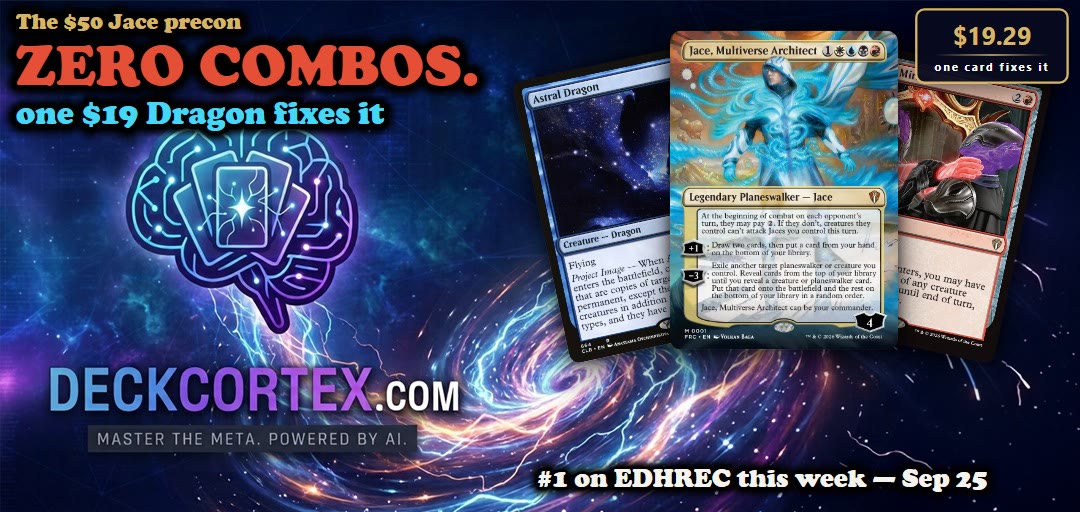
Turn five. Jace, Multiverse Architect comes down, you point his −3 at the 1/1 Mite that Skrelv's Hive made this upkeep, and you start turning over cards. Whatever you hit is going to be big. That isn't optimism, it's the decklist: every creature and planeswalker card in the 99 of Multiverse Reforged costs six mana or more. That's nineteen cards, from Dack Fayden, Helping Hand at six to Memnarch, the Warden at ten. The flip can land on a bad six-drop, but it can't land on a small one.
That's what to understand about Reality Fracture's only Commander deck before you spend a cent on it: it's a polymorph deck. Tokens go in, six-drops come out. The crowd building it this week, which is a big crowd, keeps upgrading it into something else. Jace was EDHREC's most-built commander of the past week with 2,341 new lists. Two of the next three, The Ur-Sphinx at #2 and Niv-Mizzet, Ghost Counsel at #4, come out of the same $49.99 box. (EDHREC figures are external, pulled September 25, and they move by the hour.)
We fed two versions of the deck to DeckCortex's combo engine. One is the stock deck, card for card from Wizards' decklist. The other is the average list EDHREC's builders had converged on by this morning. The box has zero complete combos, at least none that the catalogue behind the engine lists. (A reader found a luck-dependent one it doesn't; see the Astral Dragon section.) The crowd's list has two, and between them they use four cards that cost $22.29 together. Jace is in neither. The cheapest way to give the stock deck a combo isn't on the crowd's list at all. It's one $19.29 Dragon, and because it's a creature card, Jace's −3 can flip right into it.
What Jace actually does
He's : , four loyalty, and three lines that matter.
The toll. At the beginning of combat on each opponent's turn, that opponent may pay . If they don't, their creatures can't attack Jaces you control this turn. Read it twice, because the table will read it wrong. It's one payment per combat, not per creature. It protects every Jace you control: the commander, The Theorist, Jace Beleren if you run him, and the blue Jace tokens that Empower Jace makes. It doesn't protect you, and it doesn't protect Elspeth, Sun's Champion.
The +1. Draw two cards, then put a card from your hand on the bottom of your library. That's a card and a filter every turn, and it's the ability that keeps him alive.
The −3. Exile another target planeswalker or creature you control. Reveal cards from the top of your library until you reveal a creature or planeswalker card, and put that card onto the battlefield. The rest go to the bottom in a random order. He lands on four and drops to one when he flips. Two turns of +1 get him back to three, and flipping from three puts him in the graveyard. Three turns get you a flip he survives. In practice you flip the turn he lands, then +1 every turn until the next flip is worth losing him over.
Two details decide whether the flip works. First, it targets. If an opponent kills or exiles your token in response, the ability doesn't resolve and nothing gets revealed. The three loyalty stays spent, because it was the cost (Comprehensive Rules 608.2b and 606.4). So flip into a tapped-out table, or aim at something nobody wants to waste removal on. Second, it can target a planeswalker, and that includes a Jace token. A Jace token isn't a creature, so it survives the creature wipes that take out the rest of your fodder.
The box is a polymorph deck, not a superfriends deck
A Jace deck sounds like a pile of planeswalkers. The 99 holds exactly one other walker, Elspeth, and eighteen creatures, counting the box's second commander. Every one of those creatures costs six or more:
The rest of the deck exists to feed and fire them. The fodder side:
- Skrelv's Hive charges a life each upkeep for a 1/1 Mite.
- Dreadhorde Invasion grows one Zombie Army a counter at a time.
- Kher Keep makes a 0/1 Kobold for .
- Secure the Wastes, Lingering Souls and Elspeth's +1 go wide.
The converter side swaps a creature for whatever's next in your library:
- Jace's −3.
- Mass Polymorph and Synthetic Destiny exile every creature you control and reveal that many creature cards. Tokens count toward "that many". Synthetic Destiny is the instant, and its reveal waits for the next end step.
- Proteus Staff does it one creature at a time, at sorcery speed.
- The box's second foil commander, Nissa, Leyline Tamer, draws a card on every landfall. The first time each turn, she also reveals until a creature and puts it onto the battlefield.
Thirty-nine lands and thirteen mana rocks get you there. It isn't elegant, and it doesn't need to be.
Two cards in the box make Jace tokens. Fatehold Charm does it at instant speed: draw a card, empower Jace 2. Plan for All Outcomes empowers Jace 1 whenever you cast your first noncreature spell each turn. As the release notes point out, it can't trigger on the turn you cast it, because Plan was that spell. Empower Jace puts its counters on a Jace token and nothing else, creating the token first if you don't have one (rule 701.71a). It never charges the commander. That's fine, because a small Jace token is exactly what the −3 wants: a planeswalker you control that nothing else in the deck needs.
One myth to kill before it costs you a game. You'll read that Avacyn, Angel of Horror makes every polymorph free. She doesn't. She returns nontoken creatures that die, and every converter in the box exiles, except Proteus Staff, which puts the creature on the bottom of your library. Your fodder is tokens anyway, and tokens aren't cards. Where Avacyn does work is your own wraths. With her on the battlefield, cast Martial Coup or White Sun's Twilight with X of 5 or more. Every other creature is destroyed, Avacyn included. At the next end step your nontoken creatures come back, Avacyn with them. You also keep the tokens the spell just made. That's a one-sided wipe that refills your fodder.
The one card: Astral Dragon
$19.29 for the Commander Legends: Battle for Baldur's Gate printing. It's a 4/4 flyer with Project Image: when it enters, create two tokens that are copies of target noncreature permanent, except they're 3/3 Dragon creatures with flying. Now look at a card the box already gave you. Cursed Mirror is a three-mana rock that, as it enters, may become a copy of any creature on the battlefield until end of turn, with haste.
Cast the Mirror as a plain mana rock, so it's on the battlefield and not copying anything. Then:
- Astral Dragon enters and targets Cursed Mirror. You get two token Mirrors that are 3/3 flying Dragons.
- As each token enters, its own Mirror text applies. Have it become a copy of Astral Dragon, with haste.
- Each of them entered as an Astral Dragon, so each triggers Project Image. Target the original Cursed Mirror again.
- Repeat as long as you like.
That's an unbounded number of hasty 4/4 flying Dragons. Commander Spellbook's catalogue lists exactly this two-card line, counted in 9,988 decks. Add the Dragon to the stock list and DeckCortex's engine goes from zero complete combos to one. The catalogue's version says "cast Astral Dragon", but Project Image is an enters trigger, and it doesn't care how the Dragon arrived. Jace's −3 puts it onto the battlefield, and so do Mass Polymorph, Proteus Staff and Nissa. Flip it in your first main phase and the Dragons swing that turn. If Synthetic Destiny finds it at an end step, combat is already over. Once the copy effect wears off, though, the tokens stay behind as 3/3 flying Dragons, and your next turn is a formality.
Here's the part that matters: it doesn't break the flip. Astral Dragon costs eight, so the stock deck's −3 still can't hit anything smaller than a six-drop. The crowd knows the card, too. It's the tenth-most-added card on EDHREC's Multiverse Reforged upgrade page, in 190 of 891 lists. It just isn't in the average one.
Two things to watch. If an opponent controls Torpor Orb, Hushbringer or the set's own Karn, Argent Defender, creatures entering don't trigger anything, and the loop never starts. And the loop needs a Mirror that isn't copying a creature that turn. A Mirror that's pretending to be an Archon is a creature, and Project Image can't target it.
Update, September 27: a reader on Instagram pointed out that the box isn't completely combo-free, and they're right. Dack Fayden, Helping Hand hands the creatures his trigger reveals to your opponents. If one of them is Venser, Fervent Forger, Venser's own enters trigger is still yours. Point it at the Venser an opponent now controls, and you get two token Vensers, each of which triggers again. The legend rule only trims the extras, so the loop runs as long as you like, making hasty copies of anything your opponents control. The catch is getting Venser revealed. At a four-player table Dack turns over three creatures out of the seventeen left in your library, roughly a one-in-six shot. You can force it if Venser is already in your hand: put him on top with Brainstorm or Brainsurge before you cast Dack. Commander Spellbook lists this line only with Scroll Rack, which isn't in the box, and that's why DeckCortex's engine counts zero complete combos for the stock list. Astral Dragon is still the fix that needs no setup.
What the crowd changed, and what it cost the flip
Here's the list we imported this morning, EDHREC's average Jace deck at that hour, clickable:
Against the stock deck it's 22 cards in, and 20 cards plus two Plains out. The cuts are the ones this week's upgrade guides mostly agree on: nine legends, eight of them new to Magic, starting with Dack Fayden. He's the right first cut. His enters trigger reveals a creature card for each opponent and puts them onto the battlefield goaded. Then each opponent gains control of one of them. He's the one six-drop in the box you don't want the flip to find. Out, too, go The Ur-Sphinx, Niv-Mizzet, Omnath, Locus of the Void and the rest. They make better commanders for their own decks than 99-slot cards in this one.
The adds come in three piles:
- The Jace package, $112.63. It holds The Theorist ($35.42, the Rhystic Study on a planeswalker from our debut-wave ranking), Jace, the Mind Sculptor ($19.07), Jace, Reality Sculptor ($8.66), Sanctum Lurker ($8.87), Overwrite the Multiverse ($28.34) and Loyal Tutor ($12.27). That's more Jaces behind the toll, more ways to make and charge Jace tokens, and a one-mana way to put any planeswalker card on top of your library.
- The combo four, $22.29. Aminatou, the Fateshifter, Oath of Teferi, Nicol Bolas, Dragon-God and Spark Double. More on those below.
- Everything else. More converters (Divergent Transformations, Identity Echo). More fodder (Bitterblossom, Ovika, Enigma Goliath). And Hullbreaker Horror, Ajani Unrelenting, Vraska, Betrayal's Sting, Flux Channeler and four shocklands.
At Scryfall's paper prices this morning, the 22 adds come to $240.62, on top of the $49.99 box.
Now count the flip again. The crowd's list has 14 creatures and 8 planeswalkers. So the −3 pool is 22 cards instead of 19, and 14 of them cost six or more. From a fresh library that's a six-drop on roughly two flips out of three (our arithmetic on the list, not engine output). Eight cards cost five or less, but not all of them are real misses:
- Three are combo pieces: Aminatou, Bolas and Spark Double.
- Three are Jaces you'd happily flip into.
- The true whiffs are Flux Channeler and Sanctum Lurker. Both are engine cards for a planeswalker plan, and both are three-mana bodies when the −3 turns them up.
One of the cheap hits is secretly the best card the flip can find. Spark Double can enter as a copy of a planeswalker you control, and it isn't legendary when it does. So when the −3 turns it up, copy Jace. You get a second Jace, Multiverse Architect with five loyalty (the printed four plus one, per Spark Double's rulings). He can flip again immediately, because he's a new permanent that hasn't used a loyalty ability this turn (rule 606.3). Each Jace also has his own toll trigger. An opponent who pays one and not the other still can't attack your Jaces, so attacking them effectively costs .
The crowd's two combos, and the $1 switch
Oath of Teferi lets you activate the loyalty abilities of each planeswalker you control twice each turn instead of once. On its own, that's a value engine for a walker deck. Next to Aminatou, it's a loop. Her −1 exiles another permanent you own and returns it, and a blinked planeswalker comes back as a new permanent with fresh loyalty and two fresh activations. DeckCortex's engine finds two complete lines in the crowd's list, and both run through Aminatou and the Oath. Our deck page flags it on the card itself: Oath of Teferi, ∞2 +3. It's in both complete lines, and in three more that are one card short.
Line 1: Aminatou + Nicol Bolas, Dragon-God + Oath of Teferi. Bolas has all loyalty abilities of all other planeswalkers on the battlefield, Aminatou's −1 included. Aminatou needs three loyalty to start.
- Aminatou −1: blink a land you've tapped for mana. It comes back untapped.
- Aminatou −1 again: blink Nicol Bolas. He returns as a new permanent with four loyalty.
- Bolas +1: you draw a card, and each opponent exiles a card from their hand or a permanent they control.
- Bolas uses Aminatou's −1 to blink Aminatou. She returns with three loyalty. Go back to step 1.
Every loop nets a land's worth of mana, and every opponent loses a card or a permanent. Keep going until they have nothing left, and stop before your own library runs out, because the draw isn't optional.
The list already owns an upgrade to that line. With Sanctum Lurker on the battlefield, your planeswalkers have "[+2]: This planeswalker deals 1 damage to each opponent and you gain 1 life", and Bolas is a planeswalker. Use that in step 3 instead of his +1. He goes 4, 6, 5; each loop deals 1 damage to each opponent, and nobody draws. Forty loops takes out a whole table at 40 life. That's our reading of the Oracle text, not a catalogue entry, so walk through it with the cards in front of you before you spring it on a pod.
Line 2: Aminatou + Spark Double + Oath of Teferi.
- Aminatou −1: blink any permanent you own.
- Aminatou −1 again: blink Spark Double. It comes back as a nonlegendary copy of Aminatou with four loyalty.
- The copy does the same two blinks, ending on the real Aminatou, who returns with three loyalty. Go back to step 1.
On its own that's infinite blinks, and blinking a land you've tapped is infinite mana. The list has three ways to end it:
- Blink Archon of Cruelty. Each entry makes a target opponent sacrifice a creature or planeswalker, discard a card and lose 3 life. You draw and gain 3 each time, so mind your library.
- Have Ajani Unrelenting on the battlefield. He creates a 2/2 Cadet whenever you activate a loyalty ability, so every step of either loop makes a token. Then activate Ajani's +1: creatures you control get +1/+0 and haste.
- Blink Sanctum Lurker. It empowers Jace 1 per entry, so you can charge a Jace token as high as you like.
Notice who's missing: Jace. His −3 can dig for three of the four pieces, since Aminatou and Bolas are planeswalker cards and Spark Double is a creature. Loyal Tutor into a −3 puts Aminatou straight onto the battlefield (how that works is in the rules list below). But the loops don't need him.
Now the bracket, which is why this section has "switch" in its title. We run a deterministic replication of DeckCortex's bracket-fit model. It puts the stock deck at the bottom: no Game Changers, no combos, no tutors, and nothing that trips a Bracket 2 cap. The crowd's list floors at 3, "Upgraded", and the cap that binds is the combo count. It still has zero Game Changers. Take out Oath of Teferi and nothing else, and the engine finds zero complete lines. The floor drops to 2, held off 1 only by Loyal Tutor, since the Bracket 1 cap on tutors is zero. Pulling Aminatou instead does the same. A $1.12 enchantment is the difference between the Bracket 2 deck you told your pod about and the Bracket 3 deck you're actually holding. The engine counts complete lines; it doesn't assign the final bracket. We covered why that distinction matters here.
Rules you'll get asked about at the table
- The toll is , paid by the player whose turn it is, once per combat. It covers every Jace you control, tokens included. It doesn't cover you or your other walkers.
- The −3 targets. Kill the target in response and nothing is revealed, and the three loyalty is gone anyway.
- A planeswalker the −3 finds can activate right away. It's a new permanent, and rule 606.3 only stops a second activation of the same permanent.
- Empower Jace only charges Jace tokens, never the commander. If you already have a Jace token, you can't make a second one.
- Sanctum Lurker keeps a zero-loyalty walker on the battlefield. Per the release notes, that walker can still use abilities that cost [0] or add counters. It still can't pay a minus cost it doesn't have the counters for (rule 606.6).
- One loyalty ability per walker per turn, however many it has gained (release notes). Oath of Teferi makes it two.
- Spark Double entering through Mass Polymorph can't copy a creature entering at the same time. It can copy a Jace that's already on the battlefield.
- Mass Polymorph with more creatures exiled than creature cards left reveals your whole library, puts every creature card onto the battlefield, then shuffles.
- You can stack the −3. It reveals from the top and puts the rest on the bottom without shuffling, so a card you've set on top is the first one revealed.
- Loyal Tutor finds a planeswalker card and puts it on top.
- Brainstorm, Brainsurge, JTMS's 0 and Aminatou's +1 put back cards from your hand.
- Fabled Passage, Mass Polymorph and Synthetic Destiny shuffle, so use them after the flip, not before.
What beats it
Instant-speed removal on your −3 target, first of all. Keep a second target around, or flip when the table is tapped low. Enters-trigger hate hits hardest. Torpor Orb, Hushbringer and Karn, Argent Defender stop the Archon, Ob Nixilis, the Ascended's wrath of tapped attackers and the Astral Dragon loop. The flip itself still happens; it just lands a vanilla body. Artifact wipes take all thirteen mana rocks at once, the Mirror among them. And the toll only protects Jaces. A fast deck that ignores your walkers and swings at your face owes you nothing.
The answers are already in the box: Swords to Plowshares, Despark, and Flawless Maneuver, which is free while you control your commander. Grand Crescendo keeps your tokens alive through a destroy wipe. The crowd's list keeps every one of them, and so should you.
The decision
| You want | Change | Costs | Complete lines | Bracket floor | |---|---|---|---|---| | The deck as designed | Nothing | $49.99 (MSRP) | 0 | nothing past Bracket 2 | | A combo that keeps every flip a six-drop | + Astral Dragon | $19.29 | 1 | 3 | | The crowd's planeswalker deck | 22 in, 20 cards and 2 Plains out | $240.62 | 2 | 3 | | The crowd's deck at a Bracket 2 table | The crowd's list without Oath of Teferi | $239.50 | 0 | 2 | | All of it | The crowd's list + Astral Dragon | $259.91 | 3 | 3 |
If you bought the box to flip six-drops onto the battlefield, buy the Dragon and stop there. If you bought it to play planeswalkers, the crowd's list is a real deck. Just know which card makes it a Bracket 3 deck, and take the Oath out if your table said 2. Either way, rebuild your version in DeckCortex before your next pod and run the scan. The engine shows every complete line in your list, and the bracket fit tells you which card to pull before anyone at the table has to ask.
Data notes: The stock list is Wizards' Multiverse Reforged decklist (September 16, 2026). The crowd's list is EDHREC's average Jace, Multiverse Architect deck as imported into DeckCortex on the morning of September 25, 2026. EDHREC ranks and deck counts are external figures retrieved September 25 and move daily. The MSRP comes from Wizards' Reality Fracture buyer's guide for Commander. Card prices are Scryfall paper-aggregate asks via the DeckCortex proxy on September 25, 2026, using the cheapest black-bordered printing for the four shocklands. Reality Fracture Commander singles aren't priced yet and aren't quoted. Combo lines come from DeckCortex's spellbook engine on the exact lists described. Catalogue deck counts show relative popularity, not win rates. The Sanctum Lurker and Ajani Unrelenting finishers and the flip odds are our readings of the Oracle text and arithmetic on the lists, not engine output. The bracket floor is our deterministic replication of DeckCortex's bracket-fit model: a lower bound, not a final 1–5 bracket. Reality Fracture cards are legal from October 2, 2026. Until then no play data exists, and nothing here is a tournament result. Rules references are to the Comprehensive Rules effective September 25, 2026, and the Reality Fracture release notes.