Kwia Vigorbloom Makes One Lotus a Turn. The Deck Everyone Copies Blinks Her With a Unicorn and Goes Infinite
Kwia Vigorbloom makes one Lotus a turn, and her card says so. The average deck EDHREC's builders copy gets around it with a $10.63 unicorn: Emiel the Blessed blinks her, the Kwia that comes back is a new object that hasn't made her Lotus yet, and that Lotus pays for the next blink. DeckCortex's engine finds nine complete combo lines, all through Emiel, and Commander Spellbook calls the list Ruthless.
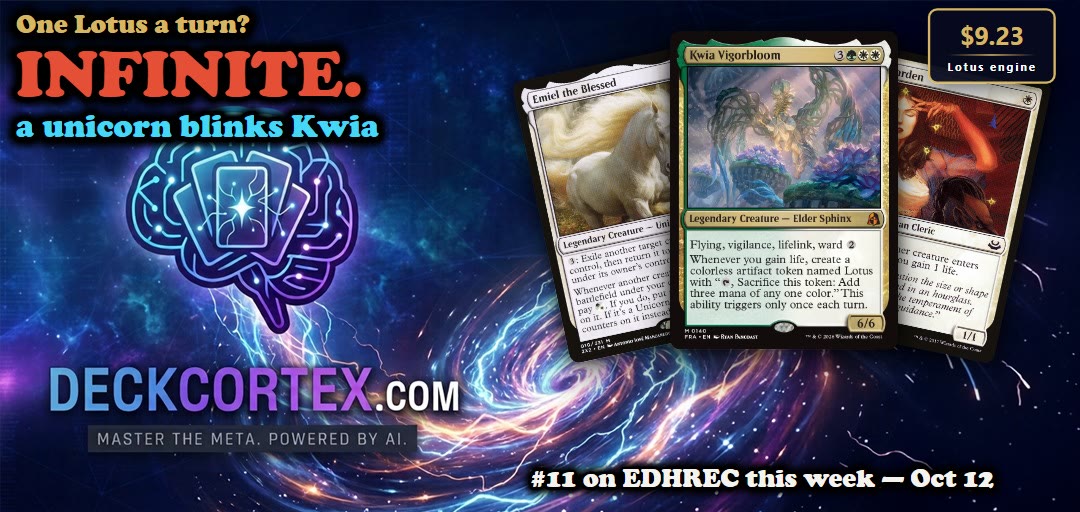
Your Soul Warden gains you a life, a colorless token named Lotus hits the table, and the player to your left asks the obvious question: how many of those do you get? One a turn. Kwia Vigorbloom costs , and whenever you gain life she creates a Lotus with ", Sacrifice this token: Add three mana of any one color." The last sentence in her text box is the one the table reads twice: "This ability triggers only once each turn."
It hasn't slowed anyone down. On EDHREC, Kwia was the 11th most-built commander of the past week with 1,497 new decks, and her page counts 3,920. New lists kept arriving faster into October, from between 136 and 162 a day in the last days of September to 227 and 234 on October 9 and 10. (EDHREC's figures are external, pulled the afternoon of October 12, and they move by the hour.)
When we ranked her tenth among the Reality Fracture debut cards in September, we called her a value commander for a Bracket 3 table and said the once-per-turn line does exactly what Wizards meant it to. Then we ran EDHREC's average Kwia deck through DeckCortex's combo engine. It found nine complete combo lines, and Kwia is in every one of them. They're one loop with nine ways to finish it: Emiel the Blessed blinks Kwia, the Kwia that comes back hasn't made a Lotus yet this turn, and her Lotus pays for the next blink.
One Lotus a turn, and what that buys you
She's a 6/6 flier with vigilance, lifelink and ward , so she feeds her own trigger every time she connects. The token is the interesting part, and four details about it decide how the deck plays:
- A Lotus isn't a creature. The summoning-sickness rule (Comprehensive Rules 302.6) only stops creatures from using abilities, so you can crack a Lotus the moment it arrives.
- It isn't a Treasure either. It's an artifact token named Lotus with no subtype, so cards that count Treasures don't see it.
- It waits. Mana empties at the end of each step, but the token stays until you sacrifice it. A Lotus you make on an opponent's turn is still there on yours.
- Three mana, one color. A green Lotus pays the on Craterhoof Behemoth. It can't cover a cost on its own.
And "once each turn" means each turn, not each round. Your turn is one, and so is every opponent's. At a four-player table that's up to four Lotuses a round, twelve mana, as long as you gain life on turns that aren't yours.
The misread to avoid is stacking life gain. With Soul Warden, Essence Warden and Soul's Attendant all on the battlefield, one creature entering is three separate life-gain events, and Kwia still makes one Lotus. The Wind Crystal doubles the life you gain and Cleric Class adds 1 to it. Neither adds a Lotus.
What does stack is tokens. The limit sits on Kwia's trigger, not on what the trigger makes, so token doublers work on it. Doubling Season, Parallel Lives, Anointed Procession, Mondrak, Glory Dominus and Exalted Sunborn all double the tokens you'd create, and the crowd's list plays all five. One doubler turns each trigger into two Lotuses. Two doublers make four, which is twelve mana from one point of life.
A Lotus on every player's turn
The engine runs on life you gain while somebody else is playing. Some cards in the list do that and some only work on your turn, and the difference is one line of Oracle text.
Sunscorch Regent is the most reliable one: "Whenever an opponent casts a spell, put a +1/+1 counter on this creature and you gain 1 life." Almost every opponent casts something on their own turn, so that's a Lotus on almost every turn that isn't yours. It costs 27 cents, and EDHREC counts it in 2,319 of the 3,920 Kwia decks.
The rest of the list, sorted by when it fires:
- Anyone's creature. Soul Warden and Essence Warden read "Whenever another creature enters, you gain 1 life." Auriok Champion and Soul's Attendant say the same with a "may". They count your opponents' creatures too. Soul Warden is in 3,385 Kwia decks.
- Their creatures. Authority of the Consuls gains you 1 life whenever a creature an opponent controls enters, and those creatures enter tapped. It's in 3,074 decks.
- Whenever you want. The Great Henge has ": Add . You gain 2 life." That's a mana ability, and you can activate a mana ability any time you have priority (rule 605.3a), so tap it in an opponent's end step and take your Lotus. Pristine Talisman (": Add . You gain 1 life.") copies that one line for 32 cents, though not the Henge's card draw. It isn't in the average list, but 927 Kwia decks play it.
- Kwia herself. Lifelink plus vigilance means she attacks on your turn and is still untapped to block on theirs.
Five life-gain cards in the list go quiet on other players' turns. Prosperous Innkeeper, Guide of Souls, Liliana the Faultless, Haliya, Guided by Light and Ajani's Welcome only trigger on things entering under your control. On someone else's turn they need an instant that makes creatures, and the list has two: March of the Multitudes and Grand Crescendo.
One card in the list switches the engine off. Teferi's Protection says your life total can't change until your next turn, and it phases out Kwia along with everything else you control. That's a full round without a Lotus. It's still the card you want when the whole table points at you. Just know what it costs.
What the Lotuses pay for
Bank them. Three opponents' turns can hand you nine mana before your own untap step, and the list knows where to put it. Storm Herd costs and makes X 1/1 fliers, where X is your life total, which in this deck is a big number. Craterhoof Behemoth takes a green Lotus for its . Finale of Devastation puts a creature with mana value X or less onto the battlefield from your library or graveyard. March of the Multitudes is an instant with convoke, so banked Lotuses become a pile of lifelink Soldiers in an opponent's end step, and each Warden gains you 1 life for every one of them.
Mana you don't need yet can stay a Lotus and get copied. Ocelot Pride, once you have the city's blessing, copies each token that entered this turn at your end step, and that includes the Lotus you made this turn. Second Harvest isn't in the average list, but it copies every token you control at instant speed, Lotuses included.
The loophole: Emiel the Blessed
Emiel's first ability reads ": Exile another target creature you control, then return it to the battlefield under its owner's control." Point it at Kwia. The official ruling on Emiel says the creature that comes back "will be a new object with no connection to the card that was exiled." That sentence is the whole trick. "Once each turn" belongs to the Kwia who already made her Lotus. The Kwia who just came back hasn't made one.
The list we tested is EDHREC's average Kwia deck as it stood on the afternoon of October 12. You can open the current version on EDHREC's average-deck page, which updates daily, so it may differ from ours by a few cards. Here's the loop as Commander Spellbook catalogues it, with Soul Warden:
- Pay . Emiel exiles Kwia and returns her.
- Kwia enters, Soul Warden triggers, and you gain 1 life.
- The new Kwia triggers and creates a Lotus.
- Tap and sacrifice the Lotus for three mana, and pay for Emiel again.
Every pass costs three mana and makes three, so it never runs dry. What it produces is as much life as you like, plus a creature and an artifact entering and leaving on every pass. Any card that gains you life when Kwia enters can finish it, and the crowd's list has nine: Soul Warden, Essence Warden, Soul's Attendant, Auriok Champion, Haliya, Liliana the Faultless, Prosperous Innkeeper, Guide of Souls and Ajani's Welcome. That's why the engine counts nine lines. They're one combo.
Unlimited life doesn't end a game on its own, but the list has the card that does. Aetherflux Reservoir's second ability is "Pay 50 life: This artifact deals 50 damage to any target", and there's no tap symbol in it, so with all the life you want it deals 50 to each opponent, as often as it takes. Archangel of Thune gets there more slowly, putting a +1/+1 counter on each creature you control every pass. And if any one of the five doublers is out, every blink makes two Lotuses: six mana back for three spent, so the loop also makes as much mana as you want. Those three finishes are our reading of the card text. The engine only lists the three-card loops.
Three things the table will ask:
- She's your commander. Does she go home? No. Emiel exiles and returns her in one ability. The option to move an exiled commander to the command zone is a state-based action (rule 903.9a), and by the time those are checked she's already back. Blinking her isn't casting her, so there's no commander tax either.
- Can it be stopped? Yes. Emiel's ability, the Warden's trigger and Kwia's trigger all use the stack, and only cracking the Lotus doesn't, because it's a mana ability. Remove Emiel or the Warden in response and the loop ends. Ward doesn't stop your own Emiel; it only taxes your opponents.
- How fast is it? Not very. In DeckCortex's combo-assembly simulation of the crowd's list (10,000 games, nobody interacting), the loop comes together by turn 6 in 6.2% of games and by turn 12 in 28.5%. When it does, it's turn 8.4 on average. Finale of Devastation, the list's only tutor, can put Emiel onto the battlefield with X = 4.
How common is it in real decks? Emiel is in 1,205 of the 3,920 Kwia decks on EDHREC, about three in ten. Commander Spellbook lists 28 combos for Kwia that fit her colors, and every one of them needs Emiel. So half of September's take holds: a board full of Wardens still gets one Lotus a turn, and the once-per-turn line does what it says. The other half needs an update. The limit counts per Kwia, the crowd found the card that makes a new one, and with Emiel in the 99 she's a combo commander.
The list in DeckCortex
The exact list we tested is in DeckCortex too, card for card, as a deck you can open, copy and edit. Run the combo scan on it and it lists all nine Emiel lines.
Bracket 3, Bracket 2 or Ruthless: it depends who's counting
We ran the exact list through DeckCortex's Bracket Fit, using the app's own code and live settings. It lands at Bracket 3, with a power level of 4.0 out of 10. One card keeps it out of Bracket 2: Teferi's Protection ($36.13), the list's only Game Changer. Sol Ring and Finale of Devastation count as one fast-mana card and one tutor, and Bracket 2 allows both.
What the Bracket Fit doesn't count is the loop. Its combo signal counts two-card combos, and every Kwia line is three cards: Kwia, Emiel and a life-gain card. So the combo count reads zero, and if you cut Teferi's Protection, DeckCortex says Bracket 2 with the loop still in the deck.
Commander Spellbook's bracket estimator calls the same list Ruthless, its Bracket 4+ tag. Spellbook treats your commander as always available, which turns each line into Emiel plus one card: a two-card combo you can start for three mana. Cut Teferi's Protection and Spellbook still says Ruthless. Cut Emiel, and DeckCortex's engine finds zero lines and Spellbook's estimate drops to Powerful, its Bracket 3+ tag. Cut both, and DeckCortex says 2 and Spellbook says Exhibition.
Spellbook's reading is closer to how this plays. Your commander is always there to be cast, so once Emiel is on the battlefield, any one of nine cards finishes the job. If your table plays Bracket 3 and doesn't mind a late combo, keep Emiel and say so before the game. If your table says no infinites, Emiel is the cut, and the Lotus plan won't miss him. Either way, don't take DeckCortex's 2 to a table with Emiel still in the deck. Combo counts and bracket numbers are signals, not verdicts, and we've written about why.
If you cut Emiel to get under, don't put Walking Ballista in his slot. It's in 673 Kwia decks, and with at least two counters on it, it's a two-card combo with Heliod, Sun-Crowned, which the list already plays: Heliod gives Ballista lifelink for , every ping gains you 1 life, and every life gain puts a counter back on Ballista. Archangel of Thune and Cleric Class (at level 2) do the same once something gives Ballista lifelink. DeckCortex counts those as two-card combos, so a Bracket 2 version with Ballista goes straight back to 3.
What the crowd's list costs
At the cheapest paper printing of each card, the crowd's list comes to $819.27. Seven cards are $347.64 of that: The Great Henge ($63.37), Anointed Procession ($57.08), Esper Sentinel ($56.32), Boseiju, Who Endures ($50.19), Mondrak ($44.13), Ocelot Pride ($40.42) and Teferi's Protection ($36.13). Two of those seven touch the Lotus, and both are token doublers in a list that plays three more. Kwia herself is $9.23, Emiel is $10.63, and the nine cards that finish the loop cost $41.80 together.
On a budget, those seven go first. Here's the version we ran. Every swap keeps the Lotus engine running, but none of them is a like-for-like replacement, so the last column says what you give up:
| Cut | Put in | What it does for Kwia | What you give up | |---|---|---|---| | The Great Henge ($63.37) | Pristine Talisman ($0.32) | Life on any turn you want it, so a Lotus on any turn | The Henge's card draw, its +1/+1 counters and its cost reduction | | Anointed Procession ($57.08) | Second Harvest ($3.83) | Copies every token you control at instant speed, Lotuses included | A permanent doubler; Second Harvest is one burst, and the list keeps three more doublers | | Esper Sentinel ($56.32) | Dawn of Hope ($0.29) | "Whenever you gain life, you may pay . If you do, draw a card." | The tax on each opponent's first noncreature spell; Dawn of Hope costs per card | | Boseiju, Who Endures ($50.19) | Forest | A land for a land | Boseiju's channel removal | | Mondrak, Glory Dominus ($44.13) | Felidar Sovereign ($3.36) | You win at your upkeep with 40 or more life, and Commander starts you at 40. Mention it before the game | A token doubler; Felidar is a different plan, an alternate win | | Ocelot Pride ($40.42) | Elenda's Hierophant ($2.44) | Gets a +1/+1 counter every time you gain life | A Cat every end step you gained life, and token copies with the city's blessing | | Teferi's Protection ($36.13) | Flawless Maneuver ($8.43) | Free if you control a commander; your creatures gain indestructible | Protection from everything and phasing for your whole board; Flawless Maneuver only stops destruction |
The list drops to $490.30, and the engine still finds the same nine lines, because Emiel stays. That makes it the trap version, too: with Teferi's Protection gone, DeckCortex says Bracket 2 and Spellbook says Ruthless. If your table plays at 2, cut Emiel as well. That's $479.67, the engine finds zero lines, DeckCortex still says 2, and Spellbook drops to Exhibition.
Three upgrades are worth it at any budget, and none of them is a combo with this list:
- Pristine Talisman ($0.32). A Lotus on any turn you choose, for less than a dollar.
- Flickering Hound ($7.86). "Whenever you cast a creature spell, exile up to one other target creature you control, then return that card to the battlefield under its owner's control." Point it at Kwia and you get the fair version of Emiel's trick: a new Kwia every time you cast a creature, and another Lotus that turn if you gain life after she's back, which a Warden handles. It's in 583 Kwia decks, and the engine finds no combo with it in the list.
- Ephemerate ($3.62). Blink Kwia in response to removal, get a fresh Kwia, and do it again on your next upkeep with rebound.
Rules you'll get asked about at the table
- Once each turn means every turn. Yours and each opponent's.
- More life-gain triggers don't make more Lotuses. Three Wardens and one creature entering is three life gains and one Lotus.
- Token doublers do. One doubler makes two Lotuses per trigger, two doublers make four.
- The Lotus isn't a creature or a Treasure. Crack it right away or keep it for later. Cracking it doesn't use the stack.
- Each Lotus makes three mana of one color, chosen when you crack it.
- A blinked Kwia is a new Kwia. She can make another Lotus that turn. That's Emiel's loop, and it's how Flickering Hound and Ephemerate get you a second Lotus.
- Blinking your commander doesn't send her home. She's back before the command-zone choice comes up, and there's no tax.
- Teferi's Protection shuts the engine off. Your life total can't change and Kwia is phased out until your next turn.
- Ward only taxes opponents. Your own Emiel targets her for free.
The decision
| You want | Change | Cost (cheapest printings) | Complete lines | DeckCortex Bracket Fit | Spellbook estimate | |---|---|---|---|---|---| | The crowd's list | Nothing | $819.27 | 9 | 3 | Ruthless | | The same Kwia, no infinite | − Emiel the Blessed, + Flickering Hound | $816.50 | 0 | 3 | Powerful | | A Bracket 2 table | Also − Teferi's Protection, + Pristine Talisman | $780.69 | 0 | 2 | Exhibition | | A Bracket 2 number with the loop still in | − Teferi's Protection only | $783.14 | 9 | 2 | Ruthless | | The budget build | The seven swaps above | $490.30 | 9 | 2 | Ruthless | | The budget build for a Bracket 2 table | The seven swaps, − Emiel the Blessed | $479.67 | 0 | 2 | Exhibition |
If your table plays Bracket 3 and likes a finish, the crowd's list is a real deck, and its kill isn't the Lotus. It's Emiel resetting Kwia until Aetherflux Reservoir fires. Say so before the first turn. If you built a 6/6 flier to make mana on every player's turn, swap Emiel for Flickering Hound and keep the rest: you still get a second Lotus on turns you cast a creature, you lose the infinite, and the price barely moves. For a Bracket 2 table, cut both Emiel and Teferi's Protection, never only the Protection. Then build your version in DeckCortex, or copy our imported list, and run the scan before your next game. The combo scan lists every complete line in your 100, the Emiel lines included, so read it next to the Bracket Fit before anyone has to ask.
Data notes: The crowd's list is EDHREC's average Kwia Vigorbloom deck as served at 12:18 UTC on October 12, 2026; average lists change during the day. EDHREC ranks, deck counts and inclusion counts are external figures retrieved the same afternoon. Card prices are Scryfall paper-aggregate prices retrieved October 12, 2026, at the cheapest paper printing of each card (gold-bordered collector prints excluded, basic lands at $0); Reality Fracture cards are new and their prices move daily. Combo lines come from DeckCortex's spellbook engine on the exact lists described, with removed cards replaced by basic lands or by the named cards. The loop's steps come from Commander Spellbook's catalogue; the Aetherflux Reservoir kill, the doubler math and the blink readings are ours, from the Oracle text, Emiel the Blessed's official ruling and the Comprehensive Rules effective September 25, 2026. Kwia has no official rulings yet. The Bracket Fit, power level and combo-assembly figures come from DeckCortex's own app code, run on the exact lists with live settings on October 12, 2026; the simulation plays 10,000 games without opponents and measures when a combo comes together, not when you win. The Spellbook estimate comes from Commander Spellbook's public bracket estimator on October 12, 2026; it is Spellbook's reading, not Wizards'. The DeckCortex reference deck holds the same 100 cards as the tested list. DeckCortex's tournament data has no Kwia lists yet.