Pauper in July 2026: The Ban Worked, the Format Moved On, and Everything Now Points at a 2/1 Flier
One month after the Seeker of Skybreak ban, Pauper's real story is a forty-cent flier: Sneaky Snacker sits in 23.4% of the 2,561 published 75s we track, the Gates deck that lost its combo nearly tripled instead of dying, and the year's two biggest paper events crowned Jund Wildfire and Dimir Terror anyway. We measured the MTGO-versus-paper split — including the July 15–27 stretch nobody else wrote up — and what the August 10 announcement can actually do about it.
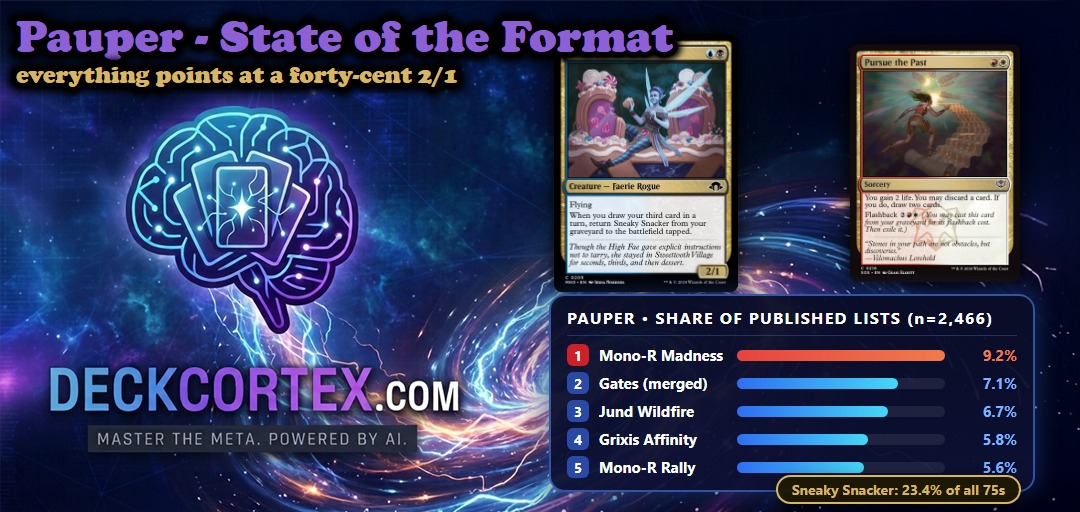
One month ago, the Pauper Format Panel banned Seeker of Skybreak to kill a turn-three combo. The ban did exactly what it was supposed to do and nothing more: no chaos, no power vacuum, no follow-up emergency. What July actually produced is stranger than that. The deck that lost its combo rebuilt itself into the most-feared strategy on Magic Online, the two biggest paper tournaments in Pauper history shrugged and crowned midrange instead, and the card at the center of all of it — Sneaky Snacker, a 2/1 flier that costs about forty cents — now sits in 23.4% of every published Pauper decklist we track (600 of 2,561 full 75s, June 27–July 27). That makes it the most-played creature in the format — every card ahead of it in our ranking is a spell or an artifact, not a body.
On August 10, the Panel has promised to talk about exactly this card. Two weeks out, here's what our corpus says the format actually looks like — including the two quiet weeks nobody else has written up.
The month in numbers
Our trailing window (2026-06-27 to 2026-07-27) holds 2,466 published tournament lists — more than double June's sample, because July gave Pauper two paper majors, four extra Last Chance events, and a 250-player Showcase Challenge on top of the usual grind. Before the table, the honesty notes. These are decklist-appearance shares of published results, not field share and not win rate — we don't track match results, so every win rate below is Joe Dyer's, labelled as such. The window's leading edge includes the final pre-ban weekend; the 29 lists still carrying Seeker of Skybreak (1.1%) are that edge, quantified — MTGO has enforced the ban since June 30. And our classifier splits archetypes across source-specific labels, so as always we merge same-core labels before saying anything about families.
| Family / label | Lists | Share | June share | |---|---|---|---| | Mono-Red Madness (Madness Burn + Mono R Madness) | 227 | 9.2% | 9.7% | | Gates (Gates + Naya Gates + Bow Gates) | 176 | 7.1% | 2.6% | | Jund Wildfire | 164 | 6.7% | 5.0% | | Grixis Affinity | 142 | 5.8% | 5.9% | | Mono-Red Rally (Red Deck Wins + Rally Red) | 137 | 5.6% | 4.7% | | Mono-Blue Terror (three labels) | 109 | 4.4% | 5.0% | | Elves | 85 | 3.4% | 4.7% | | Urzatron | 83 | 3.4% | 2.4% | | Snow Jeskai Ephemerate | 76 | 3.1% | 3.9% | | Balustrade Spy | 53 | 2.1% | — (below June cutoff) |
(Shares of n=2,466 published lists, 2026-06-27..07-27; June = n=1,026, 06-02..07-02. Full label table in the data appendix.)
Read that top block twice. Mono-Red Madness is still the volume king, barely moved by the ban — and per Dyer's event data for the July 1–5 week (MTGGoldfish, July 12), it was also the most-played deck at 55 copies while winning less than half its non-mirror matches (49.3%). Meanwhile the Gates family nearly tripled, from 2.6% to 7.1%, in the month its two-card kill got deleted. That's the July story in one row, and we'll get to it.
Two more things the table hides. Jund Wildfire is the single most-played label in the format for the first time in our data — and, spoiler for the paper section, it just won the year's biggest Pauper tournament. And Dimir Terror posts the best top-cut conversion in the table, reaching the cut from 42.1% of its counted entries (n=19, small, cite with care). Blue's fair deck didn't go anywhere. It just stopped being alone at the top; Dyer demoted Mono-Blue Terror from his best-deck pick to, in his words on July 12, a great deck that's "got some competition now."
One texture note before the decks: the most-played card in Pauper right now isn't a win condition. It's Pyroblast, in 37.3% of all 75s, with Hydroblast (31.1%) and Relic of Progenitus (31.0%) right behind. The entire top ten of our card ranking is answers plus Counterspell and one cantrip engine. Pauper in 2026 is a format where everyone shows up expecting blue, red, and graveyards — and packs accordingly.
The deck that lost its combo and got better
The June ban read like a death sentence for Gates. The Panel deleted Seeker of Skybreak, left Hawkeye's Bow alive, and the assumption everywhere — ours included — was that the shell would slink back to fringe play. Instead, the Gates players performed the most efficient identity swap we've measured. In our June window, the Naya Gates label was defined by the combo: Seeker in 8 of 20 lists, Bow in 9. In July? Sneaky Snacker in 62 of 62 Naya Gates lists. Pursue the Past in 61. Melded Moxite in 54. Hawkeye's Bow in 9 — and Seeker in zero, because it has to be. The community calls the result Snacker Gates; our classifier still files it under Naya Gates, Bow Gates, and a new catch-all Gates label, which is exactly the kind of split the merge row in the table above exists for.
The engine is worth spelling out precisely, because it's why this card is on a watch list. Sneaky Snacker triggers when you draw your third card in a turn, returning itself from the graveyard to the battlefield tapped — once per turn, no mana spent. Pursue the Past is a sorcery: gain 2 life, optionally discard a card to draw two. Cast it after your draw step and the discard pitches a Snacker while the two draws are cards two and three of the turn — the Snacker you just discarded comes straight back. Melded Moxite staples the same discard-draw-two rider onto a artifact that later sacrifices into a 2/2 Robot. Dyer called Pursue the Past "the card that makes this whole thing work" — and the flashback means one copy does it twice. Layer Basilisk Gate as the payoff land, Sacred Cat and Outlaw Medic as the bodies, Prismatic Strands as the fog, and you get a midrange deck that never runs out of blockers and gains incidental life the whole way down.
On Magic Online, this deck spent early July collecting trophies. The 65-player Challenge on July 3 and the 250-player Showcase Challenge on July 5 — the biggest MTGO Pauper event in recent memory — were both won by it, by seasonofmists at 9-1 and duke12 at 11-1, with three copies in the Showcase Top 8 (all per Dyer's July 12 event coverage; field sizes are his numbers too). Dyer measured the week's "Other Midrange" bucket, which was exclusively this deck, at a 58.3% non-mirror win rate — the best figure of any deck he tracked — while everything else clustered at 49–52%. Here are both winning lists as they sit in our corpus; note that duke12's build keeps Writhing Chrysalis where seasonofmists trims it for maindeck Guardian of the Guildpact:
A methodology confession, because we'd rather flag it ourselves: our scraper stores MTGO decklists in the page order mtgo.com publishes, which reflects Swiss standings, not playoff results — the two winners above sit at #2 in our raw rows. Playoff winners for MTGO events in this article are therefore Dyer's reporting, and our own MTGO numbers are used for what they're actually good at: who showed up, in what numbers, with which 75s. Paper events from the MTGTop8 feed carry true final standings.
Then paper voted differently
July 11–12 was the biggest paper weekend Pauper has had all year: Paupergeddon Summer in Lucca with 1,086 players — a number we can verify from our own event rows, against a 1,300 cap — and the first-ever Paupergenesis in Pikesville, Maryland with 248. Both Top-cut feeds are in our corpus, and neither looks anything like the MTGO story.
Lucca's Top 8: Jund Wildfire wins (Jan Plachý), over White Weenie (Giovanni Favetta), with two Urzatron, two Red Deck Wins, a second Jund Wildfire, and a Reaping the Song rounding out the bracket. Not one Gates deck in the elimination rounds — in the whole published Top 64, the Gates family is 4 of 64 lists. The single most-represented archetype in that Top 64 is Grixis Affinity at 9 lists (11 counting two generic Affinity labels), which tells you the Italian metagame answered the format's actual volume, not its Twitter discourse.
Plachý's winning list is the format's midrange mirror-breaker thesis in 75 cards: 4 Cleansing Wildfire plus 4 Cast Down for the format's engines, the full Writhing Chrysalis / Refurbished Familiar / Fanatical Offering value stack, 3 Krark-Clan Shaman against the aggro decks — and 3 Lembas, the quiet Food that cantrips, gains 3, and shuffles home, which almost nobody talks about and 100% of this Top 8's watchers had to read twice.
Pikesville's winner is the twist the whole ban debate should sit with. Christopher Jacobs — Thediabetical on the standings — won Paupergenesis with Dimir Terror over Gavin Clark's Ephemerate deck (the build the community calls Azorius Familiars; our classifier says Ephemerate, same 75). Format Panel member Paige Smith made the Top 8 on Elves, per our rows. And Jacobs' maindeck? Four copies of Sneaky Snacker, alongside Tolarian Terror and the full cantrip suite.
So no, the Snacker deck didn't crack a paper Top 8. The Snacker card won one of the two majors anyway, riding in a completely different shell. Hold that thought.
One more paper detail we can verify down to the card: Favetta's second-place White Weenie runs a one-of Spider-Man, Web-Slinger — web-slinging to rebuy a tapped attacker — next to three Leonardo, Big Brother, which every single Weenie White list in our window (33 of 33) now plays. More on the Marvel angle below.
The split, and the two quiet weeks
Alex Ullman put the tension plainly in his July 13 recap: the Basilisk Gate strategy had been among MTGO's most popular decks for weeks, yet was "absent from the elimination rounds in both tabletop events" — and he floated the uncomfortable possibility of "an inbred Magic Online metagame" before conceding there isn't enough information to know. His weekend numbers back the fair-format read: Madness Burn was the most popular deck everywhere at once (15.63% of MTGO Top 32s, 12.3% of Paupergeddon Day 1, 10.2% at Paupergenesis — his figures) and still only converted six Top 8s and one win across all of it.
External coverage stops there. Dyer's last column is July 12; Ullman's recap is July 13; the tracker snapshots everyone quotes still blend pre-ban June into their windows. The July 15–27 stretch exists in print nowhere — except in a corpus like ours. Fifteen more MTGO events landed in our window after July 14, and the pattern didn't break: the Gates family kept grinding Top 32s (seasonofmists alone put Naya Gates into four more published lists between July 15 and 22, peaking at #10 on July 17 in our Swiss-order rows), duke12 carried it into the July 26 Showcase Qualifier, and the family's 7.1% window share held through the final week. The MTGO signal is not a two-week fluke that died after Lucca. It's still there, right up to the announcement.
What we can't tell you from our own rows is whether it converted trophies in those two weeks — our scrape stores the Swiss-ordered decklists, not the playoff brackets the MTGO event pages publish separately, and no column has written those weeks up. We won't infer winners from Swiss order; that's a gap, stated as one.
August 10 is a referendum on a 2/1
Gavin Verhey's June 29 Panel article named its watch item without hedging: Sneaky Snacker "keeps slotting into more and more decks," and the Panel would revisit it on August 10 after watching the summer's big events. The big events have now been watched. Here's what they'd see in our data:
- 23.4% of all published 75s carry Sneaky Snacker in the July window — 600 of 2,561 lists, up from 21.9% over the trailing three months. It is the most-played creature in Pauper; the ten cards above it in our ranking are removal, counterspells, graveyard hate, one sweeper, Lightning Bolt, and Lórien Revealed.
- It is in every Mono-Red Madness list our distribution engine holds (221 of 221 across both labels), 100% of July's Naya Gates, 36 of 37 Bow Gates, and the Paupergenesis-winning Dimir Terror list — a mono-red aggro deck, a white-red-green midrange pile, and a mono-blue tempo shell that share almost nothing else. Dyer's phrasing: it's "so free that it fits into a bunch of other decks."
- The precedent is on the banned list already. Deadly Dispute — the sacrifice-draw-two that ended up in every black shell — was banned in Pauper for exactly this show-up-everywhere pattern, and Pauper's draw-two economy is what makes Snacker free in the first place. Dyer expects the same ending here, writing that he imagines Snacker eventually gets banned for its ubiquity.
- The counterweight is real, and it's the paper results above: the decks Snacker powers hover at or below 50% non-mirror in Dyer's win-rate data (Madness 49.3%, Terror 50.9%), the Gates shell went 0-for-2 in tabletop elimination rounds, and the Panel's own published bar for action has been dominance, not popularity. If White Weenie and Elves are functioning predators — and Lucca's final plus Smith's Top 8 say they are — the restraint case writes itself.
The other August 10 item resolves quietly. Bonder's Ornament, back from the banned list on a trial unban, sits at 8.6% of our July 75s (220 lists) — real adoption (the Monster Tron list in the July 3 Top 8 ran three) with zero dominance attached. Verhey already called it "in an acceptable spot"; Dyer called the unban "a bit of a nothing-burger" and meant it as a compliment. Expect it to stay legal.
So treat the announcement as the experiment it accidentally is. If Snacker gets banned, the Panel is saying the MTGO signal — volume, win rate, and that 58.3% — outweighs a clean bill of health from 1,300 paper players. If it stays legal with another "watching closely" paragraph, Ullman's paper-first caution carried the day, and the next month of Challenges becomes the tiebreaker. Either way you learn what actually moves this Panel — and our corpus is positioned to measure the aftermath within a week.
Marvel's real footprint, one month later
The June panic said Marvel Super Heroes would warp Pauper. The July data says it furnished it. Hawkeye's Bow outlived its combo partner: 56 lists (2.2%) still run it, 20 of 37 under the Bow Gates label, as a fair reach-and-pings equipment nobody is scared of — which is precisely the outcome Verhey said he'd take when he left it legal and banned the 1997 half instead. Our data has no case for flipping the two, and neither does anyone else's.
The set's actual residents are role-players. Crossover Collaboration — teamwork 2, exile two cards to play through end of next turn, plus a Treasure when cast for the teamwork cost — showed up as a three-of in the Ruby Storm list that finished runner-up on July 3, where tapping a Kessig Flamebreather-adjacent board covers the cost for free. Call Damage Control regrows Tron pieces out of sideboards. Spider-Man, Web-Slinger is a White Weenie one-of. That's the footprint: useful, marginal, nothing on a ban trajectory. Ullman's July 8 warning wasn't about any of these cards — it was that a set this size is an unexplored space, and unexplored is not the same as safe.
The one Marvel-era card with a genuine story is still Utrom Monitor — technically TMNT, same Universes Beyond problem. It's now in 128 of 135 Grixis Affinity lists (94.8%) and still flagged as a top gainer in our distribution, the deck that put 11 lists into Lucca's Top 64. The price panic, though, has cooled instead of compounding: $5.53 on today's Scryfall paper aggregate, versus $5.22 on July 2 — flat, and well off the ~$10 the spring discourse quoted. The structural worry survives the price chart: one printing, in one sealed product, with an IP-locked creature type that makes a functional reprint legally awkward. Flat at $5.50 is fine. There is no mechanism pointing it back down, and one deck away from pointing it up.
While we're on prices (Scryfall paper aggregate, today): the expensive commons in this "budget format" are almost all answers and engines — Pyroblast $12.06, Mental Note $8.53, Krark-Clan Shaman $8.45, Prismatic Strands $7.39. Yes, the $9 Mental Note is real; we re-checked it because we didn't believe it either. The deck-defining July cards, meanwhile, cost pocket change: Sneaky Snacker $0.41, Pursue the Past $0.22, Melded Moxite $0.18. Whatever August 10 does, it won't be about money.
What to do with two weeks
If you're playing before the announcement: the field is Madness, Gates, and Jund at the top of the volume charts, with Pyroblast in more than a third of all 75s — build your blue decks knowing that. If you own a Gates shell, enjoy the window; it's the best-measured deck on MTGO and the announcement may close it. If you're betting on August 10: our data says Sneaky Snacker is the only plausible action, Bonder's Ornament survives its review, and nothing else in the format is within sight of the bar.
And whichever way it goes — paste your own 75 into DeckCortex and count your Snacker triggers before the Panel counts them for you. For how we got here, the ban itself is written up in The Seeker Ban: A 1997 Common Dies So a Marvel Card Can Live.
Data: DeckCortex corpus, 43,363 tracked Pauper decklists; trailing window 2026-06-27..2026-07-27, n=2,466 published tournament lists (staples shares use the raw-snapshot denominator, n=2,561). Shares are decklist-appearance shares of published MTGO + MTGTop8 results — not field share, not win rate; we don't track match results. All win rates and MTGO field sizes are Joe Dyer's (MTGGoldfish, July 12, 2026); weekend cross-event figures are Alex Ullman's (July 13, 2026). MTGO playoff winners per Dyer — our MTGO rows preserve Swiss order. Prices are Scryfall paper aggregates fetched 2026-07-27, not live vendor quotes.