Reality Fracture First Impressions: Two of Every Planeswalker, and What the Card Text Actually Says
Reality Fracture put a blue Chandra next to the red one on purpose — every booster ships an "echoed pair" from Jace's mirror reality, and only 21 unique cards are public. We pulled the live Oracle text for all of them and ran the released analogs through our corpus: why The Theorist is the first pod-shaped Jace (the Mind Sculptor sits in 27 of 58,564 cEDH lists), why Enlightened Confidant lands in a Modern where Dark Confidant is down to 4 decks in 18,326, what the previews got wrong about both Garruks and "the white Mother of Runes," and where the Planar Chaos 2.0 criticism is fair. No prices, no leaks — card text and measurements only.
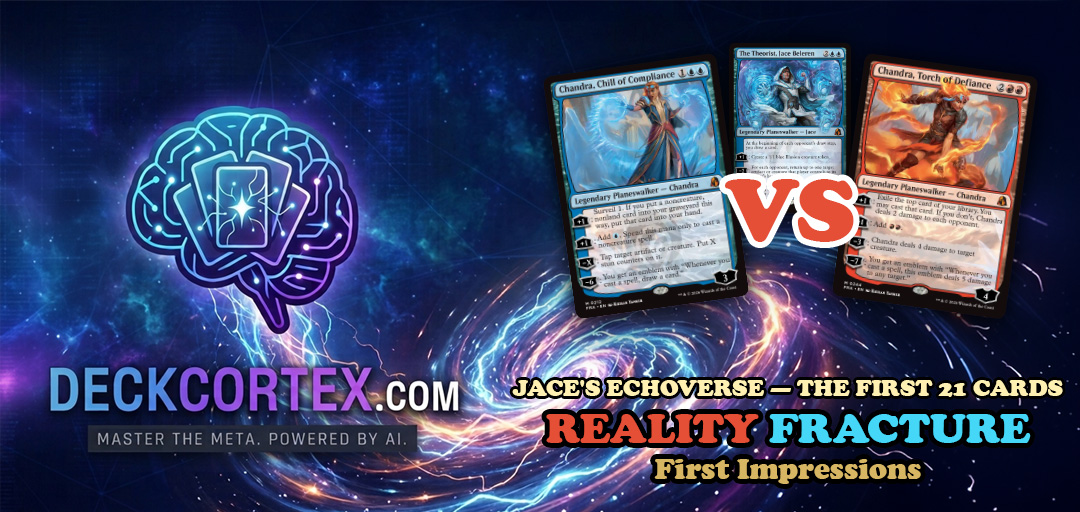
There's a blue Chandra in the next Magic set. Not a joke, not a leak, not an alter — Chandra, Chill of Compliance, , printed in the same set as a straight reprint of Chandra, Torch of Defiance. That one image is the whole pitch for Reality Fracture: Jace built a mirrored reality, and every icon of the game walked out of it wearing the wrong colors.
Here's the frame to keep, same one we used for Star Trek's First Look: what's public right now is 21 unique cards — 11 mythics, 3 rares, a handful of uncommons (Scryfall lists 43 entries, but half are booster-fun variants of the same cards). The set doesn't release until October 2, with prerelease September 25 to October 1 and Arena on September 29. Nothing has been shuffled, sideboarded, or lost to a turn-one blowout yet. Every hot take you've read is a read off card text. So that's what this is too — except we pulled the live Oracle text for all 21, and where the previews invite a comparison to a released card, we ran that card through our own corpus so the comparison has a number attached instead of a vibe.
The premise is real, and it's baked into the boosters
The story setup, confirmed on Wizards' own pages: this is Jace's Echoverse — a mirrored reality Jace created, populated with alternate versions of established characters, and the finale of the arc Magic has been building for three years. Mark Rosewater's framing at the Amsterdam panel was "We are telling a finished story with this set." The reveal actually happened twice: the premise and the first cards dropped at MagicCon Las Vegas back in early May, and the full First Look — the panel plus the Collecting article — landed at MagicCon Amsterdam on July 17. (Those blurry April leak images you may remember? All three of those cards turned out to be real. We're still only citing what's officially in the galleries.)
What makes this more than a story gimmick is the collation: Wizards promises that every Play Booster and Collector Booster "contains an echoed pair" — one card from the Multiverse we know, one from the Echoverse, almost always the same character on both sides. The one exception is Jace himself. He built the mirror; he doesn't have a reflection. On the collector side that theme carries into 30 borderless echoed-pair cards (15 pairs) and 13 "shattered mirror" treatments, plus a 500-copy serialized run of the set's chase double-face card with Mark Poole on art duty.
Products, quickly, per the July 17 Collecting article: one Reality Fracture Commander deck — Multiverse Reforged, Jace at the helm, , 16 new-to-Magic cards — plus five Foundations Commander starter decks riding along, and a new Secret Lair Bundle product. Commander decklists beyond the face cards: still unrevealed.
Prepared is back — and no, the copy isn't free
The set's marquee mechanic isn't new. Prepared debuted this April in Secrets of Strixhaven, and the rules haven't changed: a preparation card is a creature with a spell stapled into an inset frame, and while the creature is prepared, a copy of that spell sits in exile waiting. Casting the copy works like casting any other spell — you pay its cost, you follow its timing (a sorcery copy waits for sorcery speed), and casting it un-prepares the creature. If the creature leaves or gets un-prepared first, the copy evaporates.
Look at the first two side by side, because this is the set's design thesis in miniature. Strixhaven's headliner Emeritus of Ideation // Ancestral Recall carries the literal Ancestral Recall — , target player draws three cards. Reality Fracture answers with Bloodline Recollector // Ancestral Craving: a Vampire Warlock whose spell is Ancestral Craving — , target player draws three cards and loses 3 life. Same spell through a black mirror, life paid for cards, exactly the color-pie discipline Wizards keeps pointing at when people yell "Planar Chaos." The preparation gate is the tell for where it wants to live: the Recollector becomes prepared at the beginning of each end step only if three or more creatures died this turn. That's not a control card. That's an aristocrats payoff that refills your hand mid-grind.
The five-card uncommon cycle (one per Hexhaven school, all hybrid costs) splits into two patterns worth knowing at prerelease: Prudent Fateseer // Peer Review and Vigorbloom Vanguard // Seed Suture enter already prepared — the spell is live the turn they land — while Paradox Shaper // Omit Variables, Stingerquill Voxmancer // Vicious Verse and Woodwork Prodigy // Soul Tether re-prepare at your upkeep, which reads as a slow engine you're meant to cast the copy from every turn or two.
The mirror gallery, pair by pair
Chandra. The confirmed lore is genuinely fun: in the Echoverse her father was never killed, the Nalaars work for the Consulate, and Chandra grew up a calm, contented ice mage. Hence "Chill of Compliance."
Mechanically the blue Chandra is a tidy three-mana control walker: +1 surveil 1 that upgrades to card selection (a noncreature, nonland card you put into the graveyard goes to your hand instead), a second +1 that makes for noncreature spells — a ritual that protects her the turn she lands — a −X that taps something down under stun counters, and a spells-draw emblem at −6. Early write-ups called her solid for 60-card play and noticeably worse in Commander, which matches the text: everything she does is fair, incremental, and better against one opponent than three. Her mirror is the Kaladesh-era classic, reprinted untouched at — Rosewater's stated reason being that a "perfect version" of red Chandra already existed. The community mostly agreed on the card and grumbled about the new art.
Ajani. Ajani Resolute is the white lifegain Ajani you already know how to play: he ticks up on every lifegain event, 0 to gain 1, −4 makes an Ajani's Pridemate token, −10 is a +2/+2 emblem. In a lifegain shell he's a two-mana engine that defends himself; outside one he does close to nothing, and reviewers said exactly that. Ajani Unrelenting is the wild one — a mono-red Ajani at that makes a 2/2 Cadet token whenever you activate a loyalty ability, any loyalty ability, including your other planeswalkers'. The +1 hastes the team, the −2 is a full hand reset (discard your hand, draw a card per creature you control), and the −3 deals 4 to every creature except tokens you control — read that twice, your nontoken creatures are in the blast too. TheGamer ranked him the set's worst walker, six mana being "a tough pill to swallow," and for Constructed that's fair. In a Superfriends pod where every activation mints a blocker, he's a different card entirely.
Garruk. One correction before the takes, because a preview-panel quote muddied it: the graveyard hate is not on the green one. Garruk, Veiled Butcher — mono-black, — carries the static "If a creature an opponent controls would die, exile it instead." That's quiet, always-on graveyard lock against three opponents' worth of dies-triggers, sacrifice fodder, and reanimation targets, stapled to an edict that pays you a 4/4 Beast and a group-discard that can draw you cards. Garruk, Curse Breaker — — has no graveyard text at all: he draws a card whenever a power-4-or-greater creature enters under your control, untaps two lands at +2, and makes the same 4/4 Beast. He's a green midrange engine, and the flavor beat (the art has him holding the Chain Veil again) did a lot of the panel's cheering for him.
Liliana. The pair everyone will remember, because neither card is a planeswalker. Liliana lost her spark in the current story, and the panel coverage leaned on that to explain why both versions are legendary creatures — a one-mana white Cleric and a two-mana black Warlock.
Liliana the Faultless gains you a life whenever another creature or planeswalker you control enters — walkers included, which no Soul Warden variant does — and for , a tap and a card she gives another creature or planeswalker hexproof until end of turn. Early takes called her a Mother of Runes; the text disagrees. Mother of Runes protects for free, grants protection from a color (which breaks blocks and removal alike), and can save herself. Faultless costs a card, only grants hexproof, and can't target herself. She's a solid lifegain-tribal engine with a protection rider, not the format-warping nanny — and for calibration, the real Mother of Runes sits in 23.9% of the 5,598 Duel Commander lists in our corpus this half-year. Liliana the Repentant mills two off the same trigger and carries an Exhaust ability — , sorcery speed, once per game: return a creature or planeswalker card from your graveyard to the battlefield. She fills her own bin and then buys back the best thing in it. Modest stats, real engine.
And the Bones. The uncommon pair is the set's best joke: Tinybones, Pocket Nuisance makes each opponent discard on entry and pings each opponent for 1 whenever any player discards — your own wheels included — while Titanbones, Towering Heart is a 4/3 reach Skeleton Druid in green that grows two +1/+1 counters per lifegain event and gains you 3 when you discard him. Draftsim's live reaction — "TINYBONES IS NO LONGER TINY" — is the correct one. For scale: the original Tinybones, Trinket Thief appears in 28 of 58,564 cEDH lists in our corpus, so this is casual gold, not a competitive story.
Jace kept the best card for himself
The set's villain gets the set's scariest text box. The Theorist, Jace Beleren costs with starting loyalty 3 — the exact frame of Jace, the Mind Sculptor, and that's clearly deliberate — but the headline is the static: at the beginning of each opponent's draw step, you draw a card. In a four-player pod that's three extra cards per turn cycle before you activate anything. The +1 makes Illusion chump-blockers to protect him, and the −2 scales with the table too: for each opponent, bounce up to one artifact or creature that player controls. MTG Rocks called the static "absolutely absurd" and slotted him into "every single bracket 3 blue deck," and for once the preview hyperbole tracks with the text — this is a multiplayer engine on a rate Constructed walkers only dream about.
The corpus adds the punchline: the Mind Sculptor, the most famous planeswalker ever printed, shows up in 27 of 58,564 cEDH lists this half-year (and 1.6% of Duel Commander). JTMS was never a pod card — his power is a 1v1 power. The Theorist is the first Jace whose text box is shaped like a pod. If any card from these previews ends up with a real cEDH inclusion number in our data by winter, it's this one. That's a projection, not a measurement — nothing here has been played yet.
The Constructed watchlist, against our own numbers
Stingcaster Mage is the cleanest mirror design in the set: its trigger is word-for-word Snapcaster's — "target instant or sorcery card in your graveyard gains flashback until end of turn. The flashback cost is equal to its mana cost." Wizards changed exactly one word that matters: Flash became Haste. Red gets the aggressive half of the card. The forum consensus (MTG Salvation's Lectrys, back in April: "failing to profitably target instants on opponents' turns with Flash is huge") is right that it's a downgrade for control mirrors — but that critique assumes you're playing Snapcaster's game. Our corpus says where Snapcaster actually lives in 2026: 33.9% of Duel Commander lists, 2.7% of cEDH, and just 1.7% of Modern (318 of 18,326 lists this half-year). The reactive-blue Snapcaster era already ended. A hasty 2/1 that rebuys a burn spell the turn it lands is a proactive card for prowess and storm shells, and that's the lens to watch it through.
Enlightened Confidant is Bob through the white mirror, and the inversion is thorough. Dark Confidant pays you a guaranteed card every upkeep and charges life for it. The Kor Cleric pays you nothing unless you gained life this turn — then at your end step you surveil 1 and, if the card's mana value is at most the life you gained, it goes from graveyard to your hand. Conditional where Bob is guaranteed, life-positive where Bob is a clock on yourself, and the card even passes through the graveyard on the way to your hand, which delirium and escape decks will notice. Here's the fact that reframes the whole comparison: Dark Confidant appears in 4 of 18,326 Modern lists in our corpus this half-year. Four. The card that defined black midrange for fifteen years is functionally extinct — modern Magic's life-total pressure killed it. A Confidant that gains life instead of losing it, in the same Modern where white lifegain-energy shells are already a top deck (we profiled Boros Energy as the format's deck to beat), is the single most format-plausible card in these previews.
Craterclaw Colossus got the "red Craterhoof" label, and the differences are exactly where the color pie lives: Craterhoof Behemoth gives +X/+X counting your creatures; the Colossus gives +X/+0 counting your artifacts, one mana cheaper, same 5/5 haste body, same mass trample. No toughness means no wrath insurance — it's a pure damage calculation for artifact-token decks that already went wide. Worth saying out loud: even the original Craterhoof is down to 0.7% of cEDH lists in our corpus — the alpha-strike finisher role has been shrinking everywhere — so read the Colossus as a bracket-3 haymaker for artifact-token boards that already go wide, not a competitive staple in waiting.
One Standard note that changes every evaluation: there is no rotation this fall. The next Standard rotation moved to the first premier set of 2027, so Reality Fracture drops into the deepest Standard card pool in years — new cards have to beat established engines, not fill a post-rotation vacuum. (External schedule data, not ours.)
Commander reads: the Angel and the four-color Jace deck
The one Commander-product preview, Darksteel Angel, is Platinum Angel rebuilt for the format that actually punished her: same "You can't lose the game and your opponents can't win the game," but now on an indestructible 4/4 flier for that also carries Melira's exact clause — "Creatures you control can't have -1/-1 counters put on them." That last line is why the combo chatter started immediately: with the Angel out, Devoted Druid's untap cost (put a -1/-1 counter on it) resolves without the counter ever landing, the same interaction Melira, Sylvok Outcast made famous — untap it as often as you like, infinite green mana. Rules-solid, completely untested, and a nine-mana setup piece in a 100-card deck, so treat it as a build-around dare rather than a discovered engine. Our baseline for the effect is sobering anyway: Platinum Angel sits in 0.1% of cEDH lists — 66 decks of 58,564 — because "can't lose" bodies eat removal in competitive pods. Indestructible fixes the Wrath problem, not the exile problem. Bracket 3 tables are going to hate this card; cEDH will mostly shrug.
The precon to watch is Multiverse Reforged — Jace-led, , 16 new cards, zero of them revealed beyond the face. Between that deck, The Theorist, and the walker-heavy main set, Superfriends is getting its biggest supply drop in years — Ajani Unrelenting minting a Cadet off every loyalty activation is quietly one of the better payoffs that archetype has been handed.
The fair fight: is this just Planar Chaos again?
The loudest criticism has a name, and it predates the previews: "Planar Chaos 2.0." Magic Mics ran a whole segment under that question in March, Tolarian Community College's concept video wore the same framing, and the fatigue argument is coherent — color-shifting beloved cards is a twenty-year-old trick, and multiverse "What If?" stories are the most exhausted device in modern franchise fiction. If that's your read, nothing in these 21 cards will talk you out of it.
The counter-argument is on the card faces. Planar Chaos moved cards across colors wholesale — blue Wrath, black Counterspell — and made the color pie the casualty. Every mirror here pays the pie's costs: the red Snapcaster trades flash for haste, the black Ancestral taxes 3 life, the blue Chandra locks her ritual to noncreature spells. You can dislike the gimmick and still notice the discipline.
The other discourse thread is planeswalker count. Wizards spent 2024–2025 on a stated one-walker-per-premier-set diet, and when Rosewater polled Blogatog about it in October 2024 (~2,000 votes), roughly 40% wanted two per set and about a fifth wanted three — the diet was less popular than the menu. Asked about reversing it, his answer was "We're talking about it." Reality Fracture, with seven new planeswalker cards plus two Lilianas-as-creatures, is the loudest possible answer — though as an event set telling what Rosewater keeps calling a finished, finite story, it's a special occasion, not necessarily the new normal.
What nobody knows yet — and the bottom line
Still officially unrevealed, so your preview coverage can't know it either: the set's total size, the main preview-season and full-gallery dates, all six Commander decklists past their faces, the Special Guests slate, and the Store Championship promos (Wizards is keeping those deliberately secret — names are circulating, but they're leak-sourced, so you won't find them here). The dates that are locked: prerelease September 25–October 1, Arena September 29, tabletop October 2.
Where that leaves each table: Constructed players should bookmark exactly two cards — Enlightened Confidant, because the deck that wants it already exists and its predecessor's graveyard is measurable, and Stingcaster Mage as a proactive red engine, not a Snapcaster replacement. Commander players are the target market and it shows: The Theorist is the chase, the Liliana and Bones pairs are the charm, Darksteel Angel is the argument-starter. Everyone else gets the rare preview season where the marketing gimmick — a mirror in every pack — is also the design spine, and it holds up under Oracle text.
The day Reality Fracture decklists start hitting the scrapers, every projection in this piece gets replaced by a measurement — our cEDH corpus alone is at 114,817 deck snapshots and counting as of this writing, and the new cards join it the moment real lists do. Until then, keep the frame: 21 cards, zero games played, and now at least you know which reads match the text.
Card data validated against live Oracle text via the DeckCortex Scryfall proxy on July 22, 2026; preview cards are digital renders and wording can still change before release. No play data exists for an unreleased set — every format read above is a design projection, not a measurement. Analog-card numbers are DeckCortex decklist-appearance shares (cEDH n=58,564, Duel Commander n=5,598, Modern n=18,326; window 2026-01-23 → 2026-07-22) — not field share, not win rates, not external aggregator numbers. Release dates per Wizards' official pages (prerelease Sept 25–Oct 1, Arena Sept 29, tabletop Oct 2, 2026). By editorial choice, this piece contains no preorder pricing or market speculation.