The Hobbit Set Review: Four Smaugs, 48 Legends, and a Market Making Up Its Mind
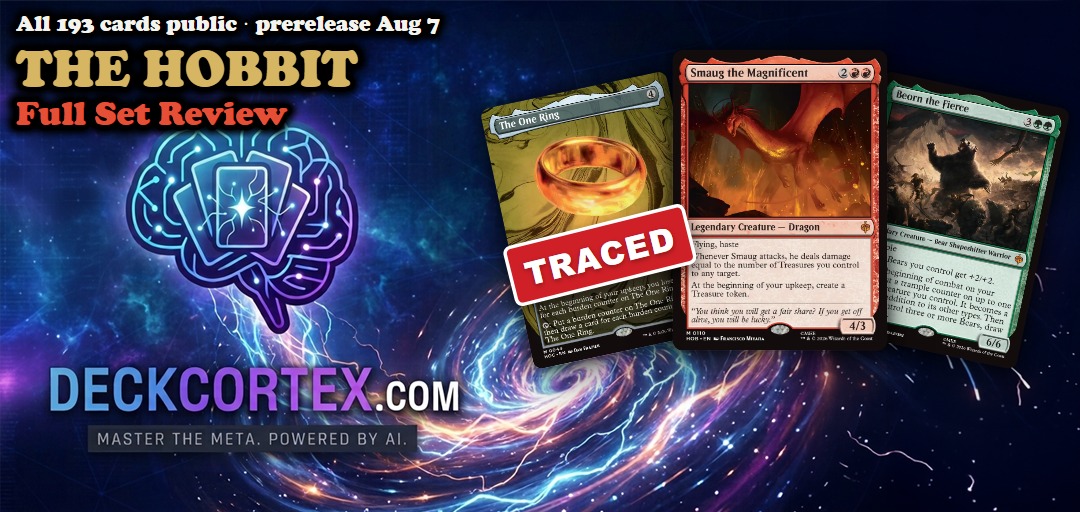
Spoiler season closed July 31 with all 193 cards public, and the preorder market immediately started contradicting the "low-power flop" consensus — Beorn up 139% in a week, the One Ring refusing to crash, an $800 collector box. The full Hobbit set review: four Smaugs, 48 legends, the traced Ring shown side by side with its source, and our own corpus numbers on every reprint that matters.
The Hobbit Set Review: Four Smaugs, 48 Legends, and a Market Making Up Its Mind
The consensus on The Hobbit has been set since May: low-power file, high-heat packaging. The preorder market spent the last week of spoiler season quietly disagreeing with itself about which half matters. Beorn the Fierce jumped from a $17.60 ask to $42.00 in the seven days between our first look and the final spoiler — up 139% — while the set's literal cover dragon slid five percent. The One Ring's original printing was supposed to wobble under reprint news and instead closed the week up a dollar and a half. Whatever this set is, "everyone agrees it's weak" isn't the whole story.
The file is complete now. The last cards went public on July 31, prerelease runs August 7–13, Arena and Magic Online get the set August 11, and paper release is August 14. We pulled the full checklist from Scryfall, loaded live Oracle text for every card discussed below, refreshed every price, and re-ran the marquee reprints through DeckCortex's own format corpus. This is the set review: what's actually in the box, which cards survive contact with their own rules text, and where the money is behaving strangely.
One correction to get out of the way, aimed at ourselves: our first look carried "198 main-set cards" from early coverage. The final file is 193 unique cards — 188 numbered cards plus five basics. When the checklist and the marketing disagree, the checklist wins.
The full file, counted
Small set, enormous cast. Of the 188 numbered cards, 48 are legendary creatures — a quarter of the set — next to 15 mythics, 53 rares, and a land suite of five basics, five common duals, a common utility land, and two rare lands. The eternal companion sheet (code HOC, legal in Commander, Legacy, and Vintage) adds another 117 cards: twelve Scene Box exclusives, the forty Middle-earth Classic Artist box toppers, five cards printed entirely in Dwarvish script, nine collector-booster-only legends we'll get to, and a block of Welcome Deck reprints that turns out to be the sneakiest supply story in the product line.
The five common duals also quietly confirm the draft format's shape, because each one sacrifices to pump exactly one tribe: Lake-town feeds Humans, Goblin-town Goblins and Orcs, Mirkwood Bears, Spiders, and Wolves, Iron Hills Dwarves, Elvenking's Halls Elves. That's the archetype grid in land form: WU Humans on recruit, BR Goblins on amass, BG beasts on ferocious, RW Dwarves on storied, GU Elves on landfall, with signposts like Bard the Bowman, Bolg of the North, The Chief Warg, Bifur, Melodic Rider, and Thranduil, Sindarin Liege // Silvan Rally marking the lanes.
If you skipped spoiler season, the three new mechanics in one breath: storied gives you "an enduring story for the rest of the game" once you control three or more artifacts, legendaries, and/or Sagas — the designation sticks even if the board doesn't, and each storied card brings its own payoff (Thorin Oakenshield grants ward , Bifur, Melodic Rider makes your Dwarves' triggered abilities trigger an additional time). Recruit is draw a card, then discard a card, plus a 1/1 white Human Soldier token if you discarded a nonland. Hone counters sit on Equipment at +1/+0 apiece, debuting on Sting, Bilbo's Sword. Adventure is the returning headliner, and amass now builds Goblin armies.
Smaug, four ways
The set's loudest card argument is about a 4/3. Smaug the Magnificent costs for flying, haste, a Treasure every upkeep, and an attack trigger that deals damage equal to your Treasure count to any target. The comment sections wanted a boss monster and got a rate card — "Smaug just 4/3 is ridiculous" is the representative reader take under Card Game Base's reveal coverage, and even the article's author conceded the card doesn't match the lore's greatest and wickedest of worms. The criticism is half right. Smaug does nothing the turn he arrives beyond a 4-power haste hit, the attack trigger starts at zero without prior Treasures, and removal in response to the attack blanks it entirely. But "underwhelming mythic" and "bad card" aren't the same claim: untouched, he ships a growing Fireball every combat while making his own ammunition, and the market still asks $70.90 for the privilege — down from $74.66 a week ago, cooling but hardly capitulating.
Here's the twist the discourse missed: the best Smaug for actual Commander tables is probably the rare. Smaug, Wicked Worm — and yes, the card is literally named after the "wicked worm" line everyone quoted at the mythic — enters for as a 5/5 flier and creates a tapped Treasure for every artifact your opponents control. At a Commander table where three players each have a Sol Ring and a Signet out, that's a six-plus Treasure windfall, and from then on every Treasure-funded spell draws you a card for one life. The $18.34 ask says the market is starting to notice. Smaug, the Great Calamity // Spew Flame gives Limited a common Dragon whose Adventure half burns a creature for 5, and the Scene Box Smaug the Impenetrable is the stat monster the mythic refused to be — 8/7 flying, indestructible, haste, converting all noncombat damage thrown at him into Treasures, at a $49.99 preorder ask that outprices half the main set's mythics.
The chase version is its own subplot: the Gleaming Gold Smaug the Magnificent (Ted Nasmith's illustration, roughly 500 copies, Collector Boosters only, English only) is this set's white whale. It is not serialized — worth saying plainly, because even finance coverage keeps calling it "the serialized version." Roughly 500 unnumbered copies is exactly the situation where graded, in-hand verification matters, and the grading-first advice circulating (SparkMTG among others) is sound.
The back half's real cards
Spoiler season front-loaded the marquees, and the July reveals were mostly role-players — but a few of them out-design the headliners. The Master of Lake-town is the set's best sleeper at a $6.96 ask: a 3/2 deathtouch body that makes every player mill cards equal to any life they lose, you included, and draws you a card on death for each graveyard with seven or more cards in it. That's a mill engine, an aristocrats payoff, and a self-mill enabler on one rare, and the symmetry is the fun part — he feeds your own Thranduil graveyard as happily as he turns every Bowmasters ping at the table into extra mill.
Dáin Ironfoot is the Equipment deck's missing two-drop: his enter trigger makes an Axe token (equip , +1/+0) and attaches it free, and whenever he attacks, every equipped attacking creature gains double strike — not just Dáin. Line him up with Thorin, Mountain-king, whose enter trigger attaches any number of your Equipment to one creature and then has it deal its own power to a creature you choose, plus The Lonely Mountain minting discounted 2/2 Dwarves, and mono-red Dwarf Equipment stops being a meme and starts being a curve. Orcrist, Goblin-cleaver connecting in that deck names Dwarf and pays out a Treasure per Dwarf you control; its $42.08 ask is the market taking the archetype more seriously than the coverage did.
Two more worth your radar: Radagast of Rhosgobel makes your first creature spell each turn cost less and castable as though it had flash — an honest, repeatable cheat on both mana and timing that green midrange decks in every format will at least audition. And Azog, Moria's Ruin is removal on legs with a genuinely interesting drawback: destroy up to one other creature, but its controller amasses Goblins X where X is the dead creature's power. Aim it at your own creature and you keep the Army and draw a card. The Lord of the Eagles, a flash 8/8 that costs less for the total power of your fliers, closes out the "the eagles arrive exactly when the math says they can" file, and its $16.60 ask is pure Commander romance.
Standard: one bet, honestly priced
This is the first Tolkien set that's ever been Standard-legal, and the most important Standard card in it is a reprint. Settle the Wreckage — exile all attacking creatures target player controls, instant speed, they ramp basics as consolation — re-enters Standard almost nine years after Ixalan. Our own corpus is blunt about its current résumé: 21 Pioneer lists in three months (0.6% of 3,690), nineteen cEDH appearances, two in Modern. Nobody plays this card right now, and the $2.50 Ixalan copy prices that in. The reprint is a bet on context, not on pedigree: exile-based, one-sided, instant-speed sweepers are exactly what token and go-wide metagames hate, and Standard gets to run that experiment from August 14. It's the single cleanest test of the "low power means no Constructed impact" thesis.
Among the new cards, The Queen of Dale is still the best Constructed argument: a 2/1 that recruits whenever an opponent casts their first noncreature spell each turn — their cantrips, their removal, their counterspells all pay you a card's worth of selection plus a potential body. Her ask drifted from $46.00 to $44.72 over the week, which reads as the market holding its breath rather than losing faith. Gollum, Riddle Master remains the odd/even punisher with front-loaded value and a $19.70 ask. Everything else in the file is a design read until real decklists exist, and we'll say so until they do: if any HOB card clears a couple percent of the Standard metagame by September, the low-power narrative dies and we'll write the follow-up. That's the threshold; hold us to it.
Commander: the market already voted
The Commander story hasn't changed since July — it has compounded. Thranduil, the Elvenking wields every activated ability of every Elf card in your graveyard and pays out two cards (then a discard) whenever another legendary Elf enters under your control. EDHREC counts 1,095 registered decks as of August 1, up from 324 in the reveal week and 618 at our first look — all preorder theorycraft, no play data, but as a hype curve it only points one direction. The community's builds lean exactly where the card text begs: Buried Alive shows up with an 82% synergy inclusion on his page, because entombing Priest of Titania-class Elves is the whole engine, and 59% of his decks carry EDHREC's combo tag. Our own combo engine gets its say once real lists hit the corpus. Meanwhile his ask climbed from $16.12 to $19.06 against the week's falling tide — modest money following loud attention.
The week's actual price story is Beorn the Fierce. A 6/6 trampler that pumps other Bears +2/+2, converts up to one creature into a Bear (with a trample counter as the parting gift) at the beginning of combat on your turn, then draws two cards if you control three or more Bears — a mythic Bear lord for the tribe that's been a running joke since Alpha. Ask on July 25: $17.60. Ask on August 1: $42.00. That 139% week is pure preorder emotion and should be treated as such, but it's also the clearest signal in the data that this set's commercial engine is typal nostalgia, not tournament tables. Bard, King of Dale went the other way, $30.49 to $26.69, which feels like a market correcting from "draw doubler and token doubler on one card!" to "six mana, 3/5, wins slowly." Both replacement effects are real; so is the clock they don't present.
One standing instruction survives from the first look, because preorder pricing still hasn't absorbed it: read the Adventure half before you assume an artifact fits your deck. The Arkenstone // Seek the Heart's sorcery half costs , making the card white-identity — it does not go in "every deck" at any price, and $31.76 is a price that thinks it does. Same trap on My Precious // Allure of Power: the Equipment is colorless, the instant is , the card is black-identity .
The nine collector-booster exclusives (hoc:98–106, all mythic) are 2027 arriving early: they preview next year's Battle of the Five Armies co-op kit, and three of them — Bilbo, Unexpected Adventurer, Thorin, Company's Leader, and Chief of the Wilds — carry rules text referencing the battle card type, a type we haven't seen supported since March of the Machine. As cards they're solid rather than shocking: Thranduil the Strategist gives your other Elves ": Add or " while landfall mints more Elves, Dáin of the Ancient Halls hits each opponent for your Dwarf count every time he attacks, Bolg, Erebor's Reckoning shrinks the opposing board by one-and-one every combat while pumping your Goblins and Orcs. As product design they're the set's most cynical move — booster-gated supply on cards a 2027 kit will presumably want, and the $49.99 asks on Gandalf, Shadow's Foe and Bard, Heir of Girion show the gating working exactly as priced.
The Scene Boxes ($41.99, six new eternal-legal cards each plus three Play Boosters) hide the set's most quietly pushed white card: Ori, Plate Stacker destroys all artifacts and enchantments your opponents control on entry — one-sided, no ceiling, life gain per permanent as a garnish. Fíli and Kíli, Joyous is a haste ritual on legs for Dwarf, Equipment, and Saga spells, and Bag End Banquet plus Dragon's Desire give Food and Treasure tables their toys.
Reprints: where the value actually sits
We ran the reprint sheet through DeckCortex's own corpus, May 3 through August 1 — decklist-appearance shares in our scraped lists, not field share, not anyone's aggregator. The demand under this set's reprints is real and format-specific. Orcish Bowmasters sits in 30.4% of 28,156 cEDH lists, 20.3% of 4,922 Legacy lists, and 8.7% of 8,866 Modern lists — the rare card that's a pillar in three formats at once, and its $44.26 price already eased 6% into the reprint news. Mox Amber is in 60.9% of cEDH lists — second only to Arcane Signet's 68.1% among the cards we checked — and Wizards reprinted it exclusively in Collector Boosters, in Dwarvish runes, as one of five such cards. A $76.86 card whose new supply is a novelty script in a $37.99 pack is a collectible event, not a price event. The One Ring lives in Legacy (12.6%) and cEDH (23.6%) and nowhere else that matters — it's been banned in Modern since December 2024, whatever the preview coverage keeps implying — and its box-topper-gated reprint explains the price chart: $105.29 before the final spoiler week, $106.86 after. No crash, no panic, and the "watch, don't panic-sell" camp has the data on its side for now.
The under-reported reprint story is in the humblest product. The Welcome Decks — five mono-color beginner decks — carry the eternal sheet's numbers 161 through 212, and tucked inside are current Constructed staples at common: Lórien Revealed appears in 23.7% of the 8,219 Pauper lists in our window and 7.9% of Legacy lists; Troll of Khazad-dûm is in 6.7% of Pauper decks; Stern Scolding shows up across Modern's fair blue decks. A $5.44 Pauper pillar getting a fresh common printing in a beginner product is real supply for the format where price-per-card matters most. Nobody's marketing that; it's still the best value sentence in this review. On the new-card side of Pauper's ledger, Óin the Brave (a storied common with a built-in loot engine) and Ragged Short Spear (discard one, draw two, on a Equipment) are the community's early candidates, and for once the design reads look plausible.
The box toppers themselves — forty reprints with new art from classic Magic illustrators, one per display — are top-heavy as value: below Bowmasters, the Ring, and Mithril Coat ($34.95), the sheet thins fast toward Flowering of the White Tree at $10.87 and Lotho, Corrupt Shirriff at $12.84. A topper is a lottery ticket with a handsome frame, and it replaces the bonus sheet this set doesn't have.
The One Ring, traced
Look at these two cards side by side, because the whole controversy is visible from your chair: left, Marta Nael's borderless One Ring from the 2023 bundle promo; right, the new box topper credited to Dan Frazier. Same ring, mirrored, inscription gone, on Frazier's trademark marbled gold.
The timeline, since it keeps getting compressed in the retelling: the box topper debuted May 1 at MagicCon Las Vegas. Within a day, Reddit had the overlay comparisons up. Frazier's representative initially said the artist had never seen the final version — "After several changes requested we never saw this version" — and veteran Magic illustrator Donato Giancola publicly described the piece as a digitally sampled, flipped copy of Nael's painting with the Elvish script removed, doubting Frazier had much say in the outcome. On May 2, Frazier and Wizards published joint statements. Frazier owned it: "I made a mistake, and I feel awful," describing how he'd used Nael's ring as reference and painted over it — "I didn't make it my own." Wizards said it was "disappointed our review process didn't catch the issue," promised Nael credit alongside Frazier on digital versions, and committed to compensating her. Nael herself hasn't said anything publicly that we can find.
Three months later, what's actually changed: the digital versions get dual credit, Nael gets paid, and the physical card ships August 14 exactly as revealed — which is precisely what the community's angriest thread keeps pointing at. The market's verdict is stranger: the traced topper's preorder ask is $148.28, some forty percent above the $106.86 original and sixty-five percent above Nael's $89.81 bundle version. Notoriety prices, apparently. Giancola widened the story into a critique of Universes Beyond art contracts — work-for-hire, digital-only, no artist-owned originals — as the structural reason corners get cut, and it's worth noting Wizards didn't sever the relationship the way past plagiarism cases went (the Fay Dalton "Trouble in Pairs" affair in 2024 ended with the art replaced, a contrast mtgrocks drew early). The closing grace note belongs to Nael: her actual brush is on two cards in this very set — Smaug the Impenetrable and Dragon's Desire, both in the Smaug's-hoard Scene Box. The set's most-discussed artist never traced anything.
No precons, an $800 box, and what your money buys
There are no Commander precons. Not a rumor, not an oversight — Wizards' position is that 2023's four Tales of Middle-earth decks already covered Tolkien, and the 2027 co-op kit is the format's new toy instead. The community reception ranges from resigned to the top-voted version of "How did TMNT and marvel get pre cons but hobbit doesn't?!" It's a fair question with an unsentimental answer: 2026 has already shipped more than a dozen UB precons, and this slot got cut. The Scene Boxes and Welcome Decks are the replacement tier, and the four 2023 precons remain purchasable for anyone who wants Sauron in a box.
Sealed is where this set stops being a power-level conversation entirely. Rippr's May model put a Collector Booster display at $425–540 against a ~$455 MSRP-equivalent; eBay ran $440–600; by late July, Draftsim observed listings around $800 on TCGplayer — nearly double a Lorwyn Eclipsed box — with preorders sold out at plenty of retailers. The premium is buying the topper lottery plus surge foils plus the ~500-copy Smaug, and the bull case leans on Tales of Middle-earth collector boxes having peaked at two to three times MSRP after release. The bear case is just as easy to state: that precedent had a serialized one-of-one ring in it, and this set deliberately doesn't. The 2023 chase ended with a Toronto player pulling the 1-of-1, grading it PSA 9, and selling it to Post Malone for 2.64 million Canadian dollars — the most expensive Magic card ever sold, per CBC. The Gleaming Gold Smaug is a fine white whale, but five hundred unnumbered copies is a different myth, and anyone modeling LTR's sealed curve onto this set is pricing a story it didn't print. For European readers there's a quieter arbitrage note: EU presale asks are running far below US asks card-for-card (Beorn at €13.66 against $42.00 is the loudest example), partly thin Cardmarket presale depth, partly a genuinely calmer market — the first look found the same pattern in sealed, and it's held.
Bottom line
Standard and Pioneer players: one real watch item — Settle the Wreckage against the token decks — plus the Queen of Dale experiment. Everything else needs to show up in a decklist before it earns your attention. Commander players: Thranduil is the event, Beorn is the sentiment index, the Dwarf-Equipment shell (Dáin, both Thorins, the Lonely Mountain, Orcrist) is the most underpriced archetype in the file, and the Master of Lake-town at seven dollars is the pickup. Check every Adventure artifact's color identity before you preorder it. Value hunters: the reprint demand is real and ours to measure — Bowmasters and Mox Amber carry three-format and cEDH weight respectively, the Welcome Decks are quietly the best Pauper news of the summer, and the One Ring's chart shows a market that has decided not to be scared. Collectors: the box premium assumes a chase this set intentionally didn't print. Know that before you pay double.
What we're watching from here: whether the One Ring original holds above $70 once boxes actually crack (below that, the reprint pressure is real and the whole sheet re-prices); whether any HOB card touches 2% of Standard; the first 17lands winrates on the five draft pairs, where the small-set balance worry gets its test; and Thranduil's deck count against the LTR commanders' 2023 launch curves. The file is closed. The data starts August 14, and we'll be back with it — this time with our own inclusion numbers instead of asks and design reads.
Card data validated against live Oracle text via the DeckCortex Scryfall proxy and the full Scryfall set file on August 1, 2026; printed wording can still change before release. Format-presence figures are decklist-appearance shares in DeckCortex's own scraped corpus, window May 3 – August 1, 2026 (cEDH n=28,156 · Modern n=8,866 · Pauper n=8,219 · Legacy n=4,922 · Pioneer n=3,690) — not field share, not external aggregator numbers. Prices are Scryfall paper aggregates; unreleased-card prices are preorder asks, and week-over-week changes are ask movement, not confirmed sales. No play data exists for an unreleased set: every competitive claim about a new card is a design read, and EDHREC deck counts are external hype signals cited as such. Release, product, and event facts per Wizards' official product and WPN coverage (tabletop Aug 14 · Arena/MTGO Aug 11 · prerelease Aug 7–13 · Gift Bundle Sept 4).