The Game Changers Staircase: Ranking All 53 of Commander's "Equal" Cards
One Rhystic Study flips your bracket exactly like one Panoptic Mirror — but one of them is in 62.1% of the 58,497 cEDH tournament lists we track, and the other is in six. We walked all 53 Game Changers down the staircase on two axes, our tournament corpus against EDHREC's casual census, sorted the list into its four real rooms — and met the card that outplays the list's most famous member without being on it: Mystic Remora, 64.8%.
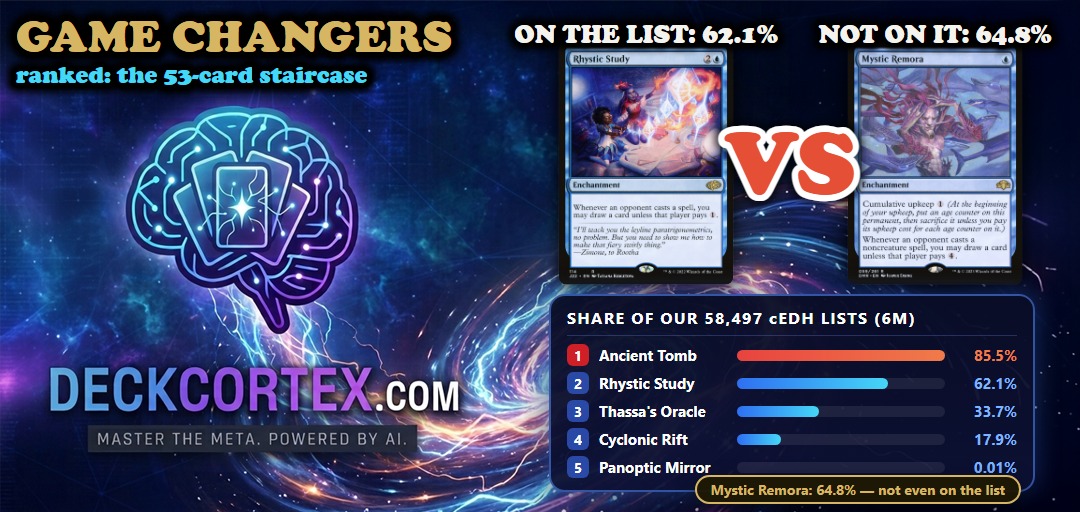
One Rhystic Study turns your precon into a Bracket 3 deck. So does one Panoptic Mirror. By the official bracket rules those are the same event — a Game Changer is a Game Changer, and Bracket 2 allows exactly zero of them. Here's what that equivalence looks like in actual decklists: Rhystic Study appears in 62.1% of the 58,497 cEDH tournament lists we tracked over the past six months, and in over a million decks on EDHREC. Panoptic Mirror appears in six of ours. Not six percent — six decks, out of fifty-eight and a half thousand.
The Game Changers list isn't a plateau. It's a staircase, and the drop from the top step to the bottom is about four orders of magnitude. That's not a gotcha aimed at Wizards — the Commander Format Panel has said openly that the list isn't a power ranking, and it has named its own wobbliest members. What nobody had done yet is walk the whole staircase with tournament data. So we ran all 53 cards through our cEDH corpus, set the results against EDHREC's casual census, and sorted out which Game Changers actually change games, which ones only change some games, and which ones are on the list for their reputation.
One card that is not on the list outplays the list's most famous member in our data. We'll get to it.
The rule, and what WotC says the list is
The official format page is blunt: Bracket 1 and 2 decks exclude Game Changers, Bracket 3 allows up to three. No minimum, no precon exception — we covered the one-card bracket flip in detail before, including the 18 precons that are Bracket 3 in the cellophane.
What the list means is just as official. When the panel trimmed ten cards in October 2025, Gavin Verhey wrote that "power alone isn't a reason to list it as a Game Changer." The stated criteria are about warping games: running away with resources, locking people out, tutoring with no downside, shifting games in ways players find unpleasant. It's a salience list — a shared vocabulary for the pregame conversation — not a tier list. WotC even concedes the internal gradient: Consecrated Sphinx is "right on the bubble," Coalition Victory "could maybe come off some day," and of Panoptic Mirror, "we discussed removing this."
So when we rank these cards, we're not correcting the list against its own purpose. We're measuring the staircase the panel already admits exists — because if you're going to spend your three Bracket 3 slots, or wonder why your table flinched at your enchantment, it helps to know whether your Game Changer is a 62% card or a six-deck card.
How we measured (and what we didn't)
Two axes, kept strictly apart:
- Tournament axis (ours): the share of cEDH tournament decklists a card appears in — 58,497 scraped snapshots from 2026-01-29 to 2026-07-28. A 3-month sub-window (n=28,623) tracks the 6-month numbers within about two points everywhere, so none of this is a July fluke.
- Casual axis (EDHREC, external): deck counts from EDHREC's card pages, pulled 2026-07-28 in one snapshot. Where we quote a percentage it's EDHREC's own denominator — the color-eligible decks for that card.
No blended score, no fake composite. A card can be a tournament pillar, a kitchen-table legend, both, or neither — and those four verdicts are the whole point. We track no match win rates; where someone else's win-rate data matters (Playgroup.gg has a tracked-games table), we say whose it is.
The staircase, cluster by cluster
Fifty-three cards is a lot of staircase, so we grouped them by what they actually do to a table.
The mana crimes (10 cards)
The top of the entire list, by a distance, is fast mana. Ancient Tomb — two colorless a turn, two life a tap — is in 85.5% of our cEDH lists. Chrome Mox (exile a nonartifact, nonland card from hand for a mana of its colors) sits at 85.4%, Mana Vault (three colorless now, and a slow bleed later) at 83.2%, Mox Diamond (discard a land instead of paying anything) at 81.3%. In the casual room the same four cards are single-digit citizens: Ancient Tomb leads them at 9.2% of EDHREC decks, Mox Diamond manages 4.2%. Turbo starts win tournaments; they just annoy your Tuesday pod.
Lion's Eye Diamond deserves its own sentence, because no other card on the list asks for your whole hand. Sacrifice it, discard everything, get three mana of one color at instant speed — useless in a fair deck, absurd next to Underworld Breach, and that's exactly why it's in 48.5% of our lists and 1.9% of EDHREC's. Grim Monolith (33.4% vs 2.0%) tells the same story with less drama.
The lands round out the cluster and start the price conversation early: Gaea's Cradle is a real tournament card (32.7% of our lists) that costs $1,622.57 in paper. Serra's Sanctum is the same idea for enchantments, sees 0.4% of cEDH play, and still runs $500.60. Mishra's Workshop makes three mana that only casts artifact spells, shows up in 4.1% of our lists, and is a $3,000.97 card. Jeska's Will is the only spell here both rooms genuinely love — 32.2% of our corpus, 713,560 EDHREC decks — because "add for each card in a target opponent's hand, and exile three off the top to play this turn" is a rummage sale where you take both deals if you control a commander.
The tutors (12 cards)
Twelve of the 53 — the biggest cluster — search your library, which tells you what the panel actually fears: consistency. The famous ones deliver exactly as advertised. Demonic Tutor, any card straight to hand for two mana, is in 46.4% of our cEDH lists and 900,643 EDHREC decks (18.7% of the black-eligible ones) — one of the few cards in Magic both rooms treat identically. Vampiric Tutor (46.9% ours) and Imperial Seal (37.7%) put the card on top instead of in hand, at two life a search; the tournament room pays that price happily, the casual room mostly pays it for Vampiric.
The one-mana specialists — Mystical Tutor for instants and sorceries (40.1%), Enlightened Tutor for artifacts and enchantments (36.1%), Worldly Tutor for creatures (20.6%) — all put the card on top of your library, not in your hand, and all see healthy double-digit casual play too. Gamble is the budget seat's Demonic Tutor: card to hand, then discard at random, 44.0% of our lists, $17.56. Crop Rotation sacrifices a land to fetch any land — which in this format means Gaea's Cradle or Glacial Chasm — and quietly beats most of the marquee names at 31.7%.
Then the cluster falls off its own cliff. Intuition (19.6% ours, 1.7% casual — a $356.55 card the kitchen table has never met), Gifts Ungiven (10.0%), Survival of the Fittest (6.0%), Natural Order (3.6%). All four are real engines in the right shell; none of them is remotely a format-wide presence. Same list, same "one flips your bracket" weight as Demonic Tutor.
The engines (9 cards)
This is the cluster your table actually argues about. Rhystic Study is the most-played Game Changer in casual Magic — 1,053,717 EDHREC decks, 22.6% of everything that can cast it — and a 62.1% card in our tournament corpus. "Draw a card unless that player pays " is one line of text that taxes three opponents for the rest of the game, and it's the card the whole bracket debate keeps orbiting: WotC floated it as a possible ban in October 2025 and then leaned no.
Smothering Tithe is its white mirror — their draws become your Treasures unless they keep paying — and the second-most-loved Game Changer on EDHREC (885,969 decks, 20.1%) while still posting 30.9% in cEDH. Necropotence converts life directly into cards at end of turn and skips your draw step for the privilege; 27.8% of our lists run that deal. The One Ring gives you a turn of protection from everything and then an accelerating draw engine — 26.2% ours, 750,786 decks theirs, the rare artifact that made both rooms rebuild around it.
Ad Nauseam (24.1% ours, 2.3% casual) is the purest tournament read on the list: reveal-and-take until your life total says stop is a combo turn, not a value play. Bolas's Citadel flips that profile — 371,899 casual decks love casting their deck off the top for life, while cEDH plays it in 5.6% of lists. Consecrated Sphinx — the card WotC itself put "on the bubble" — draws two per opponent draw and lands at 8.0% ours / 193,151 theirs: a genuine six-mana table-warper that tournament Magic mostly aged out of. Seedborn Muse untaps your board on everyone else's turn (12.2% / 356,148), and Field of the Dead makes a 2/2 Zombie per land drop once you hit seven different land names — 1.4% of our lists, because tournament manabases are too tight for 27 differently-named lands, against a quarter-million casual decks that happily aren't.
The police (8 cards)
Free interaction and draw punishment — the cards that make the other three players play worse. Force of Will (pay 1 life, exile a blue card, counter anything) and Fierce Guardianship (free noncreature counter while you control your commander) are pillars three and four of tournament Commander at 60.6% and 60.2% — and Fierce Guardianship is the one your casual table also owns, 807,111 decks deep, thanks to a precon printing.
Orcish Bowmasters flashes in and punishes every card an opponent draws beyond their regular draw-step card — one damage anywhere, plus a growing Orc army — 31.4% ours, 385,213 theirs, and the only card in this cluster printed in the last three years that both rooms adopted instantly. Opposition Agent (13.6%) makes their tutors yours — you control opponents while they search and you get to play what they find — which is why it reads like a police card and plays like a heist. Drannith Magistrate shuts off casting from anywhere but hands — commanders included, which is the whole point — at 10.5% ours.
The draw-hate twins measure the two rooms neatly: Narset, Parter of Veils (opponents can't draw more than one a turn) and Notion Thief (their bonus draws become yours) sit at 1.3% and 1.1% in our corpus — wheels are not a cEDH plan this year — while EDHREC keeps them around as the honest answer to casual card-draw arms races. And Aura Shards (0.4% ours, 138,440 theirs) is on the list because in a creature deck every fresh body brings a free Disenchant along — a kitchen-table machine-gun that tournament games simply don't live long enough to load.
The table-wreckers (10 cards)
Mass resets and locks — the feel-bad chapter. Cyclonic Rift is the most instructive card on the whole list: 968,386 EDHREC decks (20.7%) versus 17.9% in our corpus, and falling — it's down to 15.3% in the last three months. One overloaded Rift at a four-player table undoes thirty minutes of board development; in a two-hour tournament round against decks that win from the stack, bouncing permanents is often just expensive. Same card, two different games.
Farewell is the purest casual-only Game Changer ever printed: choose any combination of exile-all-artifacts/creatures/enchantments/graveyards, 506,152 EDHREC decks, 11.5% of the white-eligible room — and 0.4% of ours, because six-mana sorceries don't answer a Thassa's Oracle trigger. Its addition to the list in February retroactively flipped four shipped precons to Bracket 3, which remains the funniest sentence in bracket history. Teferi's Protection is its bodyguard mirror on the same split (15.9% casual, 0.7% ours): your life total can't change, you gain protection from everything, your whole board phases out — the definitive answer to the wipe, in the room where wipes happen.
The rest of the cluster is where the list's reputation section lives. Tergrid, God of Fright // Tergrid's Lantern — every nontoken permanent an opponent sacrifices or discards can come back under your control — is the #4 saltiest card on EDHREC's live board and appears in 0.2% of our corpus. Grand Arbiter Augustin IV (#11 in salt, 1.2% ours) makes every spell your opponents cast cost more while your white and blue ones cost less. Humility turns every creature in the game into a textless 1/1 — 57 of our 58,497 lists, 8,878 EDHREC decks, and an all-timer in "games nobody enjoys" folklore. The Tabernacle at Pendrell Vale charges rent on every creature at 1.0% ours / 13,759 theirs and $2,899.99 a copy; Glacial Chasm makes you damage-proof at the price of your own attack step, a sacrificed land, and a life bill that doubles down every upkeep (0.2%); Braids, Cabal Minion makes every player sacrifice an artifact, creature, or land on their own upkeep (27 of our lists, and a card WotC unbanned onto this list in April 2025); and Panoptic Mirror — imprint an instant or sorcery, copy it free every upkeep — is the bottom step: six decks out of 58,497, 10,683 out of 9.5 million. The salt board agrees with the play data here, by the way: the two saltiest cards in the format right now, Stasis and Winter Orb, aren't Game Changers at all (stax and mass land denial are tracked as their own bracket criteria), and #9 Vorinclex, Voice of Hunger was removed from the list last October.
The win buttons (4 cards)
Thassa's Oracle is the most important two-drop in competitive Commander: an enters trigger that wins on the spot once your library is empty (or your devotion beats what's left), immune to the damage-based interaction that used to stop Laboratory Maniac loops. It's in 33.7% of our lists — a third of tournament Commander carries it as the default way to actually win — against 5.8% of the casual room. Underworld Breach (42.0% ours) gives every nonland card in your graveyard escape until end of turn — with Lion's Eye Diamond making the mana and a self-aimed Brain Freeze emptying the library, it's the engine of the format's cleanest kill.
Coalition Victory and Biorhythm are the other end of the button panel. Coalition Victory — win if you control a land of each basic type and a creature of each color — was unbanned in April 2025, classified straight onto the Game Changers list, and has since been registered in nine of our 58,497 tournament decks. Biorhythm (everyone's life total becomes their creature count, eight mana) got the same unban-to-list treatment this February and sits at 118. These aren't Game Changers in any observable sense; they're parolees wearing the list as an ankle monitor. Wizards has half-said as much — Coalition Victory "could maybe come off some day."
The whole staircase in one table
Our cEDH share = % of 58,497 tournament decklists (2026-01-29..07-28, main+side). EDHREC = decks containing the card, one snapshot, 2026-07-28, % of color-eligible decks in parentheses.
| Game Changer | cEDH share | EDHREC decks (% eligible) | |---|---|---| | Ancient Tomb | 85.5% | 872,014 (9.2%) | | Chrome Mox | 85.4% | 541,389 (5.7%) | | Mana Vault | 83.2% | 541,601 (5.7%) | | Mox Diamond | 81.3% | 398,387 (4.2%) | | Rhystic Study | 62.1% | 1,053,717 (22.6%) | | Force of Will | 60.6% | 448,295 (9.6%) | | Fierce Guardianship | 60.2% | 807,111 (17.3%) | | Lion's Eye Diamond | 48.5% | 179,568 (1.9%) | | Vampiric Tutor | 46.9% | 687,349 (14.3%) | | Demonic Tutor | 46.4% | 900,643 (18.7%) | | Gamble | 44.0% | 408,398 (8.7%) | | Underworld Breach | 42.0% | 291,731 (6.2%) | | Mystical Tutor | 40.1% | 534,301 (11.4%) | | Imperial Seal | 37.7% | 240,516 (5.0%) | | Enlightened Tutor | 36.1% | 644,713 (14.7%) | | Thassa's Oracle | 33.7% | 271,888 (5.8%) | | Grim Monolith | 33.4% | 190,215 (2.0%) | | Gaea's Cradle | 32.7% | 262,652 (6.0%) | | Jeska's Will | 32.2% | 713,560 (15.1%) | | Crop Rotation | 31.7% | 427,122 (9.8%) | | Orcish Bowmasters | 31.4% | 385,213 (8.0%) | | Smothering Tithe | 30.9% | 885,969 (20.1%) | | Necropotence | 27.8% | 243,636 (5.1%) | | The One Ring | 26.2% | 750,786 (7.9%) | | Ad Nauseam | 24.1% | 111,839 (2.3%) | | Worldly Tutor | 20.6% | 505,653 (11.6%) | | Intuition | 19.6% | 77,665 (1.7%) | | Cyclonic Rift | 17.9% | 968,386 (20.7%) | | Opposition Agent | 13.6% | 227,560 (4.7%) | | Seedborn Muse | 12.2% | 356,148 (8.1%) | | Drannith Magistrate | 10.5% | 183,645 (4.2%) | | Gifts Ungiven | 10.0% | 91,301 (2.0%) | | Consecrated Sphinx | 8.0% | 193,151 (4.1%) | | Survival of the Fittest | 6.0% | 64,639 (1.5%) | | Bolas's Citadel | 5.6% | 371,899 (7.7%) | | Mishra's Workshop | 4.1% | 39,272 (0.4%) | | Natural Order | 3.6% | 95,657 (2.2%) | | Field of the Dead | 1.4% | 254,677 (2.7%) | | Narset, Parter of Veils | 1.3% | 150,043 (3.2%) | | Grand Arbiter Augustin IV | 1.2% | 71,352 (3.3%) | | Notion Thief | 1.1% | 124,241 (5.3%) | | The Tabernacle at Pendrell Vale | 1.0% | 13,759 (0.1%) | | Teferi's Protection | 0.7% | 697,859 (15.9%) | | Aura Shards | 0.4% | 138,440 (6.9%) | | Serra's Sanctum | 0.4% | 51,158 (1.2%) | | Farewell | 0.4% | 506,152 (11.5%) | | Glacial Chasm | 0.2% | 69,249 (0.7%) | | Biorhythm | 0.2% | 10,752 (0.2%) | | Tergrid, God of Fright // Tergrid's Lantern | 0.2% | 85,161 (1.8%) | | Humility | 0.1% | 8,878 (0.2%) | | Braids, Cabal Minion | 27 decks | 27,493 (0.6%) | | Coalition Victory | 9 decks | 11,464 (1.8%) | | Panoptic Mirror | 6 decks | 10,683 (0.1%) |
(The last three round to 0.0%, so we print the raw counts instead.)
Four verdicts, not one ranking
Read the table on both axes and the 53 sort themselves into four rooms:
Game Changers everywhere. Rhystic Study, Demonic Tutor, Vampiric Tutor, Fierce Guardianship, Smothering Tithe, Jeska's Will, Enlightened Tutor, Mystical Tutor, Worldly Tutor, The One Ring. Double-digit presence with us, six-figure deck counts on EDHREC. If the list were only these ten, nobody would ever have written a hot take about it.
Tournament tools the kitchen table never bought. The fast-mana quartet plus Lion's Eye Diamond, Grim Monolith, Imperial Seal, Intuition, Ad Nauseam, Thassa's Oracle, Underworld Breach, Gamble. This is where "Game Changer" genuinely means tournament card — and where the casual room's exposure is mostly secondhand stories. If your pod never sees turbo starts, these names on the list are doing prophylaxis, not description.
Kitchen-table legends, tournament ghosts. Cyclonic Rift, Farewell, Teferi's Protection, Bolas's Citadel, Seedborn Muse, Field of the Dead, Consecrated Sphinx, Aura Shards — and the salt royalty, Tergrid and Grand Arbiter. This room is WotC's actual constituency for the list: cards that dominate the games most people play, whatever our corpus thinks of them. The salience argument is strongest exactly here, and the data agrees the two rooms are playing different games: Teferi's Protection is a 23× more common sight on EDHREC than in our corpus, share against share.
On the list, out of the game. Panoptic Mirror (6 of our decks), Coalition Victory (9), Braids (27), Humility (57), Biorhythm (118), Glacial Chasm, Serra's Sanctum, The Tabernacle at Pendrell Vale, Mishra's Workshop. Nothing here clears 4.1% with us or 1.8% of its eligible casual room — most don't clear half a percent on either axis. Four of these nine are former banned cards that were paroled onto the list, which says the quiet part: the bottom of the Game Changers list is partly a decompression chamber for unbans, not a read on 2026 play.
The cards that embarrass the list
Here's our sharpest single finding. Mystic Remora — one blue mana, cumulative upkeep , "opponent casts a noncreature spell, you draw unless they pay " — appears in 64.8% of our 58,497 cEDH lists. That's more than Rhystic Study (62.1%), the most famous card ON the list. It would rank fifth of the 53, ahead of every tutor, every counterspell, every win button. On the casual axis it's no fringe case either: 730,740 EDHREC decks, 15.6% of the blue-eligible room — a bigger footprint than 45 of the 53 actual members. The community has called this omission for over a year, and both axes of our data say the community is right. If the panel wants the list to mean "cards that warp games," the fish is the single most overqualified candidate in Magic.
The other omissions have official explanations of varying sturdiness. Mana Drain (7.0% ours, 667,116 EDHREC decks — nearly Vampiric Tutor's casual footprint) stays off because the mana surge is a one-time "can be fun" event. The Great Henge (410,987 decks) "can be interacted with"; Craterhoof Behemoth (332,097) is deemed appropriate for eight mana — both are green finishers the casual room plays far more than half the actual list. Wheels stay off as a category because listing Narset and Notion Thief already polices the worst wheel-plus-draw-denial lines. One wrinkle from our corpus: tournament lists run Wheel of Fortune itself at 26.3% — as graveyard fuel, not as a lock piece — while the two police cards sit near zero there. The abuse WotC is guarding against is a casual-table phenomenon, and on that turf the theory at least hangs together.
And in the other direction: Consecrated Sphinx is the panel's own named bubble candidate, and our 8.0% says it still does real tournament work — the honest cut candidates are below it. Coalition Victory and Panoptic Mirror have WotC's half-goodbye on record already. Our data just fills in the number after the ellipsis.
The bracket tax is real — and it's the staircase again
The list's flat rule has one more non-flat property: price. At the bottom of the staircase, Braids, Cabal Minion costs $0.96 and Narset, Parter of Veils $1.64. At the top, Mishra's Workshop is $3,000.97, The Tabernacle at Pendrell Vale $2,899.99, Gaea's Cradle $1,622.57, Mox Diamond $1,128.58, Lion's Eye Diamond $816.91 (all Scryfall paper, 2026-07-28; every one Reserved List). That's a ~3,100× spread inside a rule that counts them as interchangeable units — three Tabernacles or three Braids, either way you're Bracket 3.
Is Bracket 4 therefore pay-gated? The strongest counter-argument in print (CoolStuffInc, Nov 2025) points out that power and price are different axes: Swords to Plowshares costs about a dollar, and the Isochron Scepter + Dramatic Reversal engine — Scepter imprints the two-mana untapper, each activation copies it — costs less than a restaurant dinner. Budget doesn't set your bracket; intent does. Fair — and our own table half-supports it, since the four most-played Game Changers in casual Magic (Rhystic Study, Cyclonic Rift, Demonic Tutor, Smothering Tithe) all cost under $80. But the correlation at the extremes is hard to unsee: the six cards above $500 average 28% presence in our corpus and under 3% of their eligible casual rooms. The expensive steps of the staircase are mostly tournament real estate, and one 2026 reprint (Opposition Agent in Marvel Super Heroes) doesn't change the slope.
August 10: what's confirmed, what's wishcasting
The next Banned & Restricted announcement is August 10, 2026 — that date is confirmed (WotC said so in the June 29 announcement). What's not confirmed is any Commander content in it. The panel's stated posture since February has been patience: no bracket-level changes until they've watched at least one MagicCon, the beta tag "later this year" if all goes well, Game Changer edits as small tweaks rather than sweeps, and the extra-bracket idea parked. The Rhystic-or-Oracle-ban chatter in the forums is exactly that — chatter. If August 10 touches Commander at all, history says it looks like February 9: a card or two, not a rebuild.
So treat these as our editorial calls, stamped with today's data, not as predictions of the announcement: add Mystic Remora (out-plays the list's #1 name on both axes); retire Panoptic Mirror and Coalition Victory (WotC already drafted the eulogies; six and nine decks out of 58,497 finish them); and keep Consecrated Sphinx despite the bubble talk — 8.0% of tournament lists and 193,151 casual decks is not what "barely played" looks like. If the panel does none of this on August 10, the staircase will still be there in October.
What to do with your own three slots
The practical takeaway isn't "the list is wrong." It's that your three Bracket 3 slots — and your pregame conversation — deserve better resolution than "I run three Game Changers." Three Tutors is a consistency deck; three pieces of fast mana is a speed deck; Farewell plus Teferi's Protection plus Cyclonic Rift is a control deck that will be felt at a casual table long before any cEDH metric notices it. Same count, three different conversations.
Run your own list through the DeckCortex bracket engine and see which of your cards carry the flag. One honesty note while you do: the engine currently checks an internal 44-card Game Changers list that lags the official 53 — nineteen official members (including Cyclonic Rift and Farewell) don't yet flip a deck's bracket there, and a handful of October-2025 delistees still do. The official list above is the one your table will hold you to; we're updating the engine's copy.
More bracket math in the series: the one-card bracket jump · why your combo count isn't your bracket · the staples the two rooms don't share.
Data: DeckCortex cEDH tournament corpus, decklist-appearance share over 58,497 snapshots, 2026-01-29 to 2026-07-28 (3m stability window n=28,623); we track no match win rates. Casual figures: EDHREC card pages, external, single snapshot 2026-07-28, percentages against EDHREC's color-eligible denominators. Official list: Scryfall `is:gamechanger`, 53 cards, verified 2026-07-28. Prices: Scryfall paper aggregate via our proxy, 2026-07-28; Reserved List cards quoted at their priced paper printings. Quotes from WotC/CFP announcements are dated in the text; salt rankings are EDHREC's live 2025 salt scores, retrieved 2026-07-28.