Commander's 5 Most-Played Combos, Explained — and Why No. 1 Needs a Third Card
The most-played combo in Commander, Hullbreaker Horror plus Sol Ring, sits in 349,233 EDHREC decks, and it doesn't even work with two cards. We count down the five most-played combo engines with every loop step by step from the Oracle text, what stops each one, what it costs and what it does to your bracket. Then we check all five against 50,534 cEDH tournament decklists, where the Breach loop that ranks fourth at the kitchen table comes first, and Sanguine Bond plus Exquisite Blood shows up in just 90 lists.
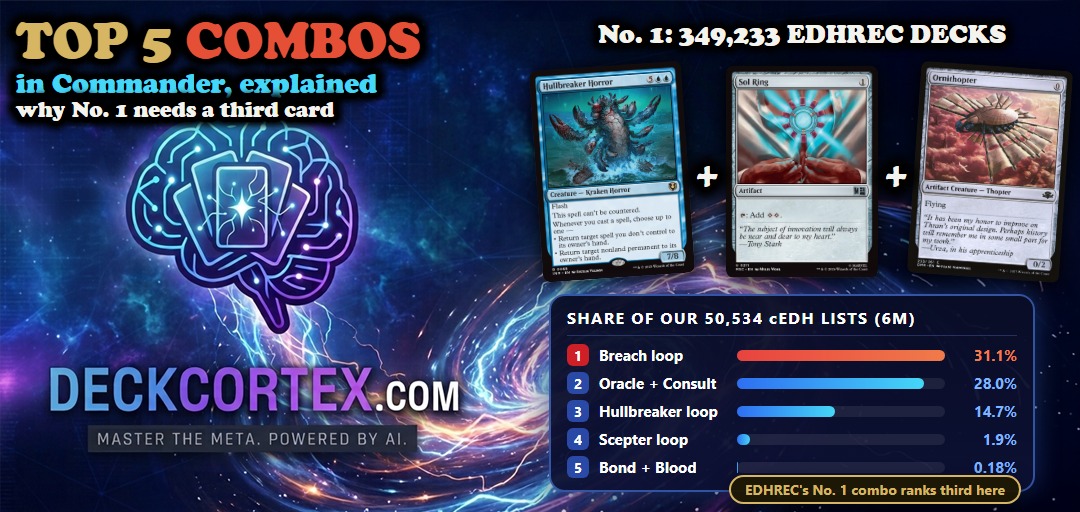
Tap Sol Ring for two. Cast an Ornithopter for free, and Hullbreaker Horror returns the tapped Ring to your hand. Recast the Ring for one, let the Horror return the Ornithopter, tap the Ring again. You're one colorless mana ahead of where you were a lap ago, and nothing stops you from going around again.
That's the most-played combo in Commander. Commander Spellbook attaches EDHREC deck counts to its combos, and Hullbreaker Horror plus Sol Ring shows up in 349,233 decks, more than twice as many as anything else. Look closer, though, and that number is mostly about Sol Ring. The Ring sits in 83% of all the decks EDHREC tracks, so roughly nine in ten decks with the Horror hold the pair almost by default. And the "two-card combo" doesn't work with two cards: take the Ornithopter away and the loop never starts.
The other four don't need an asterisk. We counted all five down to that #1. For each one you get the loop step by step, straight from the Oracle text, plus the rules detail that makes it work, what stops it, what it costs and what it does to your bracket. There's trivia too, including the Wizards ban announcement that named one of these combos card by card.
How we counted
Commander Spellbook's database, which DeckCortex mirrors every night, holds 109,260 combo variants, and plenty of them are one engine in a different outfit. Tainted Pact with Thassa's Oracle (132,284 decks) is just another way to empty your library for the Oracle. Vito, Thorn of the Dusk Rose carries Sanguine Bond's trigger on a 1/3 body (122,123 decks alongside Exquisite Blood). So we counted each engine once, at its most-played line. Five engines clear 100,000 decks that way, and they're the five below. The next one in line, Springheart Nantuko with Tireless Provisioner, sits at 91,560.
Then we checked the other room. DeckCortex tracked 50,534 cEDH decklists between March 16 and September 15, 2026 (mostly full Topdeck.gg tournament standings, plus MTGTop8) and counted how many contain every piece of each combo. The kitchen table and the tournament hall agree on exactly one of these five.
5. Dramatic Reversal + Isochron Scepter
Two cards at mana value 2, about $9 for the cheapest printings, and as much mana as you want.
Isochron Scepter has imprint: when it enters, you may exile an instant card with mana value 2 or less from your hand. From then on, and a tap let you copy the exiled card and cast the copy without paying its mana cost. Imprint Dramatic Reversal, which untaps all nonland permanents you control, and the Scepter untaps itself.
You need nonland permanents that tap for at least three mana between them. Sol Ring and Arcane Signet already get you there.
- Tap your mana rocks and dorks for at least three mana.
- Pay and tap Isochron Scepter. While the ability resolves, cast the copy of Dramatic Reversal.
- The copy resolves and untaps every nonland permanent you control: the rocks, the dorks and the Scepter.
- Repeat. Each lap nets at least one mana.
The detail that makes it more than a mana trick: the Scepter doesn't just copy a spell, it has you cast the copy. The Comprehensive Rules treat that as a real cast (rule 707.12), so every lap adds to your storm count and triggers anything that cares about casting, magecraft included. Where that copy gets cast from turns out to matter too. More on that below.
Infinite mana still needs somewhere to go. The classic outlet is Aetherflux Reservoir: whenever you cast a spell, you gain 1 life for each spell you've cast this turn, and paying 50 life deals 50 damage to any target. Loop until your life total is silly, then start firing. Reservoir and Dramatic Reversal debuted in the same set, Kaladesh (2016), thirteen years after Mirrodin gave us the Scepter. And if your deck needs help finding the pieces, Muddle the Mixture can transmute for any card with mana value 2, so it finds either half.
How to stop it. Destroy the Scepter in response to an activation and the ability still makes that copy, but there's no next lap. Stifle on the activation leaves the Scepter tapped and the loop dead. Collector Ouphe (or its $114 Reserved List cousin, Null Rod) switches off activated abilities of artifacts, mana abilities included. Here's the one most tables miss: the copy is created in exile and cast from there, so an opposing Drannith Magistrate ("Your opponents can't cast spells from anywhere other than their hands") turns the Scepter into a paperweight.
Bracket and budget. No Game Changers. Commander Spellbook estimates the combo at "Spicy (Bracket 3-4+)", a fast, game-winning line whose real bracket depends on how easily your deck finds the pieces. The official bracket guidelines rule out intentional two-card infinite combos in Brackets 1 and 2.
Kitchen table vs. tournament. It sits in 105,623 EDHREC decks, but in cEDH it's a niche line: 983 of our 50,534 lists (1.9%), led by Urza, Lord High Artificer decks.
4. Underworld Breach + Lion's Eye Diamond + Brain Freeze
Wizards banned a card over this exact combo and named all three pieces in the announcement. We'll get to that.
Underworld Breach costs . While it's on the battlefield, each nonland card in your graveyard has escape, so you can cast it from your graveyard by paying its mana cost and exiling three other cards from your graveyard. Breach sacrifices itself at the beginning of the end step, so everything happens in one turn. Lion's Eye Diamond costs : discard your hand and sacrifice it for three mana of any one color, activated only as an instant. Brain Freeze costs . Target player mills three cards, and it has storm.
Start with Breach and the Diamond on the battlefield, Brain Freeze in your graveyard, and at least six other cards between your hand and graveyard.
- Activate Lion's Eye Diamond: discard your hand, sacrifice the Diamond, add . Your old hand is now graveyard fuel.
- Cast the Diamond from your graveyard with escape: plus three other cards exiled.
- Cast Brain Freeze from your graveyard with escape: plus three more cards exiled.
- Storm copies Brain Freeze once for each spell cast before it this turn. Aim the original and one copy at yourself, which mills six cards to replace the six you exiled, and point every other copy at an opponent.
- Brain Freeze goes back to your graveyard after it resolves, and the Diamond is on the battlefield again. Back to step 1.
Each lap nets one mana (three in, two out) and adds two spells to your storm count. It isn't truly infinite, because your library runs out. When it does, the leftover mana finishes the job: cast Thassa's Oracle with an empty library, from your hand or escaped from your graveyard, and win. 10,444 of the cEDH lists we tracked run the Oracle alongside Breach. Or you've already pointed enough copies at the table to mill everyone out, and they lose the next time they draw.
Two rules details carry the whole thing. Escape doesn't exile a card after use: an escaped instant goes right back to the graveyard, ready to escape again. The official ruling on it even cracks a joke about the state of security in the underworld. And the Diamond's ability is a mana ability that you can only activate when you could cast an instant, which the Gatherer ruling sums up as "Yes, this is a bit weird." Because it's a mana ability, it doesn't use the stack, and nobody can respond to it.
The budget twist. Swap the Diamond for Lotus Petal and the loop still runs, just leaner. Two Petal escapes pay for each Brain Freeze, nine cards get exiled per lap instead of six, and no mana is left over. That version sits in more EDHREC decks, 114,648 against 93,628, which is why this engine ranks #4. The price gap is hard to ignore. The Diamond is on the Reserved List with a single paper printing (Mirage, 1996) and costs about $798. The whole Petal version runs about $45.
Trivia. Wizards banned Underworld Breach in Legacy on March 9, 2020, 45 days after Theros Beyond Death came out, and the announcement named Breach, Lion's Eye Diamond and Brain Freeze as the interaction it had been watching. Pioneer banned Breach that August. Modern held out until March 31, 2025. The Modern version milled itself with Grinding Station and a zero-mana artifact, and Wizards noted it could win as early as the first turn. Brain Freeze is older than all of it: it's one of the original storm cards from Scourge (2003).
How to stop it. Graveyard hate wins this fight. Rest in Peace exiles anything that would go to a graveyard, Grafdigger's Cage stops players casting spells from graveyards, and Drannith Magistrate stops your opponents casting spells from anywhere but their hands. At instant speed, Tormod's Crypt exiles their graveyard between escapes, and a Stifle on Brain Freeze's storm trigger means no copies that lap. Collector Ouphe shuts off the Diamond and the Petal.
Bracket and budget. Two Game Changers, Breach and the Diamond, so the combo alone uses two of Bracket 3's three slots. Commander Spellbook estimates it at "Powerful (Bracket 3+)". It costs about $807 all in, or about $45 and one Game Changer with Lotus Petal.
Kitchen table vs. tournament. This is the biggest flip on the list: fourth by EDHREC decks, first in cEDH. 15,697 of our 50,534 lists (31.1%) carry the Diamond version and 16,065 carry the Petal version, and nearly all of those decks run both artifacts.
3. Sanguine Bond + Exquisite Blood
The simplest loop on the list, with the strangest way to fail.
Sanguine Bond: whenever you gain life, target opponent loses that much life. Exquisite Blood: whenever an opponent loses life, you gain that much life. With both on the battlefield:
- Gain life. Any amount, once.
- Sanguine Bond triggers, and the opponent you target loses that much life.
- Exquisite Blood triggers, and you gain that much life.
- Sanguine Bond triggers again. Back to step 2.
You choose a target for every Bond trigger, so when one opponent hits 0 you move on to the next. The loop stops when there's nobody left to target, which means you've won.
How much life you gain doesn't matter. Sanguine Bond triggers once per life-gain event, whether that's 1 life from Soul Warden or a huge lifelink hit. You don't even have to gain life first. Damage dealt to an opponent makes them lose life, and so does paying life, so your creature connecting or an opponent paying life for a fetch land starts the loop from Exquisite Blood's side.
Now the failure mode. Neither trigger is optional, so once the loop starts, you can't stop it. If the last opponent standing can't lose (say they control Platinum Angel), the loop has no way out, and the official ruling is that the game ends in a draw.
Swaps. Vito, Thorn of the Dusk Rose puts Sanguine Bond's exact trigger on a three-mana legendary creature, so the whole deck can be built around it from the command zone. Enduring Tenacity has the same trigger and comes back as a noncreature enchantment when it dies. For the other half, Bloodthirsty Conqueror is Exquisite Blood on a 5/5 with flying and deathtouch, and its flavor text even name-checks exquisite blood.
Trivia. Sanguine Bond (Magic 2010) waited almost three years for its partner: Exquisite Blood didn't arrive until Avacyn Restored in 2012. The prices went the other way. Bond costs about $5, Blood about $37.
How to stop it. Remove either enchantment in response to a trigger and the chain breaks. A Stifle on any single trigger does the same. Sulfuric Vortex ("If a player would gain life, that player gains no life instead") means Sanguine Bond never triggers at all.
Bracket and budget. No Game Changers. Commander Spellbook says "Spicy (Bracket 3-4+)", and as a two-card infinite it's out of Brackets 1 and 2 if you built the deck for it. About $42 for the pair.
Kitchen table vs. tournament. Third by EDHREC decks (146,333), dead last in tournaments: 90 of our 50,534 cEDH lists (0.18%). Two five-mana enchantments are a kitchen-table plan.
2. Demonic Consultation + Thassa's Oracle
Three mana, two cards, one trigger.
Thassa's Oracle is a 1/3. When it enters, you look at the top X cards of your library, where X is your devotion to blue, and put up to one back on top and the rest on the bottom. Then, if X is greater than or equal to the number of cards in your library, you win the game. Demonic Consultation costs : choose a card name, exile the top six cards of your library, then reveal cards until you reveal one with that name, put it into your hand and exile the rest.
Name a card that isn't in your library, and Consultation exiles all of it. The clean sequence:
- Cast Thassa's Oracle. When it enters, its trigger goes on the stack.
- In response, cast Demonic Consultation. As it resolves, name a card that isn't in your library (it has to be a real Magic card), and your whole library gets exiled.
- The Oracle trigger resolves. There are zero cards in your library and your devotion to blue is at least zero, so you win.
Why Oracle first? Exiling your library doesn't lose you the game on the spot. You lose the next time you'd draw. But if you cast Consultation first and your Oracle gets countered, that draw is coming. With the Oracle already on the battlefield and its trigger on the stack, you only exile your library when the win is one resolution away. Killing the Oracle in response doesn't help your opponents either: devotion is counted when the trigger resolves, and zero is still greater than or equal to zero.
Why the Oracle replaced Laboratory Maniac. Laboratory Maniac did this job with a replacement effect: if you would draw a card while your library is empty, you win instead. That still meant waiting for a draw. The Oracle wins off its own trigger, and in our cEDH lists it isn't close anymore: Thassa's Oracle is in 31.8% of them, Laboratory Maniac in 1.2%.
Tainted Pact, the other library-eater. Tainted Pact does Consultation's job for . It exiles cards from the top one at a time until you put one into your hand or until two exiled cards share a name. Take nothing and it eats your library, unless your library holds two cards with the same name, which in Commander usually means basic lands. Tournament players rarely pick one: 13,858 of our lists run the Oracle with both.
Trivia. Demonic Consultation is from Ice Age (1995) and is still banned in Legacy and restricted in Vintage. Thassa's Oracle came out in Theros Beyond Death in January 2020, the same set as Underworld Breach. It also has the highest EDHREC salt score of any combo piece in this article.
How to stop it. The trigger is the soft spot. Stifle or Trickbind on it after Consultation resolves leaves the Oracle player with no library and a loss on their next draw. Torpor Orb and Hushbringer stop creatures entering the battlefield from triggering anything. They're symmetrical, though, so your own enters triggers go quiet too. Countering either spell works as well.
Bracket and budget. Thassa's Oracle is a Game Changer and Consultation isn't. Brackets 1 and 2 allow no Game Changers, so this combo starts at Bracket 3 no matter what you intended. Commander Spellbook's estimate is "Ruthless (Bracket 4+)" for a fast, game-winning two-card combo. About $29 for both.
Kitchen table vs. tournament. Here's the one they agree on: #2 at the kitchen table (149,536 EDHREC decks) and #2 in cEDH (14,173 of 50,534 lists, 28.0%).
1. Hullbreaker Horror + Sol Ring (+ a third card)
Back to the Ornithopter.
Hullbreaker Horror is a 7/8 with flash, and it can't be countered. Whenever you cast a spell, you choose up to one: return target spell you don't control to its owner's hand, or return target nonland permanent to its owner's hand. Sol Ring taps for .
Here's why two cards aren't enough. The Horror triggers when you cast a spell, and at that moment the spell is on the stack, not on the battlefield. The first mode only hits spells you don't control, and the second only hits permanents. So when you recast Sol Ring, the Horror can't return the Ring you're casting. It needs a second permanent to bounce instead. Commander Spellbook's version of the combo asks for a permanent in your hand that a single colorless mana can pay for.
With the Horror and the Ring on the battlefield, in your main phase:
- Tap Sol Ring for .
- Cast the cheap permanent. The Horror triggers; return Sol Ring to your hand. The permanent resolves.
- Cast Sol Ring for . The Horror triggers; return the cheap permanent to your hand. Sol Ring resolves untapped.
- Repeat.
With a zero-cost permanent like Ornithopter, every lap gives you one colorless mana and two spells cast: infinite mana and an infinite storm count. A one-mana permanent breaks even on mana but still casts two spells a lap, and that's all Aetherflux Reservoir needs. For the mana itself, Walking Ballista is the colorless outlet: cast it with an enormous X and remove counters to deal damage.
And "infinite" is table talk. The rules have no infinity. You shortcut a loop by announcing how many times you repeat it, and the Comprehensive Rules' own example is a player announcing a million tokens.
Protecting it. The Horror can't be countered, so opponents have to answer it on the battlefield. If you're holding any instant, casting it triggers the Horror, which can return their removal spell to their hand. The soft spots are around it. Destroy Sol Ring in response to the trigger that would return it, and the loop is over. Collector Ouphe stops Sol Ring's mana ability. A Stifle on one bounce trigger breaks a lap, but the Horror player can cast another spell in response and return your Stifle. Trickbind's split second doesn't give them that window.
Precon trivia. Sol Ring is in 177 of the 178 official precon decklists in the DeckCortex database. The only one without it is Painbow, the 2022 Dominaria United Commander deck for Jared Carthalion, which skipped it for mana rocks that make colored mana. Hullbreaker Horror is in two precons, and both shipped it next to Sol Ring: Mind Flayarrrs (2022) and Fae Dominion (2023). We've covered the other combos Wizards ships in precons. Sol Ring itself goes back to Alpha (1993). It's banned in Legacy, restricted in Vintage, not on Commander's Game Changers list, and Scryfall lists 131 paper printings of it.
How common is it, really? Sol Ring is in 83% of EDHREC's decks and 97.7% of our 50,534 cEDH lists, so the combo's count mostly follows the Horror. 385,856 EDHREC decks run Hullbreaker Horror, and roughly nine in ten of them hold the pair. Tournament players take the loop seriously too: 7,405 cEDH lists (14.7%) carry both cards, and 3,279 of those are Kinnan, Bonder Prodigy decks. Kinnan adds one more mana whenever you tap a nonland permanent for mana, so Sol Ring makes three per lap, and even a one-mana permanent nets mana.
Bracket and budget. No Game Changers, and Commander Spellbook's estimate is "Exhibition (Bracket 1+)". The official guidelines judge intent, not card lists. When brackets launched, Wizards said that accidentally finding an easy combo in your deck should be a good laugh and a reminder to take it out next time. About $7 for the Horror and the Ring, plus 35 cents of Ornithopter.
Kitchen table vs. tournament hall
| Combo | EDHREC decks | Rank | cEDH lists (of 50,534) | Rank | |---|---|---|---|---| | Hullbreaker Horror + Sol Ring | 349,233 | 1 | 7,405 (14.7%) | 3 | | Demonic Consultation + Thassa's Oracle | 149,536 | 2 | 14,173 (28.0%) | 2 | | Sanguine Bond + Exquisite Blood | 146,333 | 3 | 90 (0.2%) | 5 | | Underworld Breach + Brain Freeze (with Lotus Petal · with Lion's Eye Diamond) | 114,648 · 93,628 | 4 | 16,065 (31.8%) · 15,697 (31.1%) | 1 | | Dramatic Reversal + Isochron Scepter | 105,623 | 5 | 983 (1.9%) | 4 |
Same five combos, two different games. At the kitchen table, the ranking follows whatever sits in the most decks, and Sol Ring sits in nearly all of them. In tournament lists, the graveyard storm loop and the Oracle kill each show up in about three of every ten decks, while the two enchantments that cost ten mana between them barely register.
What stops what
| Answer | 5. Scepter | 4. Breach | 3. Bond + Blood | 2. Oracle | 1. Hullbreaker | |---|---|---|---|---|---| | Stifle | the activation | the storm trigger | any trigger | the enters trigger | a bounce trigger (can be returned) | | Trickbind | the activation | the storm trigger | any trigger | the enters trigger | a bounce trigger | | Collector Ouphe · Null Rod | yes | the Diamond and Petal | — | — | Sol Ring | | Drannith Magistrate | yes | yes | — | — | — | | Rest in Peace · Grafdigger's Cage | — | yes | — | — | — | | Torpor Orb · Hushbringer | — | — | — | yes | — | | Sulfuric Vortex | — | — | yes | — | — |
Your call
Every combo on this list is legal in Commander, and none of them is a secret. Whether one is fine at your table comes down to whether the table knows it's coming. The bracket guidelines draw the lines: no Game Changers and no intentional two-card infinite combos in Brackets 1 and 2, and Bracket 3 games are expected to last at least six turns, so an Oracle kill on turn four is a Bracket 4 plan.
So check your own list before game night. If Hullbreaker Horror and Sol Ring are both in it, decide whether you're playing the loop or just a very large flash blocker, and say which at Rule 0. If Thassa's Oracle is in it, you're not in Bracket 2, loop or no loop. And if you'd rather not hunt for combos by hand, DeckCortex's deck analysis checks your list against the same Commander Spellbook data we used here and shows every complete and near-complete combo in it. That way the pregame conversation starts from what's actually in your 99.
More on combos and brackets: why your combo count isn't your bracket · the one card that makes a deck Bracket 3 · all 53 Game Changers, ranked
Data: combo deck counts are EDHREC's, as published by Commander Spellbook (live API and DeckCortex's nightly mirror of 109,260 variants, both 2026-09-16); each engine counted once, at its most-played named line. Card deck counts and salt scores: EDHREC card pages, 2026-09-16. Tournament presence: DeckCortex cEDH corpus, 50,534 tracked decklists (Topdeck.gg standings and MTGTop8), 2026-03-16 to 2026-09-15; share of decklists containing every named card, commanders counted as cards; a three-month control window (n=23,437) lands within one point for every combo. We track decklists, not match results. Precons: the 178 unique official precon decklists in the DeckCortex database. Prices: cheapest paper printing on Scryfall, USD, 2026-09-16; card images show their own printing's price. Game Changers: Scryfall `is:gamechanger` (53 cards). "Exhibition", "Spicy", "Powerful" and "Ruthless" are Commander Spellbook's bracket estimates, not official brackets. Rulings: Gatherer via Scryfall; Comprehensive Rules of August 19, 2026.